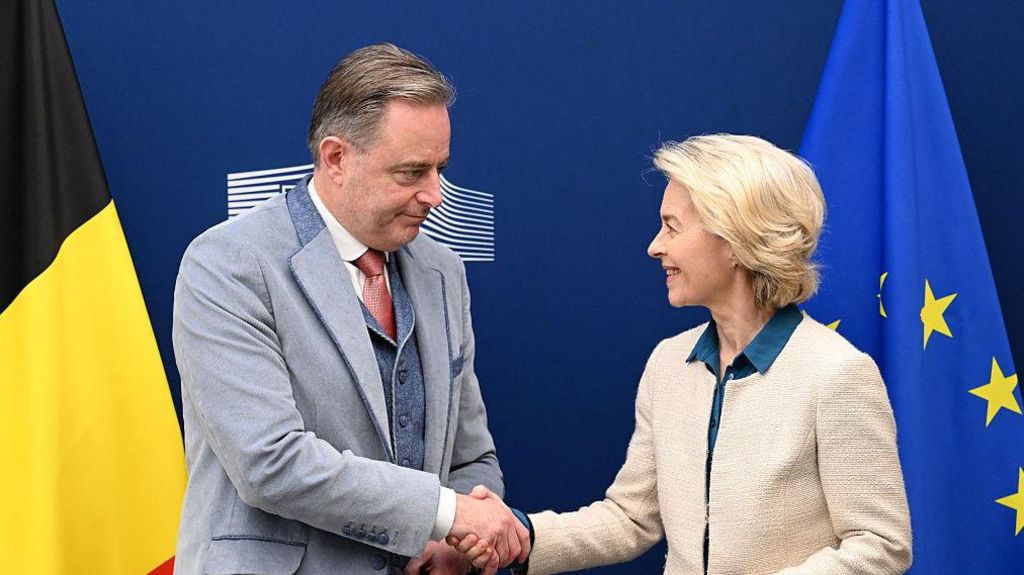
Belgium has launched a forceful diplomatic offensive against the European Union’s controversial proposal to transform frozen Russian state assets into a reparations loan for Ukraine, warning the scheme could trigger national bankruptcy and decades of litigation. The escalating confrontation pits Belgian leadership against German Chancellor Friedrich Merz and EU institutional leaders who champion the €140 billion plan.
Prime Minister Bart De Wever has formally written to European Commission President Ursula von der Leyen declaring the proposal “fundamentally wrong,” while Foreign Minister Maxime Prévot articulated specific legal and financial perils. Their central concern stems from Belgium hosting €185 billion of the €210 billion in frozen Russian assets at Euroclear, the Brussels-based securities depository, making the nation disproportionately vulnerable to Russian legal retaliation.
“If Russia takes us to court, it will have every chance of winning,” Prévot stated bluntly. “We, Belgium, will not be able to repay those €200 billion because that represents the equivalent of an entire year of the federal budget. It would mean bankruptcy for Belgium.”
The Belgian government proposes an alternative approach: the EU should borrow required funds on international markets using provisions within the existing shared budget of member states. This structure would distribute financial risk across the bloc rather than concentrating liability on Belgium.
Legal experts substantiate Belgium’s concerns. Professor Veerle Colaert of KU Leuven University explained that Euroclear maintains contractual obligations to repay the Russian Central Bank upon demand, currently prevented only by sanctions. “If sanctions are lifted and Euroclear hasn’t got the money because it’s being lent to the EU,” Colaert noted, “Belgium would have to step in, but the amount involved is simply too large.”
Russia has amplified pressure through Andrei Kostin, president-chairman of state-owned VTB Bank, who threatened “half a century of litigation” should the EU proceed. Moscow condemns the proposal as unacceptable seizure that would fund warfare rather than peace.
The European Commission had intended to present a legal framework by late November, but public disagreements have delayed the process. With EU leaders scheduled to vote on the proposal at an upcoming Brussels summit, the deep divisions suggest a resolution remains uncertain as member states balance Ukraine’s urgent needs against financial stability and legal integrity.