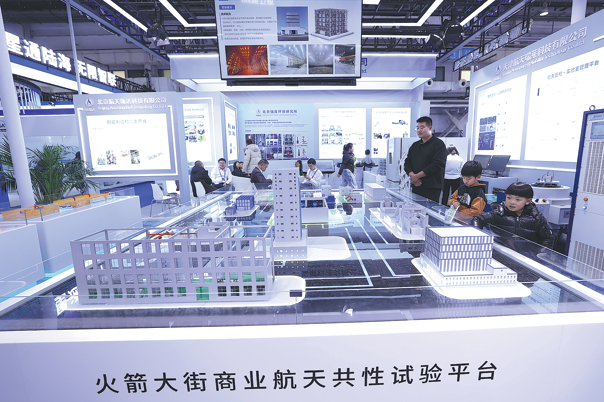
Beijing’s Economic-Technological Development Area, known as E-Town, has launched a groundbreaking initiative called ‘Beijing Rocket Street’ to transform China’s commercial aerospace sector through shared infrastructure and collaborative platforms. This innovative approach addresses critical industry challenges while accelerating satellite and rocket production capabilities.
The comprehensive project, spanning 145,000 square meters, represents China’s first shared commercial aerospace research and production base. The facility has completed final inspections and is now transitioning to operational status, featuring four specialized zones: a common technology platform, innovation and research center, high-end manufacturing center, and display/operations control center.
This development comes as China’s commercial space sector demonstrates remarkable growth. Official data reveals that in 2025, the country conducted 50 commercial space launches—representing over half of all missions—while deploying 311 commercial satellites that accounted for 84% of total orbital placements.
According to Zhang Rusheng, deputy director of the commercial aerospace department at the China National Space Administration, ‘Commercial aerospace has progressed across the full industrial chain, from research and development to satellite launches, tracking and control, and downstream applications.’ He emphasized Beijing’s evolving role as a global innovation hub shaping the sector’s development trajectory.
The shared infrastructure model specifically addresses industry pain points including fragmented resources, redundant testing facility investments, and infrastructure limitations that particularly affect private companies. The Rocket Street initiative offers more than 10 specialized services, including vibration testing, thermal vacuum analysis, and separation testing for both rockets and satellites.
Ma Zhao, deputy director at E-Town’s robotics and intelligent manufacturing industry bureau, explained the strategic vision: ‘This initiative is designed to expand industrial development space and strengthen industry support with shared platforms. By doing so, we aim to release new productive capacity while boosting confidence across the industry.’
E-Town has emerged as China’s most concentrated commercial aerospace cluster, with rockets developed in the area accounting for 24 launches in 2025—more than 90% of the nation’s commercial rocket missions. Industry leaders have welcomed the supportive ecosystem, with Galactic Energy’s vice-president Xia Dongkun highlighting benefits in talent acquisition, investment facilitation, and insurance solutions.
The innovation extends beyond traditional aerospace boundaries. Liu Chang, co-founder of Galaxy Space, noted the advantage of E-Town’s cutting-edge industrial foundation, including intelligent driving systems and embodied intelligent robotics. The company plans to establish a factory with annual production capacity for 500 satellites, potentially becoming China’s largest facility for mass-producing low Earth orbit satellites using extensive automation.
Looking forward, E-Town officials outlined ambitious plans focusing on reusable rockets, satellite internet technologies, future space innovations, and next-generation infrastructure. The development area aims to attract up to 1,000 companies, support over 1,000 commercial rocket launches, and generate hundreds of billions of yuan in revenue, solidifying Beijing’s position as a national center for high-quality commercial aerospace advancement.