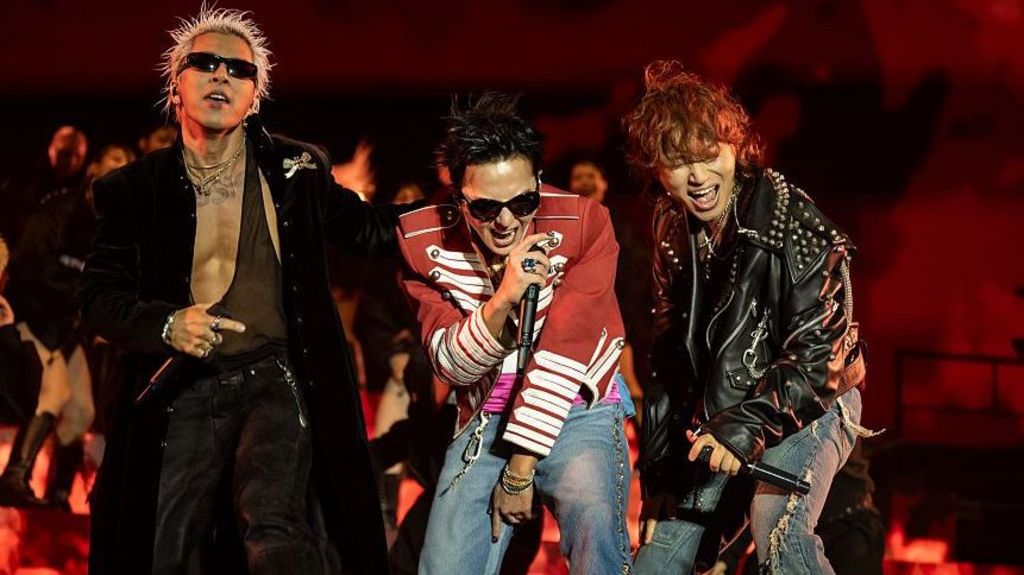
Under the bright stadium lights of Tottenham Hotspur Stadium, a sea of glowing yellow crowns bobbed in unison, thousands of voices rising in synchronized Korean chants that rolled through the near-capacity venue. When the iconic opening synth riffs of *Fantastic Baby* cut through the air, a roar of explosive energy erupted across the crowd: Big Bang, the trailblazing South Korean group that redefined K-pop’s global potential, was finally back.
Fourteen years after the band’s first major European tour, and a tumultuous decade marked by mandatory military service, member departures and high-profile legal scandals, the trio of G-Dragon, Taeyang and Daesung touched down in London Saturday as part of their 20th anniversary *XX: Cosmos* World Tour. For everyone in attendance, the night was far more than a standard concert stop—it was a landmark homecoming, and a masterclass in K-pop’s decades-long rise to global domination.
Emerging on stage in their signature high-fashion, glittering ensembles, the group set a celebratory, grounded tone from the first note. Unlike their 2012 European debut at London’s Wembley Arena, which was fueled by a hungry drive to prove K-pop could win over Western audiences and promote a new record, this reunion tour was crafted entirely for their decades-long dedicated fandom, nicknamed VIPs. The band reworked classic hits and remixed fan favorites to accommodate their two absent former members, leaning into pyrotechnics, their iconic live backing band and unmatchable stage presence instead of over-the-top elaborate staging. The result was a playful, heartfelt night that balanced nostalgia with fresh energy.
Long before BTS sold out Wembley Stadium and Blackpink headlined London’s Hyde Park, Big Bang blazed the trail for K-pop’s global crossover. As music industry scholars and fans alike emphasize, this group was the first to prove Korean pop could find massive, sustained success far beyond East Asia’s borders.
Their pioneering legacy stretches back more than 15 years: in 2011, they made history as the first K-pop act to win a major Western music award, taking home the MTV Europe Music Awards’ inaugural Worldwide Act prize. When they played their first UK show at Wembley Arena in 2012, the first date sold out in less than two hours, prompting organizers to add a second. By 2016, Forbes estimated the group had earned $44 million over the previous year, earning them a spot on the outlet’s Celebrity 100 List—the first K-pop act ever to receive the honor.
“There is no doubt Big Bang made a huge contribution to opening the global K-pop market,” explained Dr Haekyung Um, senior lecturer in music at the University of Liverpool. “Earlier acts found popularity within Asian markets, but Big Bang were true international stars. I would call them the Kings of K-pop, just as we call Michael Jackson the King of Pop. Their success was the first real proof that K-pop could fill stadiums across the Western world.”
Before Big Bang rose to fame, K-pop groups were widely dismissed as heavily manufactured products of entertainment agencies. The group shattered that stereotype: members wrote and produced their own music, cultivated their own iconic streetwear-inspired aesthetic, and blended a radical range of genres from hip-hop and R&B to trot, South Korea’s traditional folk genre. This independent, genre-bending identity set them apart across Asia, and created the blueprint for the self-produced modern K-pop acts that dominate the industry today.
For fans, Big Bang is more than a band—they are the “idols’ idols,” the starting point for an entire global love of K-pop. “They were different because they didn’t follow the uniform K-pop cookie-cutter pretty boy phase,” said Sharon, a fan who traveled from Singapore to attend the show. “They leaned harder into hip-hop and stayed true to their sound. They are the absolute OGs for me.”
Beyond their musical innovation, Big Bang revolutionized fan culture in K-pop, creating a template that groups still follow today. The band’s iconic yellow crown-shaped lightstick, the “Bang Bong,” was the brainchild of leader G-Dragon, who pushed for a custom, distinct symbol for VIPs at a time when fans relied on generic glow sticks or plain colored balloons. “Big Bang helped modernize the physical side of fan engagement,” Um noted. The Bang Bong established the model for the custom-designed lightsticks that have become a core part of K-pop concert culture worldwide.
Outside the stadium, that fan-led energy spilled onto the streets, with attendees trading handmade gifts and photo cards—a ritual Big Bang helped popularize on Western arena tours. Volunteer fan organizing groups distributed 35,000 custom printed banners across the venue, coordinating a stadium-wide tribute where fans lifted the banners in unison during select songs.
Big Bang’s 20-year journey has been far from smooth, however. All able-bodied men in South Korea are required to complete mandatory military service, and the group’s members enlisted at separate times, forcing a years-long hiatus. That break was then extended by a series of devastating scandals that split the original five-member group. In 2017, original member T.O.P was convicted of marijuana use—an offense heavily criminalized and stigmatized in South Korea—and received a suspended prison sentence before departing the group permanently. In 2019, youngest member Seungri retired from the entertainment industry entirely amid the high-profile Burning Sun scandal, a police investigation into a Seoul nightclub that exposed a ring of sex trafficking, bribery and illicit filming. South Korea’s Supreme Court upheld an 18-month prison sentence for Seungri in 2022 on charges including prostitution mediation, overseas gambling and embezzlement.
While the trio did not openly address the departures of their former bandmates on stage, their absence was palpable for long-time fans—but for many attendees, the group’s perseverance through hardship only deepened their connection to the music. “Big Bang was my introduction to K-pop,” said Annie, who flew from New York to attend the show. “I love how they’ve moved through every obstacle—it gives me hope. After all these years apart, it’s amazing to have them back. They’re the OGs.”
The K-pop industry that Big Bang helped build is almost unrecognizable today, but their 20th anniversary return has drawn a striking multi-generational crowd, blending original second-generation K-pop fans who grew up with the group and young Gen Z listeners who were barely born when Big Bang debuted. Many new fans discovered the group through archival content circulating on TikTok and YouTube, turning decades-old music and performances into viral hits for a new audience.
Gemma, who traveled to London from Edinburgh with her daughter Casey, both wearing custom handmade Big Bang jackets, explained how she first discovered the group after seeing T.O.P in the hit series *Squid Game*, then fell down a rabbit hole of their discography. “I’ve converted so many of my friends to K-pop now,” she said. “It’s all about that unmatched Big Bang energy.”
For Korean diaspora fans, the concert carried an even deeper cultural resonance. “I got into Big Bang when their 2012 *Alive* EP came out, because they felt so groundbreaking,” said Kevin. “Before, a lot of Korean artists felt like they were just mimicking what was popular in the West, but Big Bang owned their unique identity completely. It’s so rare for a K-pop group to last 20 years, and they absolutely were the ones who made K-pop mainstream globally.”
This cross-generational appeal is no accident: YG Entertainment, Big Bang’s label, was an early adopter of digital platforms like YouTube, archiving all of the group’s content and building a lasting global fan base that has grown across two decades. “Nostalgia can be built around something people didn’t even experience live when it first happened,” Um explained. “It comes from shared digital memory, and that’s kept Big Bang’s fan base growing for 20 years.”
Though the band avoided direct discussion of their turbulent history on stage, the emotional weight of their two decades together peaked during the finale performance of *Still Life*. When T.O.P’s unmistakable baritone rang through the stadium via pre-recorded vocals, a visible wave of emotion washed over the crowd. During the encore, a visibly moved G-Dragon told the audience that the group never expected their music to leave such an enduring global mark, 14 years after their first London show. As fireworks lit up the North London night sky, the three members linked hands and bowed deeply—closing out a triumphant night for the group that changed modern K-pop forever.