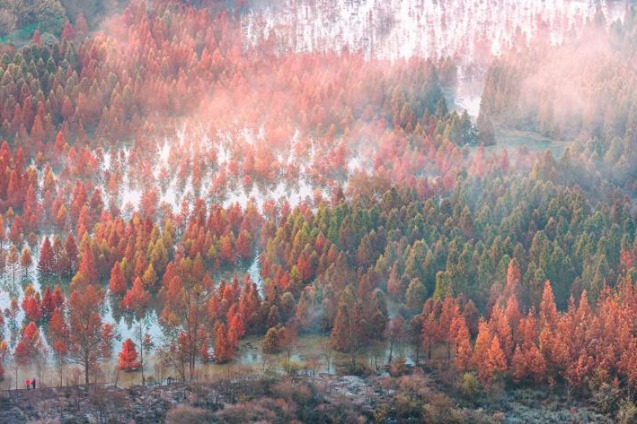
In the highlands of Yunnan province, an extraordinary ecological transformation is underway as dawn redwood forests create a stunning natural tapestry while serving critical environmental functions. The Dianwei village wetland, located upstream of Dianchi Lake within the Songhua Dam Water Protection Zone, has become the centerpiece of this remarkable conservation success story.
As early winter descends upon the region, the Metasequoia glyptostroboides forests undergo a spectacular chromatic transformation. The canopy erupts in vibrant hues of crimson and gold, creating a visual spectacle that merges poetically with the morning mist and low-lying clouds. This breathtaking panorama, captured through aerial photography, reveals a landscape where nature’s beauty intersects with purposeful ecological engineering.
The strategic planting initiative represents a sophisticated approach to watershed management. Local environmental authorities have systematically cultivated dawn redwood trees alongside complementary vegetation to establish robust forest and grassland buffer zones. These carefully designed ecosystems function as natural water filtration systems, significantly enhancing the wetland’s capacity for water purification while simultaneously supporting regional biodiversity.
Positioned within a critical water protection zone, the project demonstrates how aesthetic environmental enhancements can coincide with functional ecological benefits. The dawn redwood species, known for its rapid growth and adaptive qualities, has proven particularly effective in stabilizing soil structures and improving water quality through natural filtration processes.
This conservation model showcases how strategic reforestation can address multiple environmental objectives simultaneously—from water resource protection and habitat creation to carbon sequestration and landscape beautification. The success in Dianwei village offers valuable insights for similar ecological restoration projects throughout China and other regions facing water conservation challenges.