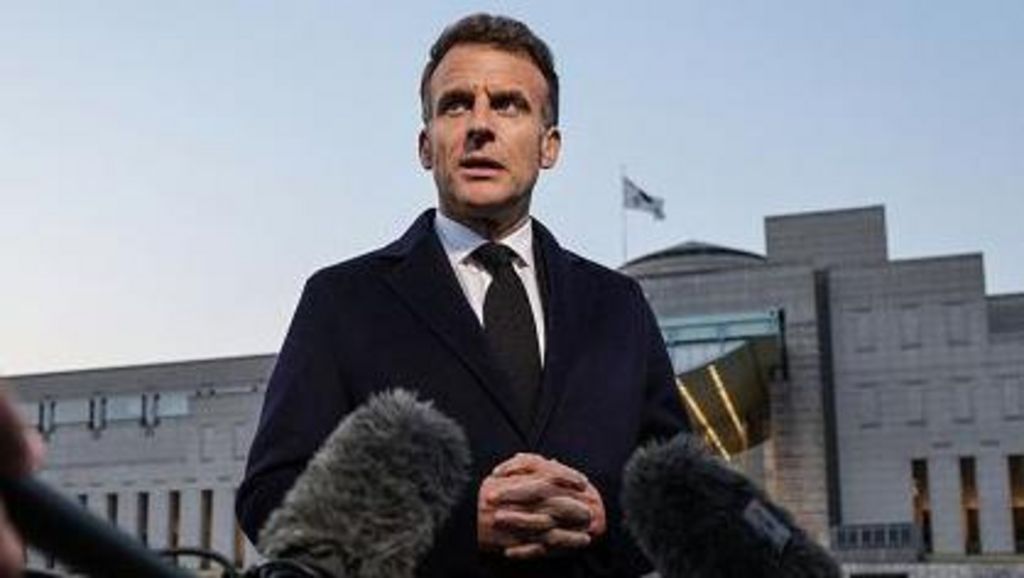
As French President Emmanuel Macron touched down in Seoul for an official state visit to South Korea, he launched a pointed, comprehensive critique of U.S. President Donald Trump’s approach to the escalating Iran conflict, while also dismissing Trump’s recent personal attacks on his marriage as unbefitting of a head of state.
The ongoing U.S.-Israeli military campaign in Iran has now entered its second month, with France and other European nations offering limited backing for U.S. regional operations but refusing to be drawn into direct participation in the conflict. Macron opened his press briefing by arguing that matters of war and peace demand a steady, serious policy, in a clear rebuke of Trump’s pattern of shifting, contradictory statements on the conflict.
“This is not a public entertainment spectacle. We are discussing questions of war and peace, and the lives of ordinary people,” Macron told reporters. “When you approach this issue with the seriousness it deserves, you do not reverse your position every single day. Perhaps there is no need for constant public commentary; sometimes, allowing tensions to de-escalate is the wiser course.”
The Trump administration has delivered consistently mixed messaging on the Iran war over recent weeks: officials and the president himself have alternately claimed a ceasefire is imminent, declared the conflict already won, and insisted the U.S. will continue military operations indefinitely. Macron also pushed back on Trump’s open questioning of the U.S.’s long-standing commitment to NATO membership, arguing that the alliance’s core strength relies on mutual trust, not constant public wavering.
“Alliances like NATO hold their value in the unspoken understanding between members – the bedrock of trust that underpins every agreement,” Macron explained. “Constantly casting doubt on your own commitment drains the organization of all meaningful purpose. Partners are supposed to stand by their agreements and show up when crises emerge, rather than speculating publicly every day about whether they will honor their commitments. There is far too much unproductive, scattered chatter right now.”
Macron made clear that France would not take ownership of a military campaign that the U.S. and Israel planned and launched independently. “They chose to act alone, and now they express regret that they are alone. This is not our war,” he emphasized.
The French president also called out the inconsistency of Trump’s claims regarding U.S. strikes on Iranian nuclear facilities carried out in June 2025. At the time, Trump announced the strikes had completely “obliterated” Iran’s nuclear infrastructure. But following the outbreak of full-scale war in February 2026, Trump described the new offensive as the “last best chance” to eliminate Iran’s nuclear weapons program.
“I remind everyone that six months ago, we were told all infrastructure had been destroyed and the issue was fully resolved,” Macron noted. He argued that no limited military strike, even one extended over several weeks, can permanently resolve the global concerns around Iran’s nuclear program. Instead, he called for the deployment of independent international inspectors to verify Iran’s nuclear activities and a binding diplomatic framework to halt further uranium enrichment, pointing out that Iranian technical expertise and hidden facilities cannot be eliminated by military force alone.
The tension between the two leaders escalated further after Trump made crude personal remarks about Macron’s marriage to Brigitte Macron during a private lunch this week. The U.S. president mocked Macron’s relationship, imitating a French accent to claim Brigitte Macron mistreats the French president, a comment widely interpreted as referencing a 2025 video that showed Brigitte Macron shoving Macron lightly on the face. When asked about the comments, Macron dismissed them out of hand.
Macron called the remarks “inelegant” and well below the standard expected of a head of state, adding “I will not dignify these comments with a response. They do not deserve one.” The personal attack triggered widespread backlash across the French political spectrum, even from Macron’s most outspoken ideological opponents. Manuel Bompard, a leading figure of the hard-left France Unbowed party, said “For Donald Trump to speak to him like that, and to speak of his wife in such terms, I find that completely unacceptable.”
In response to U.S.-Israeli strikes on Iranian territory, Tehran has closed the Strait of Hormuz, the critical global chokepoint through which roughly a fifth of the world’s daily oil supplies pass. With no quick resolution to the closure in sight, Trump has said that nations most affected by the energy supply disruption should handle the situation on their own. Macron rejected calls for a new military operation to reopen the strait, calling the idea completely unrealistic.
“A military operation to reopen the strait would expose any vessels passing through to massive risks from Iranian Revolutionary Guard coastal defenses, ballistic missiles, and a wide range of other threats,” he explained, noting that any such operation would be extremely time-consuming and put countless lives in danger.