The notoriously anonymous British street artist Banksy has officially stepped forward to confirm he is the creator of a provocative new public sculpture that has sparked widespread public intrigue and media buzz in the heart of London this week.
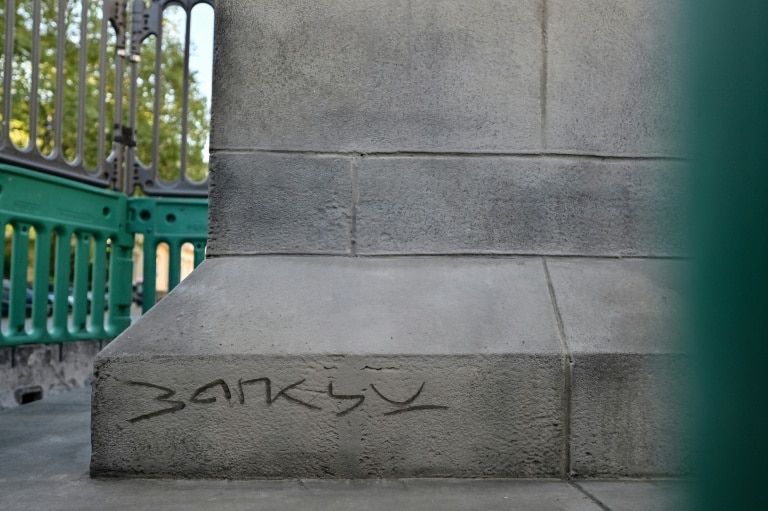
The life-sized bronze-style work first appeared unexpectedly under cover of darkness in the early hours of Wednesday morning on a vacant traffic island on Pall Mall, a historic central thoroughfare located in London’s prestigious Waterloo Place. The piece depicts a formally dressed man in a business suit mid-stride, stepping off the edge of a stone plinth into empty space. A flag wrapped completely around his head obscures his vision, leaving him unaware of the drop looming ahead. Banksy’s signature is hand-scrawled directly onto the base of the plinth, an early clue to the work’s origins that sent street art fans and passersby speculating within hours of its discovery.
In a brief official comment to Agence France-Presse, a spokesperson for Banksy confirmed the uncommissioned monument was installed by the artist’s team, noting Banksy himself selected the specific site because “there was a bit of a gap” on the traffic island. To document the surprise installation, Banksy shared behind-the-scenes footage on his official Instagram account — the platform the artist regularly uses to authenticate his new works — showing the piece being lifted into place overnight by heavy construction machinery.
The new sculpture comes just over a month after a Reuters investigation claimed to definitively unmask Banksy’s long-hidden identity, supporting a 20-year-old claim from Britain’s Mail on Sunday that the artist is 52-year-old British native Robin Gunningham, who has since changed his legal name to David Jones. The report drew on a 2000 New York arrest record and witness testimony from Banksy’s high-profile 2022 trip to war-torn Ukraine, where he painted a series of murals supporting the Ukrainian people. Banksy himself has never commented publicly on the identity claims, maintaining his long-standing commitment to anonymity as part of his artistic persona.
As word of the new sculpture spread, dozens of art enthusiasts and curious Londoners flocked to Waterloo Place to see the work for themselves, joining long lines for photos and debating its possible meaning. The site is no accident: the traffic island sits steps from existing iconic memorials, including monuments to King Edward VII, pioneering nurse Florence Nightingale, and the British soldiers killed in the Crimean War, placing Banksy’s provocative contemporary work in direct conversation with London’s traditional public memorial culture.
Visitors to the sculpture have offered a wide range of reactions. 23-year-old student Ollie Isaac, who traveled across London to see the piece, called it “brilliant” and offered his own interpretation of the work’s political subtext, suggesting it critiques the rising tide of nationalism across the globe and within the UK. “That suit screams politician,” Isaac noted, echoing the observations of many other onlookers. Other visitors, like 55-year-old teacher Lynette Cloraleigh, who made the trip after seeing the work shared on Instagram, praised the piece for its quiet audacity. “It’s intriguing how it got here,” she said. Not all feedback was positive, however: the behind-the-scenes video shared by Banksy included a clip of an elderly passerby rejecting the work outright, saying he preferred the traditional historic monuments standing nearby.
This is not Banksy’s first unsanctioned public statue in London. Back in 2004, the artist installed *The Drinker*, a satirical reimagining of Auguste Rodin’s iconic *The Thinker* that showed the famous figure leaning on a public toilet instead of his knee, just a few blocks away on Shaftesbury Avenue. That work was stolen within days of its unveiling and became the subject of a years-long legal battle over ownership that continues to this day.
Unlike many of Banksy’s temporary street works, the new sculpture looks set to remain in place for the foreseeable future. Officials from Westminster City Council, which manages public spaces in central London, released a statement welcoming the unexpected addition to the city’s public art scene. “We’re excited to see Banksy’s latest sculpture… making a striking addition to the city’s vibrant public art scene,” the council said, adding that officials have already taken preliminary steps to protect the work while keeping it open and accessible for the public to visit and enjoy. Many visitors noted that Banksy’s public works are almost always temporary, with many removed or destroyed within weeks of their unveiling, making the council’s decision to preserve the piece a rare and welcome outcome for fans.