作者: admin

  • City league to vitalize soccer in Northeast

    City league to vitalize soccer in Northeast

    Northeast China is poised to launch an innovative football league system that represents a groundbreaking approach to sports development and regional cooperation. The Northeast Football City League, colloquially known as ‘Dongbeichao,’ will commence on May 23rd with eight city-based teams representing major urban centers across three provinces and one autonomous region.

    The league emerges as a strategic initiative jointly organized by the sports bureaus of Liaoning, Jilin, Heilongjiang provinces and the Inner Mongolia autonomous region. This timing intentionally coincides with the region’s peak tourism season, creating a synergistic relationship between athletic competition and cultural tourism. The format represents China’s first cross-provincial mass sports event, establishing a new model for regional sports cooperation.

    Participating cities include Shenyang and Dalian from Liaoning, Changchun and Yanbian from Jilin, Harbin and Jixi from Heilongjiang, alongside Hohhot and Tongliao representing Inner Mongolia. Each team must deeply embody its city’s identity through home ground operations and community connections, fostering local pride and civic engagement among residents.

    The league structure features a single round-robin format with a regular season running from May 23 to August 15, followed by knockout stages from September 5 to October 1. Matches will primarily occur on weekends with a maximum of one round per week to maintain competitive intensity and spectator interest.

    Notably strict eligibility criteria require all players to be Chinese male citizens aged 16-40 who meet at least one condition of household registration, academic enrollment, local residence, or social security in their representative city. The rules explicitly prohibit current or previously registered players from professional clubs in the Chinese Super League, China League One, and China League Two, ensuring the platform remains dedicated to amateur enthusiasts and non-professional athletes.

    Infrastructure requirements mandate each team to maintain a fixed stadium featuring either natural grass or artificial turf, complete lighting systems for night games and television broadcasts, and a minimum spectator capacity of approximately 20,000. The simultaneous opening ceremonies across four regional capital cities—Shenyang, Changchun, Harbin, and Hohhot—will create unprecedented promotional synergy and rapidly generate audience enthusiasm.

    This initiative aligns with the State Council’s August policy directives promoting high-quality development in the sports industry, which aims to cultivate world-class sports events and achieve a sector valuation exceeding 7 trillion yuan by 2030. The Northeast region brings particular advantages to this endeavor, including extensive grassroots soccer participation, well-established youth training systems, and a deeply embedded fan culture that promises strong community support.


  • China to launch top-tier international science journal

    China to launch top-tier international science journal

    China is poised to make a significant entry into the global academic publishing arena with the inaugural launch of Vita, a premier international journal dedicated to life sciences and biomedicine. Spearheaded by Westlake University in collaboration with Higher Education Press and the Life Science Open Alliance, this groundbreaking publication is scheduled for its digital debut in early 2026, followed by print issuance in June.

    The journal’s nomenclature, derived from the Latin term for ‘life,’ embodies both its disciplinary focus and commitment to fostering borderless academic collaboration. According to Editor-in-Chief Li Dangsheng, the name reflects the publication’s vision of inclusive scientific discourse that transcends geographical boundaries.

    Extensive preparatory measures are currently underway, including the establishment of an international serial number and formation of an expert advisory committee comprising nearly 100 distinguished scientists from across the globe. The inaugural edition, featuring original research articles currently undergoing final review, represents China’s strategic response to address the disparity between its rapidly advancing research capabilities in life sciences and the development of high-quality domestic publishing platforms.

    Shi Yigong, President of Westlake University, emphasized the critical necessity for China to establish internationally recognized scientific publications that match its growing research prominence. ‘The creation of a world-class scientific journal led by China is not merely necessary but urgently required to complement our nation’s scientific advancement,’ Shi stated.

    The publication will maintain rigorous academic standards through a dedicated professional editorial team, ensuring both the innovativeness and credibility of published research. This initiative marks a significant milestone in China’s broader efforts to enhance its influence within global scientific communities and establish leadership in academic publishing.

  • Canada rethinks US reliance as PM looks to China

    Canada rethinks US reliance as PM looks to China

    In a significant foreign policy shift, Canada is actively recalibrating its decades-long economic and security alignment with the United States. Prime Minister Mark Carney’s upcoming four-day diplomatic mission to China—marking the first Canadian prime ministerial visit since 2017—signals Ottawa’s determination to forge stronger international partnerships beyond its southern neighbor.

    Recent trade data from Statistics Canada reveals a notable decline in Canadian exports to the US, hitting their lowest non-pandemic levels in decades. This downturn reflects growing bilateral tensions stemming from tariffs affecting key sectors including steel, aluminum, and automotive industries.

    Professor Ronald Stagg of Toronto Metropolitan University contextualizes this development within historical patterns: “Since the economic integration accelerated during World War II and solidified through free trade agreements in the 1980s, Canadian trade with the United States has consistently expanded. The current reversal represents a fundamental break from this tradition.”

    The reassessment extends beyond commerce into defense strategy. Professor Stagg highlights Washington’s “increasingly unpredictable posture toward traditional allies” and its assertion of hemispheric dominance as driving factors behind Canada’s European defense industry pact negotiations and Asian trade diversification efforts.

    Former Global Affairs Canada official Jeff Mahon emphasizes that Carney’s China visit should establish “high-level consensus on the relationship’s direction,” noting that subsequent progress will require moving beyond symbolism to “tangible actions.” Mahon advocates for identifying key principles that acknowledge mutual sensitivities while pursuing “reasonable and plausible objectives.”

    Concurrently, Canada is pursuing economic agreements in Southeast Asia, including ongoing regional free trade negotiations and a recently concluded bilateral pact with Indonesia, further illustrating its multilateral approach to reducing US-centric dependencies.

  • Military push tests postwar pacifist stance

    Military push tests postwar pacifist stance

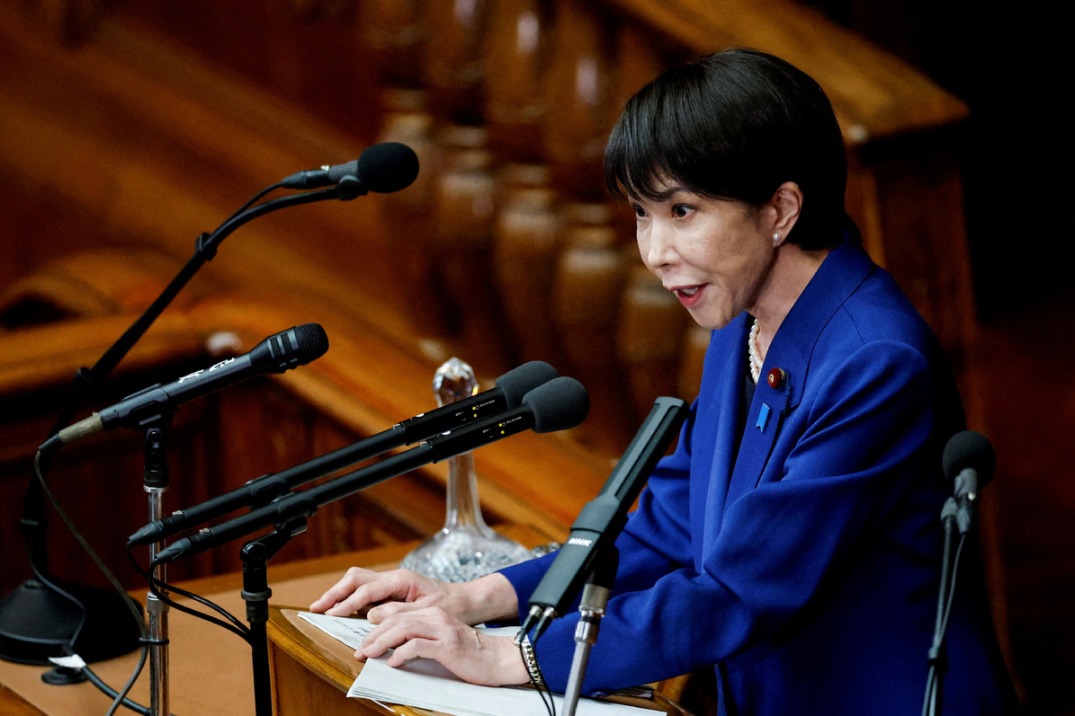
    Japan’s postwar pacifist identity, meticulously crafted over eight decades, faces unprecedented challenges under Prime Minister Sanae Takaichi’s administration. Since assuming office in October 2025, the government has initiated a comprehensive military transformation that experts warn fundamentally contradicts constitutional principles of exclusively defense-oriented posture.

    The acceleration began with November’s supplementary budget approval for fiscal 2025, catapulting defense spending to approximately 11 trillion yen ($70 billion). This achievement marks a significant milestone—reaching the NATO-inspired 2% of GDP defense expenditure target two years ahead of schedule. According to Shimbun Akahata calculations, this translates to an annual defense burden exceeding 90,000 yen ($570) per citizen.

    Prime Minister Takaichi’s autumn policy speech outlined ambitious security revisions scheduled for 2026, including modernization of Japan’s three key security documents. These revisions aim to institutionalize controversial counterstrike capabilities—frequently criticized as unconstitutional—while elevating total defense expenditure for the 2023-2027 period to approximately 43 trillion yen. The Yomiuri Shimbun additionally reports planned incorporation of ‘strengthening Pacific defense’ initiatives within these revised frameworks.

    Beyond budgetary expansions, the administration pursues substantive policy shifts including complete elimination of restrictions on lethal weapons exports, reexamination of the Three Non-Nuclear Principles, and substantial relaxation of arms export controls. Government plans indicate submission of related motions next month with implementation guidelines for the ‘Three Principles on Transfer of Defense Equipment and Technology’ scheduled for revision in April.

    Current guidelines restrict defense exports to five noncombat categories including rescue and transport operations. Their removal would authorize export of combat-capable systems including fighter aircraft and main battle tanks.

    Hiroshi Shiratori, Professor at Tokyo’s Hosei University, emphasizes the fundamental incompatibility of these policies with Japan’s constitutional pacifist principles. ‘If Japan manufactures and exports weapons, causes harm abroad and profits from it,’ Shiratori notes, ‘such thinking fundamentally conflicts with the country’s postwar national identity. It would mean that Japan is no longer a peaceful nation.’

    Regional security experts caution that these developments could revive historical memories of Japanese military actions during the Pacific War, potentially undermining international trust and triggering regional arms races. The easing of defense equipment restrictions signals Japan’s deliberate expansion of its military-industrial sector, potentially encouraging neighboring nations to pursue similar capabilities.

    Former senior Foreign Ministry official Ukeru Magosaki, now Director of the East Asian Community Institute, suggests these policy shifts respond primarily to United States strategic requirements rather than domestic needs. With American defense production struggling to meet global demand, Washington increasingly relies on allies to supply weapons to supported governments. Recent Reuters reports confirm Lockheed Martin’s seven-year Defense Department agreement to increase PAC-3 Patriot missile interceptor production from 600 to 2,000 units annually.

    Concurrently, Japan’s major manufacturers including Mitsubishi Heavy Industries report substantial increases in defense-related contracts, with military revenue comprising growing portions of corporate earnings. Toyo Keizai Online documents how expanding defense budgets positively impact medium-term sales projections across Japan’s defense industrial base.

    Magosaki concludes that unrestricted arms exports regardless of destination would heighten regional instability and be perceived as Japan’s strategic alignment with American interests, potentially further straining diplomatic relations with neighboring states.

  • The UK is watering down plans for mandatory digital ID cards after a backlash

    The UK is watering down plans for mandatory digital ID cards after a backlash

    LONDON — In a significant policy reversal, Britain’s Labour government has abandoned its controversial plan to mandate digital identification cards for employment purposes. The proposed scheme, initially championed by Prime Minister Keir Starmer as a mechanism to combat unauthorized immigration, has been substantially diluted following substantial political opposition and public skepticism.

    Transport Secretary Heidi Alexander confirmed the policy shift on Wednesday, clarifying that digital ID cards would now represent merely one option among several documentation methods for employment verification. Biometric passports will remain equally valid for proving work eligibility, fundamentally altering the compulsory nature of the original proposal.

    This development marks the latest in a series of policy reversals for Starmer’s administration, which faces mounting criticism from both opposition parties and within its own parliamentary ranks. The Prime Minister had previously asserted in September that “you will not be able to work in the United Kingdom if you do not have digital ID,” positioning the initiative as a cornerstone of immigration control and public service accessibility.

    The concept of mandatory identification documents has historically proven contentious in British politics. The nation hasn’t required compulsory ID cards for ordinary citizens since the post-World War II era, with civil liberties advocates consistently warning about potential infringements on personal freedom and data security risks.

    The government now plans to initiate a comprehensive public consultation before formulating detailed proposals for the voluntary digital identification system. This approach contrasts sharply with previous Labour administrations’ attempts to introduce similar measures, notably former Prime Minister Tony Blair’s unsuccessful effort to implement biometric ID cards two decades ago amid substantial public and parliamentary resistance.

  • Political-biz collusive graft worrying

    Political-biz collusive graft worrying

    A recent anti-corruption documentary has revealed extensive political-business collusion through the case of Luo Baoming, former Hainan Province Party Secretary, demonstrating how this form of corruption has become increasingly sophisticated and widespread. The four-episode series, which premiered this week, details how Luo established an elaborate network of associates spanning decades, exploiting his authority for personal gain through sophisticated bribery schemes.

    Luo, who served as deputy Party chief, governor, and ultimately Party chief of Hainan before retiring from the National People’s Congress in 2023, constructed what investigators describe as a ‘distorted clique’ comprising fellow townsmen, business associates, government officials, and relatives. His corruption network utilized complex methods including entrusted shareholding arrangements, property exchanges, and deferred payments to conceal illicit transactions.

    In a televised confession, Luo expressed remorse: ‘I let the Party down and failed Hainan’s people. Having worked there 16 years, I now see the countless wrongdoings and crimes I committed, which inflicted irreparable losses.’

    The Central Commission for Discipline Inspection and National Commission of Supervision identified political-business collusion as a particularly concerning evolution in corruption patterns. Luo’s descent into corruption began in the 1990s in Tianjin, where he accepted a 500,000 yuan bribe (equivalent to approximately $71,700) to approve an auction house project—an enormous sum when China’s urban per capita disposable income measured only a few thousand yuan.

    When Luo transferred to Hainan in 2001, he maintained his Tianjin business connections, exemplifying what anti-corruption authorities term ‘bringing businessmen to new posts’—a hallmark of modern collusion. The documentary details how Luo intervened to legalize unauthorized construction by a Tianjin businessman, who then arranged a property swap that provided Luo’s family with superior apartments in exchange for their older, smaller homes.

    Another scheme involved a different Tianjin businessman who purchased a Luo family property at millions of yuan above market value to disguise bribery payments. Luo also manipulated personnel appointments, installing loyalists like Dong Xianzeng—who followed him from Tianjin and rose to head Hainan’s transportation department before receiving a 14.5-year prison sentence for bribery.

    The network extended to Hainan Airlines Group, where Luo accepted luxury services including private jet travel, overseas trips for family members, and a wedding venue for his daughter—all under the guise of supporting private enterprise. Family members participated extensively, with Luo’s former son-in-law and daughter’s father-in-law allegedly receiving and facilitating millions in corrupt payments.

    In December 2025, Luo received a 15-year prison sentence, with numerous associates facing disciplinary and legal consequences. The case exemplifies the Communist Party’s ongoing campaign against sophisticated corruption networks that undermine governance and economic development.

  • Viral plea turns into national pig feast

    Viral plea turns into national pig feast

    A heartfelt social media appeal from a concerned daughter in rural China has evolved into an unprecedented nationwide phenomenon, transforming a quiet village into a vibrant celebration of communal spirit and cultural tradition.

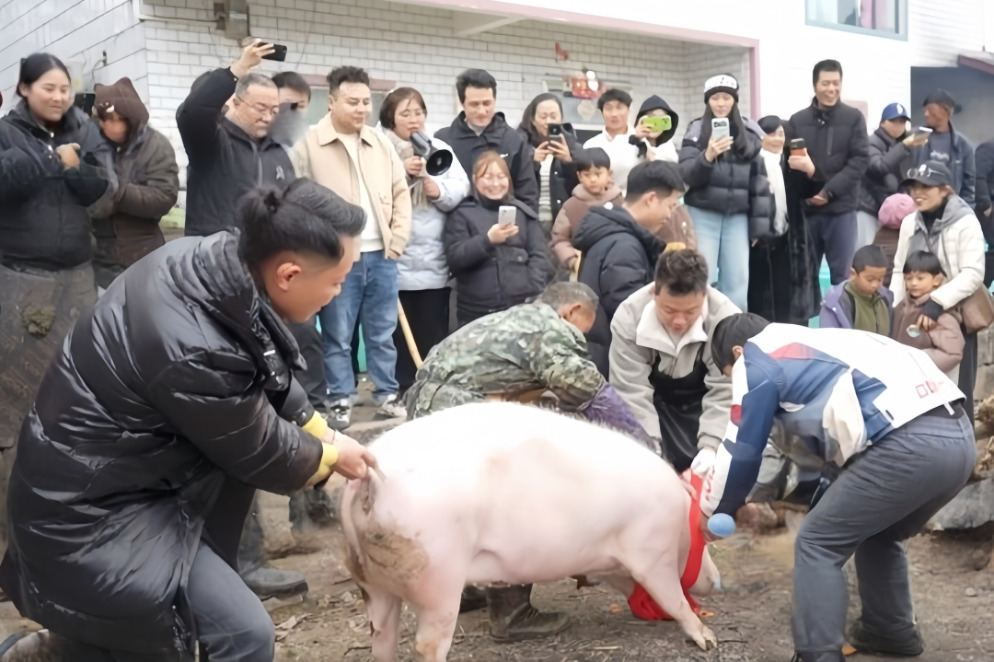
    The extraordinary chain of events began on January 9 when Daidai, a resident of Qingfu village in Chongqing’s Hechuan district, posted a video on Douyin expressing concern about her elderly father’s inability to manage the family’s annual pig slaughter tradition. The 70-year-old man, like many aging villagers, found the physically demanding year-end ritual increasingly challenging without assistance.

    Daidai extended an open invitation for helpers to participate in Paozhutang—a traditional pig slaughter feast that symbolizes Chinese New Year preparations. This centuries-old custom involves community collaboration in every aspect, from handling livestock to preparing elaborate meals, culminating in shared feasting and distribution of fresh pork as gestures of goodwill.

    What followed exceeded all expectations. Instead of the handful of neighbors Daidai anticipated, her video attracted nearly 500,000 engagements within 48 hours. By the weekend, Qingfu village experienced extraordinary gridlock with traffic stretching 10 kilometers as visitors arrived from distant provinces including Guangdong, bearing gifts as if reuniting with long-lost family.

    The overwhelming response necessitated rapid scaling of preparations. The original two pigs proved insufficient, prompting neighbors and local cultural authorities to contribute three additional animals. Ultimately, five pigs were processed to feed a rotating crowd exceeding 3,000 participants.

    The scene embodied chaotic harmony, with socioeconomic distinctions dissolving into collective effort. Observers noted Porsche owners washing dishes alongside mothers chopping vegetables and teams of young men handling the primary slaughtering tasks. The Yanzi catering team, led by 16-year veteran chef Jiang Xiaoyan, mobilized emergency resources, consuming over 500 kilograms of rice, 350 kg of oil, and truckloads of produce with estimated costs surpassing 100,000 yuan ($14,000).

    Local government responded proactively, deploying traffic police and urban management personnel while integrating cultural elements including complimentary tickets to the historic Diaoyucheng Fortress and traditional molten iron fireworks displays.

    The phenomenon has propelled Daidai to social media stardom, with her follower count surging from hundreds to over 2 million. Online commentary has celebrated both her initiative and the resulting demonstration of national solidarity, with one observer noting: ‘She’s the first person brave enough to invite the whole country to dinner.’

    In the aftermath, authorities are considering formal recognition of the event through an annual ‘Hechuan Pig Slaughter Festival’ on January 11, potentially institutionalizing this remarkable display of cultural preservation and communal generosity.

  • Scientists bring summer harvests to winter in Xinjiang

    Scientists bring summer harvests to winter in Xinjiang

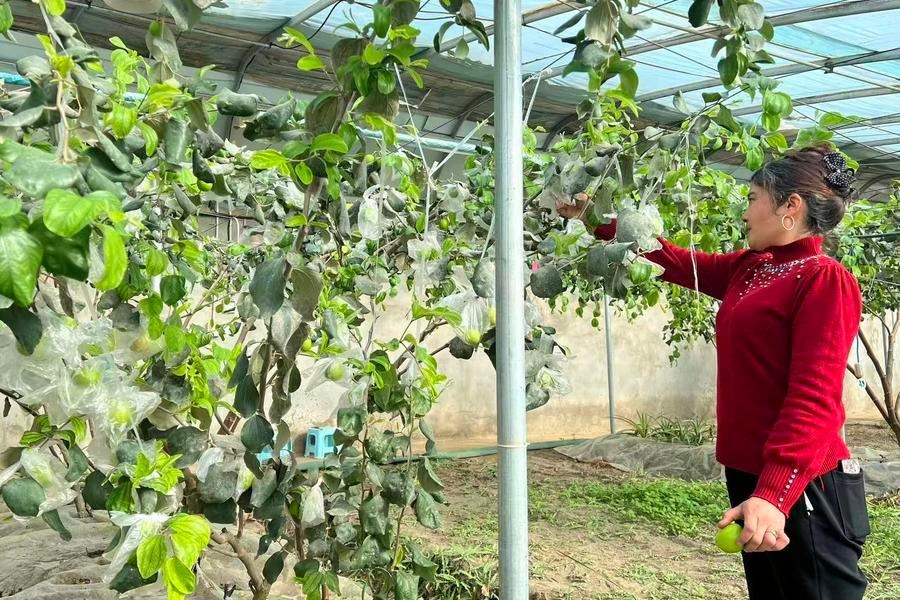
    In a remarkable display of agricultural innovation, scientists from the Chinese Academy of Sciences have transformed the winter landscape of China’s Taklimakan Desert into a thriving oasis of summer produce. At the forefront of this transformation is Ayimak village in Moyu county, Hotan prefecture, where advanced greenhouse technologies defy the harsh desert winter with vibrant displays of trellised watermelons, plump grapes, and exotic dragon fruits.

    The groundbreaking initiative, part of a rural vitalization project dating back to 2015, has established what local villagers call ‘scientific fields’ – a cluster of technologically advanced greenhouses that have become a regional attraction. According to Wang Shi, the village’s Party committee first secretary, over 40 of the village’s 122 greenhouses are now managed by the CAS project team, providing stable employment for more than 100 villagers with average monthly incomes exceeding 3,000 yuan ($430).

    Wang Xin from the CAS Xinjiang Institute of Ecology and Geography explained the scientific advantages: ‘Compared to traditional open-field planting, our trellised watermelon method allows for higher density, greater yield and superior sunlight exposure. Southern Xinjiang’s abundant sunshine and heat resources provide ideal conditions for protected agriculture, which we’ve enhanced through advanced technology to significantly boost both yield and fruit sweetness.’

    The research team has contracted eight greenhouses for pilot programs, testing various watermelon varieties to identify those best suited to local conditions. Wang Ping, another team member, has introduced over 50 fruit varieties including cherries, winter jujube, and pineapple, carefully selecting those most adaptable to the desert environment.

    Through years of research, scientists have overcome significant challenges including soil salinization, compaction, and sand dust that previously limited fruit cultivation in southern Xinjiang. The project’s success has inspired local involvement, with villager Bayimai Abudouaini noting he has acquired valuable cultivation skills and hopes to rent his own greenhouse in the future.

    The initiative aligns with regional development goals, as Xinjiang had established over 1.2 million protected agriculture units covering more than 44,600 hectares by 2023. According to Chinese Academy of Engineering academician Yu Jingquan, Northwest China’s abundant uncultivated land provides exceptional opportunities for expanding protected agriculture while reducing costs.

    A joint work plan by the Ministry of Agriculture and Rural Affairs and Xinjiang’s regional government projects that protected agriculture in southern Xinjiang will reach an annual output value exceeding 9 billion yuan by 2028, creating employment for over 200,000 rural residents. This scientific achievement demonstrates how technological innovation can transform challenging environments into productive agricultural centers, providing economic opportunities while ensuring food security.

  • Why Osimhen has become ‘king of Nigerian football’

    Why Osimhen has become ‘king of Nigerian football’

    As Nigeria prepares for its critical Africa Cup of Nations semi-final clash against host nation Morocco, the narrative surrounding superstar striker Victor Osimhen transcends mere footballing statistics. The 27-year-old Galatasaray forward stands poised to etch his name permanently into Nigerian sporting lore, needing just two goals to equal the legendary Rashidi Yekini’s national record of 37 international strikes.

    The tournament journey, while successful with five consecutive victories, has revealed the intense competitive fire that defines Osimhen’s character. A highly publicized on-field disagreement with teammate Ademola Lookman during Nigeria’s 4-0 round of 16 triumph over Mozambique sparked media speculation about dressing room discord. Osimhen’s visible frustration over a missed scoring opportunity and subsequent early departure from celebrations prompted rumors of potential camp abandonment—all firmly denied by team officials.

    Those closest to the athlete argue that this relentless drive forms the essential core of his greatness. Former Nigeria captain William Troost-Ekong provided poignant insight into the origins of this mentality, recounting Osimhen’s unimaginably difficult childhood. Orphaned at a young age in Lagos, Osimhen supported his siblings by selling water in traffic, developing what Troost-Ekong describes as a profound “hunger and hustle” that manifests in every aspect of his life, from being first to the dinner buffet to his relentless attacking positioning.

    Despite his proximity to individual glory, Osimhen maintains remarkable perspective regarding Yekini’s legacy, stating: “It doesn’t matter if I equal the record or I surpass it. I think Mr Rashidi Yekini is the best striker the Super Eagles have ever produced. I’m just trying to win something important for my country.”

    Nigerian football journalist Oluwashina Okeleji has declared Osimhen the “new king of Nigerian football,” noting his transformational impact since his under-17 days and his unofficial leadership role within the squad. This influence extends beyond international duty, evidenced by his record-breaking club career across Europe’s top leagues.

    After emerging as a scoring sensation with Lille in Ligue 1, Osimhen achieved icon status at Napoli where his 26-goal season delivered their first Serie A title in 33 years, simultaneously making him the highest-scoring African in Italian football history. His subsequent move to Galatasaray produced immediate success with 26 goals in 30 appearances, securing a domestic double and establishing continued dominance in the Turkish Super Lig.

    With continental glory within reach and historical immortality awaiting, Osimhen represents both Nigeria’s present hopes and future legacy as they seek to capture their fourth Africa Cup of Nations championship.

  • Shanxi’s tree hollows turned into canvases for local artists

    Shanxi’s tree hollows turned into canvases for local artists

    Across Shanxi province, an innovative artistic movement is transforming urban environments as local artists turn natural tree cavities into captivating canvases. This grassroots initiative has not only revitalized public spaces but also sparked renewed interest in environmental conservation and cultural heritage among residents.

    In Taiyuan, the provincial capital, 36-year-old Liu Yu leads this creative transformation. As a graduate of Taiyuan University of Technology’s art and design program, Liu discovered inspiration during travels in southern China where she encountered similar tree hollow paintings. Determined to bring this artistic concept northward, she has since created approximately 40 pieces throughout the city.

    The process involves meticulous planning and adaptation to nature’s imperfections. “Each tree hollow possesses a unique shape,” Liu explained. “I conduct repeated site evaluations before selecting animal imagery or cultural motifs that harmonize with the natural contours.” Her creations in Yingze Park now feature playful renditions of raccoons, parrots, and squirrels that have become popular photographic attractions.

    This art form, which first emerged in Chinese urban centers around 2013, has experienced a renaissance driven by cultural tourism initiatives. Artists employ environmentally-friendly paints that serve dual purposes: enhancing aesthetic appeal while providing protective coatings against moisture and insects. The practice requires formal approval from park management authorities, ensuring both artistic freedom and botanical preservation.

    What distinguishes Shanxi’s tree hollow movement is its deliberate incorporation of local cultural elements. Liu has created works inspired by the monumental Mengshan Buddha, Shang Dynasty owl-shaped bronze vessels, and settings from the popular video game Black Myth: Wukong based on Jinci Temple’s Water Mirror Terrace. “When painting works related to these cultural relics,” Liu noted, “I hope to raise awareness of Shanxi’s profound history and culture.”

    The movement has spread beyond Taiyuan, with 28-year-old Yuan Jinmiao from Datong launching her own public campaign after being inspired during a trip to Hebei province. Yuan integrates cultural landmarks including the Yungang Grottoes and Huayan Temple into her designs, along with local mascot “Fo Xiaoban.” She has expanded her charitable work to multiple cities including Shuozhou, Linfen, and Yuncheng.

    Public response has been overwhelmingly positive. Senior citizen Gong Peicai, 69, now incorporates tree hollow viewing into his daily walking routine. “The artists have turned the trees’ ‘scars’ into scenery,” he observed, “and they’ve brought Shanxi’s rich culture into our daily lives in such a vivid way.” Parents like He Qiaoning appreciate the educational value, noting how the artworks naturally spark children’s curiosity about local history and culture.

    Despite facing practical challenges including mosquito bites in summer and harsh winds in winter, the artists remain committed to their mission. Their efforts demonstrate how creative placemaking can foster community engagement, cultural preservation, and environmental stewardship simultaneously—proving that even the smallest urban spaces can become vessels for artistic expression and cultural transmission.