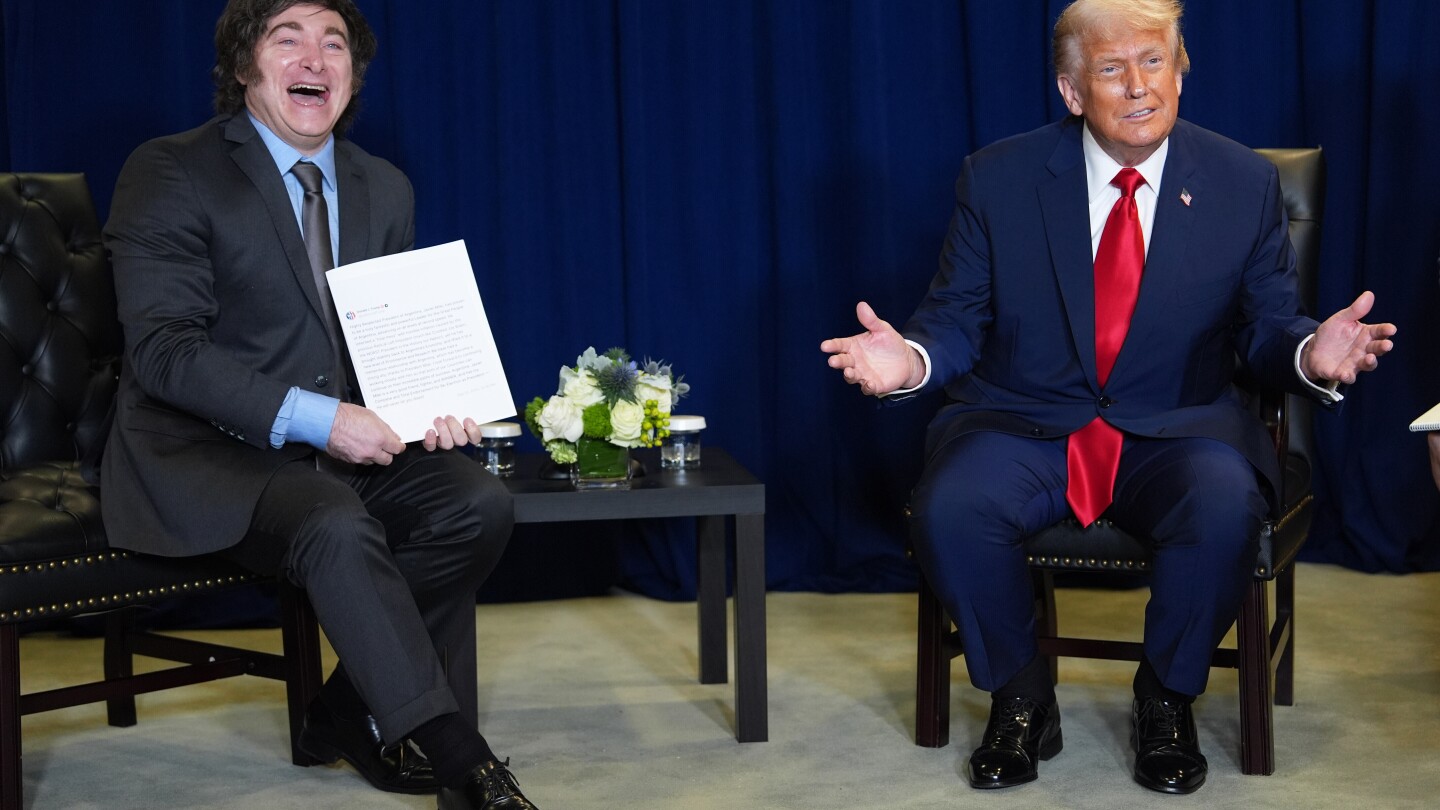
Argentina’s libertarian President Javier Milei is set to meet with U.S. President Donald Trump at the White House on Tuesday, marking a pivotal moment in their burgeoning alliance. Milei, known for his dramatic cuts to state spending and vocal opposition to leftist ideologies, has cultivated a strong rapport with Trump, positioning Argentina as one of the Trump administration’s closest allies. This relationship has already yielded significant benefits, including a $20 billion bailout to stabilize Argentina’s faltering economy. Milei’s effusive praise for Trump, particularly his role in brokering a Gaza ceasefire, underscores the depth of their political camaraderie. ‘Your commitment to life, freedom, and peace has restored hope to the world,’ Milei wrote on social media, hailing Trump as a ‘dear friend’ and a leadership exemplar. The meeting comes at a critical juncture for Argentina, which is grappling with a currency crisis, rising unemployment, and dwindling foreign reserves. Milei’s objectives include negotiating tariff exemptions for Argentine exports and securing the implementation of a $20 billion currency swap to bolster the peso ahead of crucial midterm elections. Despite concerns over Argentina’s ability to repay its debts, Milei remains optimistic, touting U.S. support as a lifeline against ’21st-century socialism’ and envisioning an economic resurgence. Critics, however, question the sustainability of this aid, warning that it may only provide temporary relief without addressing Argentina’s systemic issues.
作者: admin
-
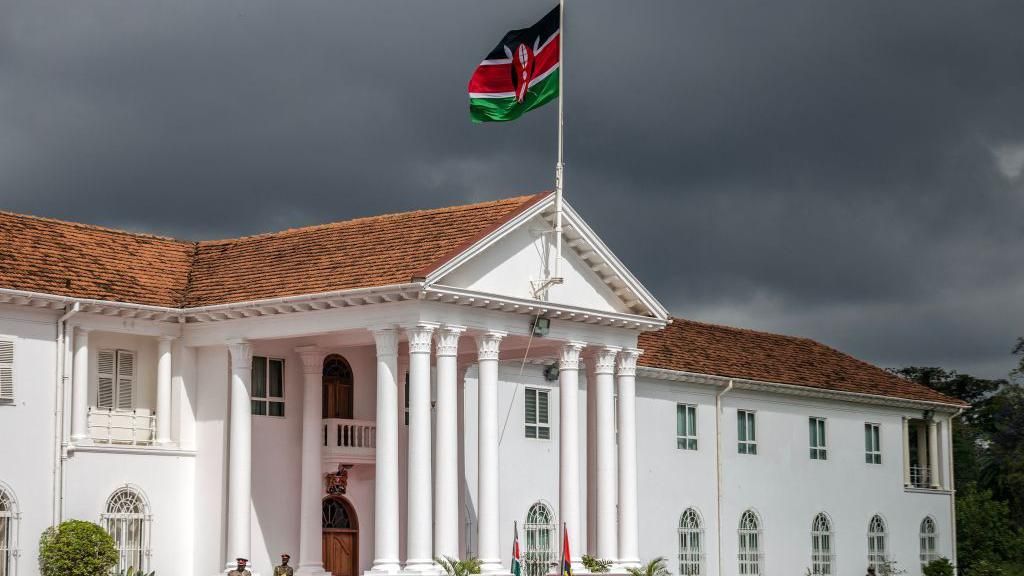
Kenyan officer killed in bow-and-arrow attack at gate of president’s residence
A tragic incident unfolded at the heavily guarded State House in Nairobi, Kenya, when a police officer lost his life after being shot with an arrow by an assailant. The attack occurred on Monday morning as a 56-year-old man, armed with a bow and arrows, approached the gates of the presidential residence. Despite orders to surrender, the man advanced and fatally shot PC Ramadhan Matanka in the ribs. The officer was rushed to the hospital but succumbed to his injuries during treatment. This shocking event has sparked concerns over potential security vulnerabilities at one of Kenya’s most secure locations. The assailant, who reportedly disguised himself as a homeless person carrying a sack that concealed his weapons, was swiftly apprehended. Video footage later showed the handcuffed suspect with visible injuries being transported to a hospital. Police spokesperson Muchiri Nyaga condemned the attack, praising the officers’ quick response and extending condolences to PC Matanka’s family. An investigation is underway to determine the motive behind the assault, and the suspect is expected to appear in court soon.
-
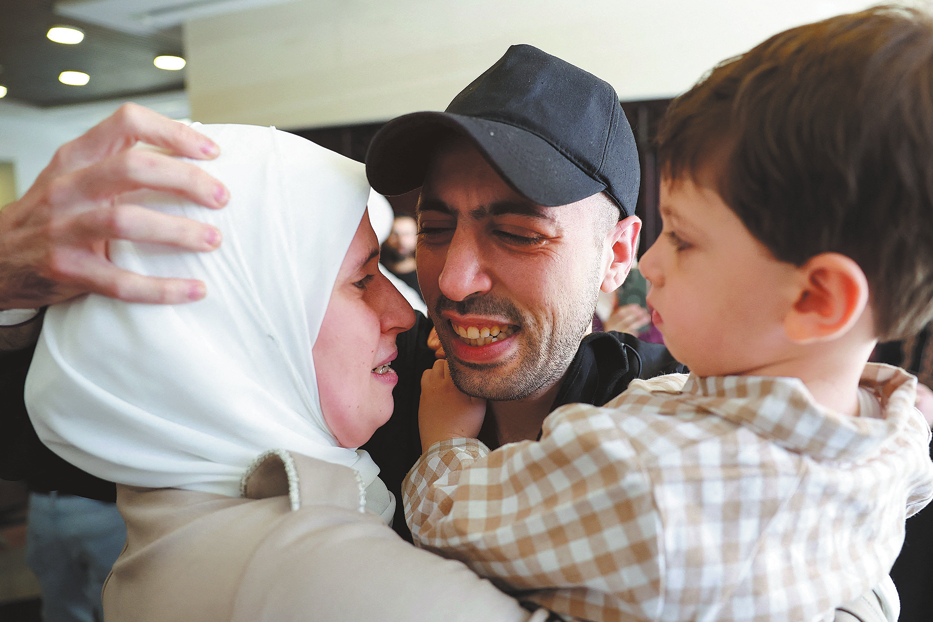
Palestinians and Israelis cheer reunions as hostages released
In a landmark development, Israelis and Palestinians celebrated the release of hostages and prisoners on Monday, marking a significant step toward peace in the region. The exchange, facilitated by a US-backed ceasefire deal, saw the release of all 20 living hostages held by Hamas and the freeing of 250 Palestinian prisoners serving life sentences. However, reports indicate that at least 154 of the released Palestinian prisoners will be forced into exile by Israel. The deal also includes the return of the bodies of 28 deceased Israeli hostages, signaling a humanitarian breakthrough after over two years of conflict. Emotional reunions were broadcast globally, with scenes of Palestinian prisoners being welcomed by jubilant crowds in Ramallah. US President Donald Trump, addressing the Knesset in Jerusalem, hailed the event as “the end of war in Gaza” and emphasized the demilitarization of Gaza and the disarmament of Hamas. Trump also acknowledged that Hamas had been rearming in Gaza with US approval for a limited period, citing the group’s significant losses. He expressed hope for regional stability and urged more nations to join the Abraham Accords. Despite the progress, challenges remain as Gaza faces extensive reconstruction, with Trump warning of potential risks as residents return to the devastated region.
-

Venezuela shuts embassy in Norway following opposition leader’s Nobel award
Venezuela has announced the closure of its embassy in Oslo, just days after opposition leader María Corina Machado was awarded the Nobel Peace Prize. The Venezuelan government, in a statement, attributed the closure to a restructuring of its foreign service, avoiding any direct mention of Machado’s accolade. Norway’s foreign ministry confirmed the embassy’s shutdown but did not provide a specific reason, labeling the decision as ‘regrettable.’ The Nobel Committee honored Machado for her ‘tireless work promoting democratic rights for the people of Venezuela,’ a move that drew sharp criticism from Venezuelan President Nicolás Maduro, who referred to her as a ‘demonic witch.’ Machado, a long-time critic of Maduro’s regime, has been living in hiding for much of the past year. In her response to the award, Machado described it as ‘an injection of energy, hope, and strength’ for her political movement, emphasizing that it reassures Venezuelans they are not alone in their struggle. The embassy closures in Oslo and Australia, coupled with the opening of new diplomatic outposts in Zimbabwe and Burkina Faso, signal Venezuela’s strategic realignment amid escalating tensions with the United States. The U.S. military’s recent strikes on boats allegedly carrying narcotics from Venezuela have further strained relations, drawing international condemnation. This incident echoes past diplomatic fallout over the Nobel Peace Prize, notably with China in 2010, when the award to dissident Liu Xiaobo led to a six-year suspension of ties with Norway.
-

An estimated 1 million cats prowl the streets of Cyprus as officials scramble to check their numbers
Cyprus, a Mediterranean island nation renowned for its feline-friendly culture, is facing a burgeoning crisis with its feral cat population. Estimates suggest there is approximately one feral cat for every one of its 1 million residents, though activists argue the number is significantly higher. The issue has prompted urgent discussions among officials, with the parliamentary environment committee highlighting the inadequacy of the current sterilization program. Environment Commissioner Antonia Theodosiou emphasized that the program, which conducts around 2,000 sterilizations annually on a budget of €100,000, is insufficient to address the scale of the problem. Cyprus has gained notoriety for its disproportionately large cat population relative to its human inhabitants, a situation that poses ecological and welfare challenges. In response, Environment Minister Maria Panayiotou announced on World Animal Day (October 4) that the government would triple annual sterilization funding to €300,000. While this move was welcomed, Charalambos Theopemptou, chairman of the Parliamentary Environment Committee, cautioned that funding alone is not enough. He stressed the need for a comprehensive plan to manage the population effectively. The unchecked growth of feral cats threatens the island’s ecosystem and exacerbates the suffering of these animals, many of which roam urban areas in search of food and shelter. Cyprus’s historical affinity for cats dates back millennia, with archaeological evidence suggesting domestication as early as 9,500 years ago. The island’s cats have become a tourist attraction, often seen lounging near restaurants where visitors feed them. However, the current population explosion is attributed to uncontrolled breeding and increased kitten survival rates due to public care. Veterinary Association President Demetris Epaminondas proposed a unified sterilization plan involving private clinics and a smartphone app to identify cat concentration areas. He also suggested establishing a donation fund to offset costs. Theodosiou revealed that her team is developing a long-term strategy to legalize private sanctuaries and implement a mass sterilization program. Despite the challenges, activists like Eleni Loizidou of Cat Alert remain optimistic, asserting that solutions are within reach.
-

US shipping chaos: I fear my wedding sari is destroyed
The Trump administration’s abrupt changes to U.S. import regulations have triggered widespread chaos in the shipping industry, leaving customers like Nicole Lobo and Janani Mohan in distress. Nicole, a 28-year-old graduate student, shipped 10 boxes of her belongings from the UK to Philadelphia in late August, expecting them to arrive within days. Six weeks later, she fears her possessions may be lost or destroyed by UPS, which is struggling to handle a surge in packages under new customs and tariff rules. ‘It’s been horrific,’ she says, recounting frantic efforts to prevent the disposal of her items after receiving a notification last month. Similarly, Janani, a 29-year-old engineer, is devastated by the potential loss of a box containing her wedding dress, an heirloom sari, and wedding photos sent by her parents in India. ‘Everything in there is very close to my heart,’ she says, describing tearful phone calls with UPS. The new rules, implemented in late August, require parcels worth less than $800 to undergo inspections, taxes, or tariffs, subjecting an estimated 4 million packages daily to more rigorous processing. This has led to longer processing times, higher costs, and widespread confusion. Businesses like Mizuba Tea Co. and Swedish Candy Land are also feeling the impact. Mizuba, which imports matcha from Japan, has five shipments worth over $100,000 stuck in processing, while Swedish Candy Land has lost $50,000 due to destroyed packages. Experts warn the ripple effects could worsen, with FedEx executives describing it as a ‘very stressful period’ for customers. The National Foreign Trade Council fears the issues may persist, as companies struggle to adapt to the new trade environment.
-
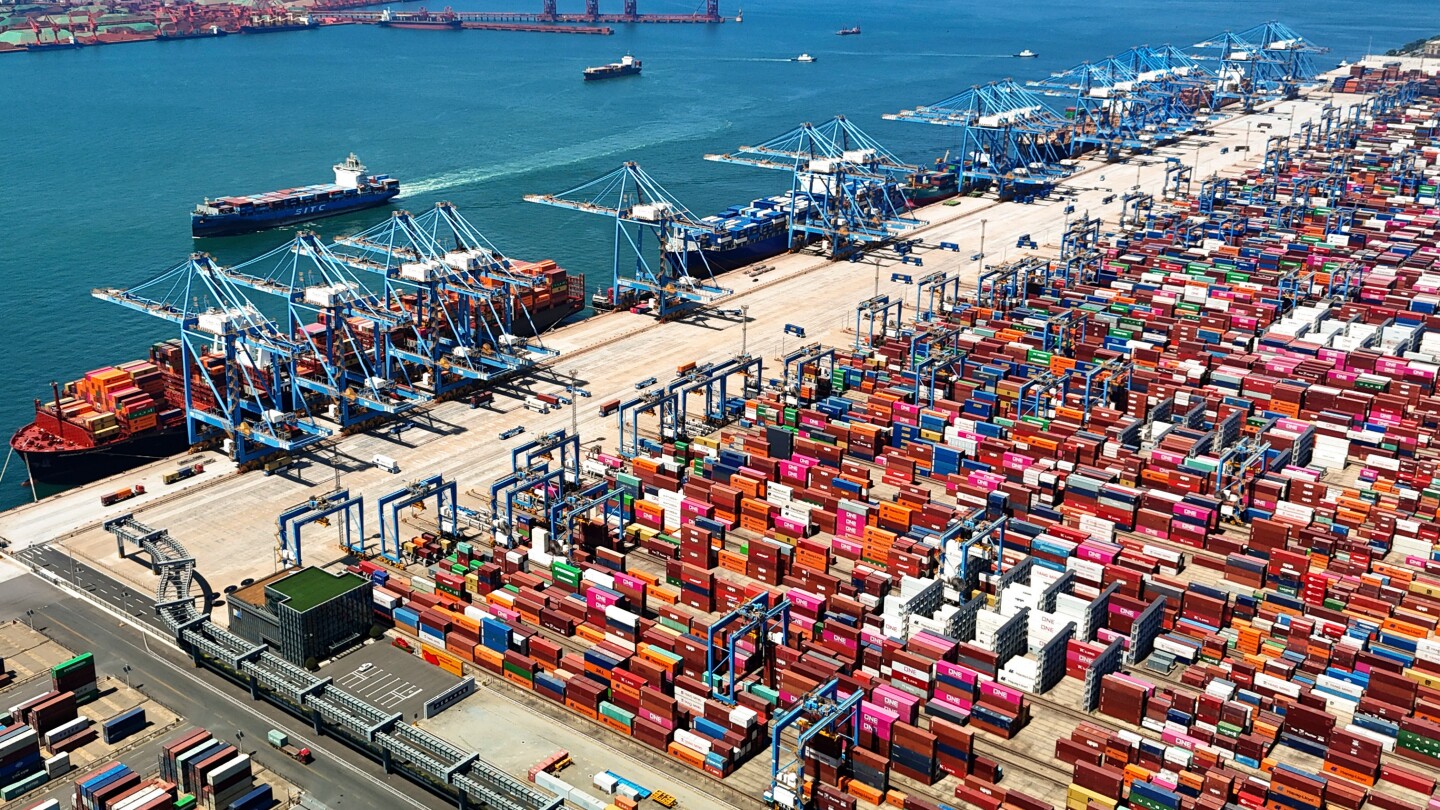
China sanctions 5 US units of South Korean shipbuilder Hanwha Ocean over probe by Washington
In a significant escalation of trade tensions between China and the United States, China’s Commerce Ministry announced on Tuesday a ban on Chinese companies engaging with five subsidiaries of South Korean shipbuilder Hanwha Ocean. This move is seen as a direct response to U.S. President Donald Trump’s efforts to revitalize the American shipbuilding industry. The sanctioned entities include Hanwha Shipping LLC, Hanwha Philly Shipyard Inc., Hanwha Ocean USA International LLC, Hanwha Shipping Holdings LLC, and HS USA Holdings Corp.
-

Rahul notches an unbeaten 58 as India defeats West Indies by 7 wickets to clinch series
In a commanding display of cricketing prowess, India clinched a comprehensive seven-wicket victory over West Indies on Tuesday, completing a 2-0 sweep in their test series. K.L. Rahul emerged as the standout performer, crafting an unbeaten 58 to guide India to the win. The triumph was sealed on Day 5, with India resuming at 63-1 and needing just 58 more runs to secure the second test. This victory followed their earlier success in the first test at Ahmedabad, where India triumphed by an innings and 40 runs. West Indies, forced to follow on after being dismissed for 248 in response to India’s formidable first-innings total of 518-5 declared, managed to put up a fight in their second innings. Shai Hope and John Campbell both notched centuries, with Hope scoring his first test century in eight years and Campbell posting his maiden test ton. Their efforts propelled West Indies to 390, ensuring India had to bat again to win. This marked only the fourth instance since 1961 that India was compelled to bat twice after enforcing the follow-on. The result extends West Indies’ winless streak against India to 26 tests, a drought that dates back to 2002.
-
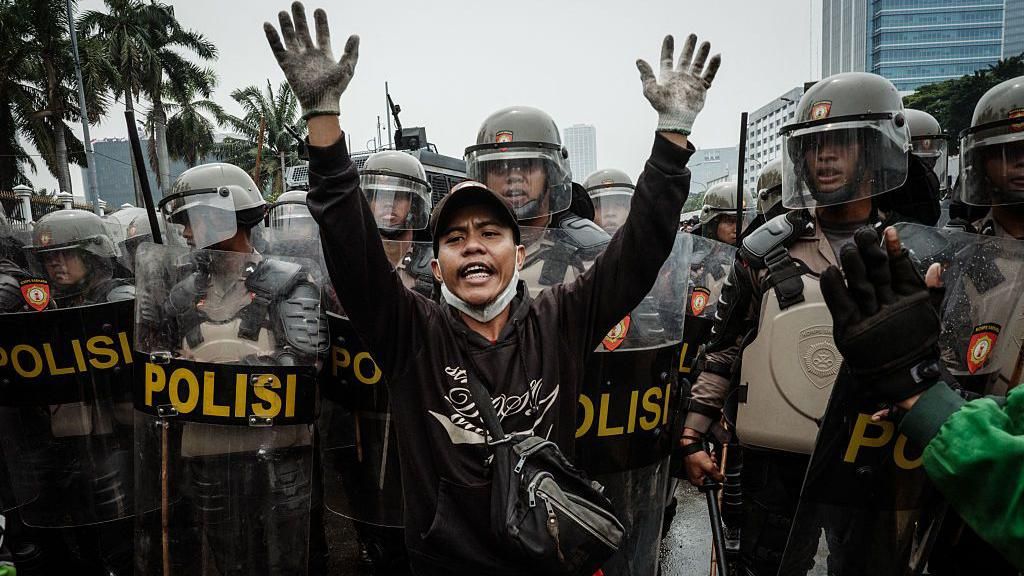
Renewed anger in Indonesia over new allowance raise for lawmakers
Indonesia is once again grappling with widespread public discontent as lawmakers’ recess allowances have been significantly increased, sparking fresh protests. The new allowance, set at 702 million rupiah ($42,400; £31,800), nearly doubles the previous amount of 400 million rupiah. This decision, announced by the country’s deputy house speaker, Sufmi Dasco Ahmad, has reignited controversy over the perceived impunity of the political elite. The recess allowance is intended to support lawmakers in their official duties, such as visiting constituents, during parliamentary recesses. However, the timing of this hike, following earlier protests in August over housing allowances, has fueled public anger. In August, thousands took to the streets to protest against lawmakers’ $3,000 monthly housing allowances, which were nearly ten times the minimum wage in Jakarta. Although the housing allowances were later cut to quell the unrest, the latest increase in recess allowances has renewed calls for accountability. Dasco Ahmad defended the hike, citing increased activities by lawmakers during recesses and rising food and transport costs. He also announced plans to launch a publicly accessible app where lawmakers must report their expenditure of recess funds, aiming to enhance transparency. Critics, however, remain skeptical. Lucius Karus from Formappi, a parliamentary watchdog, likened the situation to a ‘prank,’ expressing dissatisfaction with the emergence of another ‘fantastic allowance.’ Reports of some lawmakers receiving an extra 54 million rupiah due to human error have further exacerbated public frustration. This incident underscores a broader discontent with economic inequality and corruption in Southeast Asia’s largest economy, as many Indonesians question the government’s priorities and accountability.
-
Trump’s Gaza victory lap: A Nobel prize, lots of money and ‘a beautiful woman’
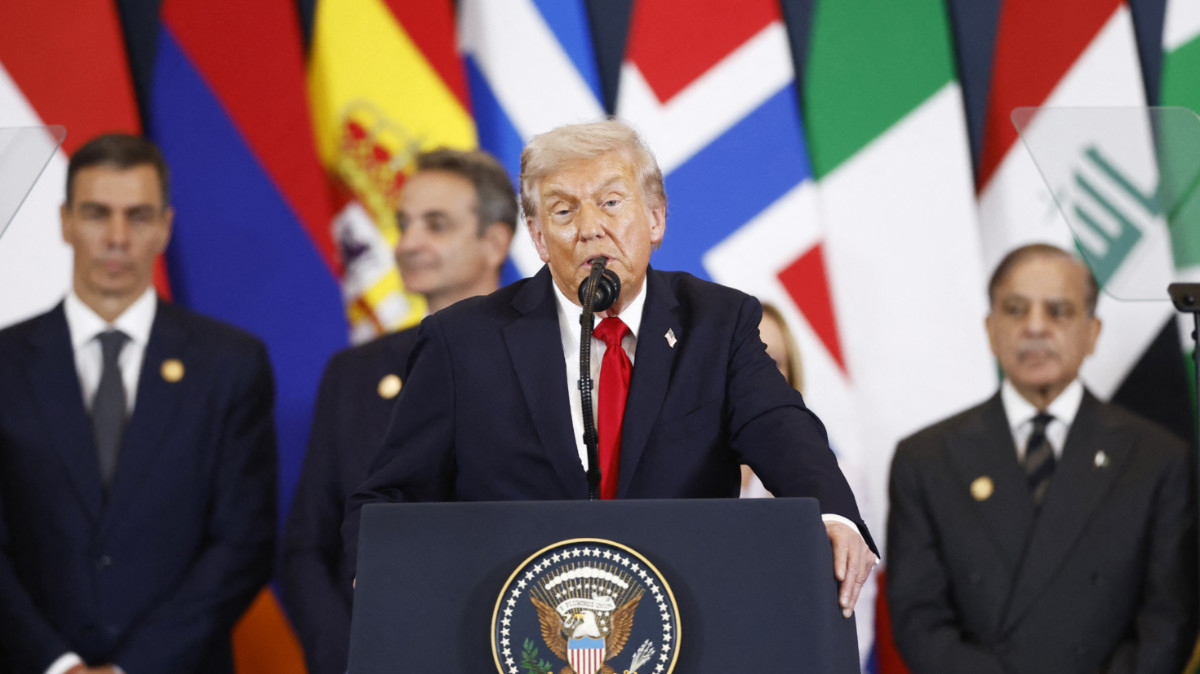
President Donald Trump’s recent Middle East tour was a masterclass in political theater, blending high-profile engagements with significant diplomatic achievements. The journey began with a landmark address at the Israeli Knesset, where Trump reaffirmed his commitment to the Gaza peace deal and the Abraham Accords. He also urged Israel’s president to pardon Prime Minister Benjamin Netanyahu, who is embroiled in a corruption trial. The tour’s second leg took Trump to Egypt’s Sharm el-Sheikh, where he declared the end of the Gaza war and the start of reconstruction efforts. Dozens of world leaders, including Egyptian President Abdel Fattah el-Sisi, Turkish President Recep Tayyip Erdogan, and Qatari Emir Tamim bin Hamad al-Thani, gathered to sign documents recognizing the ceasefire. Trump’s visit was marked by praise for Sisi’s role in brokering the deal and a public nomination for the Nobel Peace Prize by Pakistani Prime Minister Shehbaz Sharif. However, behind the pageantry, Arab states expressed concerns about Trump’s sustained interest in the peace process. Analysts noted that the summit’s internationalization of the Israel-Palestine conflict was unprecedented. While phase one of the ceasefire is complete, with Israeli troops withdrawing from central Gaza and captives released, the hard questions of Hamas’s demilitarization and Gaza’s governance remain unresolved. Trump’s expectation of Gulf funding for Gaza’s reconstruction faces skepticism, as regional powers like Qatar, the UAE, and Saudi Arabia have divergent priorities. Despite the diplomatic successes, the absence of direct references to Palestinian suffering in Trump’s speeches drew criticism, underscoring the complexities of the ongoing conflict.