作者: admin

  • World’s largest ice and snow theme park opens, igniting China’s winter tourism fever

    World’s largest ice and snow theme park opens, igniting China’s winter tourism fever

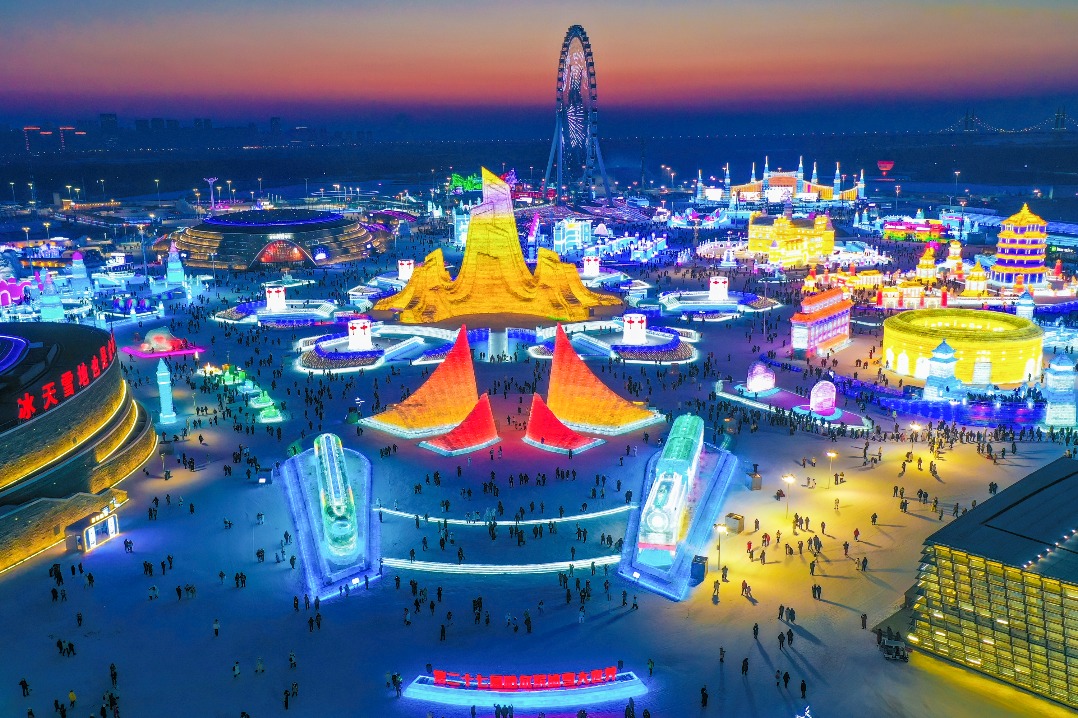
    HARBIN, China — Defying frigid temperatures, thousands of winter enthusiasts converged Wednesday at the newly opened Harbin Ice-Snow World, marking the spectacular launch of the world’s largest ice and snow theme park’s most ambitious season to date. Spanning an unprecedented 1.2 million square meters, this year’s edition presents a breathtaking fusion of artistic ice craftsmanship and immersive entertainment experiences.

    Among the first visitors was He Rui, who journeyed over 3,000 kilometers from Guizhou province to experience the park’s legendary Super Ice Slides. ‘After years of anticipation, the reality exceeded all expectations,’ He remarked, visibly exhilarated after descending the 521-meter ice track.

    The 2025-2026 season introduces groundbreaking attractions including a magnificent central tower sculpted in the form of a mountain embraced by snowflakes, symbolizing China’s burgeoning ice-snow economy. Artistic creations range from meticulous replicas of China’s Yellow Crane Tower and Baroque-style architectural marvels to international icons like Belgium’s Manneken-Pis statue. Modern technological achievements are represented through detailed models of aircraft carriers and submersibles.

    ‘We’ve created an unparalleled synthesis of Eastern and Western artistic traditions,’ stated Guo Hongwei, Chairman of Harbin Ice and Snow World Co Ltd. ‘Our expanded entertainment offerings now include singing competitions, dance performances, and fantastical indoor productions.’

    Visitor comfort receives significant enhancement with a 5,000-square-meter climate-controlled dome providing warm respite, complimentary hot beverages, and multilingual guided services. International accessibility improves with streamlined payment systems accepting overseas bank cards.

    The park’s opening festivities featured traditional dance and drum performances, with ceremonial distribution of ‘First-day Ice’—frozen artifacts collected during Harbin’s ice-cutting festival, believed to convey good fortune according to local customs.

    Harbin’s transformation into China’s premier winter destination continues generating substantial economic impact. Last season recorded 3.56 million visits to Ice-Snow World alone, contributing to Heilongjiang Province’s 266.17 billion yuan ice-snow economy. National ambitions target sector growth reaching 1.5 trillion yuan by 2030.

    Complementing the main attraction, Harbin simultaneously launches its Sun Island Snow Expo across 1.5 million square meters and an Ice-Snow Carnival along the frozen Songhua River, collectively featuring approximately 260 snow sculptures and 60 specialized winter activity zones.

    China’s cultural tourism authorities emphasize developing high-quality winter tourism products during the 15th Five-Year Plan period (2026-2030), with nationwide initiatives including specialized student programs and substantial tourism vouchers attracting global visitors to China’s winter wonderlands.

  • Trump’s expanded travel ban hits Africa the hardest but reactions are muted

    Trump’s expanded travel ban hits Africa the hardest but reactions are muted

    ZIMBABWE (AP) — The Trump administration’s significant expansion of travel restrictions has placed Africa at the epicenter of its immigration policy, with twenty additional nations added to the prohibited list. Despite affecting approximately 1.5 billion people across the continent, official responses remained measured Wednesday as governments assessed the implications of the sweeping measures.

    The newly announced restrictions build upon June’s limitations but represent a more comprehensive and punitive approach than those implemented during Trump’s initial presidency. Unlike the previous Muslim-majority focused bans reversed in 2021, the current policy cites security vulnerabilities, documentation deficiencies, and visa overstay concerns as justification.

    Notably, four African nations—Burkai Faso, Mali, Niger, and South Sudan—joined the complete prohibition list alongside Syria and Palestinian Authority document holders. Sierra Leone and Laos, previously under partial restrictions, now face comprehensive bans. Twelve of the fifteen countries subjected to partial restrictions are African, including Nigeria, Senegal, Zimbabwe, and Ivory Coast, complemented by Antigua and Barbuda, Dominica, and Tonga.

    The African Union, through spokesman Nuur Mohamu, reiterated its call for balanced, evidence-based border protection that acknowledges the longstanding partnership between the U.S. and African nations. The 55-member organization warned of potential damage to educational exchanges, commercial engagement, and diplomatic relations cultivated over decades.

    Reactions from affected governments varied from diplomatic engagement to cautious silence. Sierra Leone’s government expressed commitment to addressing U.S. immigration concerns through constructive dialogue, while Malian officials declined immediate comment, reflecting the cautious stance adopted by many administrations.

    Analysts and citizens alike criticized the measures as disproportionately affecting African nations. Ramlah Ibrahim Nok, a business lawyer in Abuja, noted the unfairness of blanket restrictions that fail to distinguish between legitimate travelers and violators. Beverly Ochieng of Control Risks Group predicted the policy would create “incoherent, unpredictable and challenging” relations between the U.S. and African countries, potentially driving partnerships toward Washington’s rivals like Russia and China.

    The timing raises additional concerns regarding the 2026 FIFA World Cup, jointly hosted by the U.S., Canada, and Mexico. Sports enthusiasts expressed uncertainty about fan attendance despite anticipated exemptions for players and staff.

    In South Sudan, human rights activist Rajab Mohandis interpreted the ban as diplomatic punishment for the government’s slow implementation of the 2018 peace agreement that ended a devastating civil war.

    Across Africa, the expanded travel restrictions have sparked concerns about economic impact, diplomatic relations, and the future of people-to-people exchanges between the continent and the United States.

  • Watch: Moment Nick Reiner is arrested after being seen in convenience store

    Watch: Moment Nick Reiner is arrested after being seen in convenience store

    Newly released surveillance footage has revealed the critical moments leading to the arrest of Nick Reiner, a 32-year-old individual now at the center of a devastating family tragedy investigation. The visual evidence depicts Reiner moving aimlessly through a convenience store shortly before law enforcement officials took him into custody regarding the deaths of his parents, Rob and Michele Reiner.

    The footage, which has become pivotal to the ongoing investigation, shows Reiner exhibiting unusual behavior while browsing store aisles, providing investigators with crucial pre-arrest behavioral evidence. Law enforcement agencies have confirmed this arrest connects directly to the suspicious deaths of the suspect’s parents, though specific details regarding motives or circumstances remain undisclosed as the investigation continues.

    Authorities have emphasized the importance of this visual evidence in establishing timeline continuity while refusing to comment on whether Reiner was making purchases or merely occupying the commercial space before his apprehension. The arrest occurred without incident according to police reports, though the emotional weight of the situation has deeply affected the local community where the Reiner family was known.

    Criminal psychologists examining the case suggest that such public footage often provides invaluable insights into suspect behavior patterns prior to formal charges being filed. The judicial process continues to unfold as prosecutors prepare their case based on accumulating evidence beyond the surveillance material.

  • Pakistan extends airspace ban for Indian aircraft until January 2026

    Pakistan extends airspace ban for Indian aircraft until January 2026

    Pakistan has formally extended its prohibition on Indian aircraft utilizing its airspace through January 23, 2026, according to an official Notice to Airmen (NOTAM) issued by the Pakistan Airports Authority on Wednesday, December 17, 2025. This decision prolongs a significant aviation restriction initially imposed in the aftermath of the Pahalgam attack in April, an incident that resulted in 26 fatalities and severely escalated bilateral tensions. The monthly renewal pattern continues, with the previous mandate scheduled to lapse on December 24. This ongoing closure compels airlines operating to and from India to navigate lengthier, more fuel-intensive flight paths, particularly affecting routes to and from Afghanistan, Central Asia, and parts of the Middle East, thereby increasing operational costs and flight durations. The persistent extension underscores the deep-rooted and unresolved diplomatic discord between the two nuclear-armed neighbors, with no immediate indications of a thaw in relations or aviation cooperation. The aviation sectors of both nations, along with international carriers servicing these routes, continue to adapt to this protracted geopolitical reality.

  • DMCC partners with Crypto.com to drive global push for commodities tokenisation

    DMCC partners with Crypto.com to drive global push for commodities tokenisation

    In a landmark move that signals Dubai’s accelerating embrace of digital asset innovation, the Dubai Multi Commodities Centre (DMCC) has entered into a strategic partnership with cryptocurrency exchange giant Crypto.com. This collaboration, formalized through a Memorandum of Understanding, aims to revolutionize global commodities trading through blockchain-enabled tokenization of physical assets.

    The partnership brings together the world’s largest free zone and commodities trading hub with one of the most prominent digital asset platforms to explore transformative solutions for tokenizing real-world commodities. The initiative specifically targets precious metals, diamonds, energy products, and agricultural goods—seeking to modernize how these assets are financed, traded, and settled across international markets.

    Key objectives include reducing settlement friction, enhancing price transparency, and expanding access to broader pools of market participants. The alliance will assess the potential listing of tokenized commodities on the Crypto.com Exchange, contingent upon regulatory approvals and existing listing requirements. Additionally, both organizations will jointly investigate digital asset custody models, liquidity-facilitation mechanisms, and digital-asset payment solutions across DMCC’s digital platforms.

    Ahmed Bin Sulayem, Executive Chairman and CEO of DMCC, characterized tokenization as a structural opportunity to modernize commodities markets that still rely heavily on legacy systems. “The ability to move real assets on-chain could significantly enhance transparency and efficiency,” he stated, emphasizing Dubai’s positioning at the forefront of blockchain-enabled trade transformation.

    The collaboration extends beyond market infrastructure to include educational initiatives through the DMCC Crypto Centre. These will feature workshops, hackathons, and capability-building programs designed to strengthen institutional understanding of tokenized asset models and foster responsible innovation within Dubai’s rapidly expanding Web3 ecosystem.

    Crypto.com President Eric Anziani highlighted the significance of tokenized real-world assets as “one of the most significant advancements in the digital economy,” noting that the partnership provides an exceptional platform to explore these opportunities responsibly and at scale.

    This agreement builds upon DMCC’s earlier partnership with Dubai’s Virtual Assets Regulatory Authority (VARA), forming part of a comprehensive strategy to develop secure, compliant frameworks for integrating physical assets into the digital economy. With over 26,000 member companies across various sectors, DMCC provides a diversified commercial environment for testing and implementing blockchain applications within global supply chains.

  • China planning to raise age limit for blood donors, shorten the minimum interval

    China planning to raise age limit for blood donors, shorten the minimum interval

    China is poised to implement significant revisions to its national blood donation policy, marking the first major update to the Law on Blood Donation since its inception in 1997. The National Health Commission announced on Wednesday, December 17, 2025, proposed changes that would raise the maximum donor age from 55 to 65 years and reduce the minimum donation interval from six months to just 90 days.

    This regulatory modernization follows extensive review of international practices and contemporary medical research. The World Health Organization’s guidelines recommend donor ages between 18 and 65, with numerous developed nations including the United States, Canada, Australia, and Japan either permitting older donors or establishing no strict upper age limitations. Similarly, the proposed 90-day interval aligns with the 8-12 week standards commonly implemented worldwide.

    The Commission emphasized that all potential donors will undergo comprehensive health screenings to ensure safety. Medical evidence confirms that donating 400 milliliters of blood represents less than 10% of total blood volume, with the human body continuously regenerating blood cells without adverse health effects.

    Several regions including Hainan Province, Jiangxi Province, and Shenzhen City have already successfully implemented similar relaxed standards through local regulations, providing practical demonstration of the policy’s feasibility and safety.

    The draft revision prioritizes donor health protection and blood safety as fundamental principles, proposing enhanced health assessments, scientific donation criteria, improved monitoring systems, and superior donor services. Additional measures include financial subsidies, extended paid leave, and improved medical service access for donors.

    The National Health Commission is currently soliciting public feedback on the proposed revisions until January 17, 2026, before submitting the final draft to the legislative body for approval.

  • Ghislaine Maxwell asks court to set aside her 20-year prison sentence

    Ghislaine Maxwell asks court to set aside her 20-year prison sentence

    Convicted sex trafficker Ghislaine Maxwell has launched a fresh legal bid to challenge her 20-year prison sentence, filing motions in a New York federal court seeking either complete vacatur or significant modification of her punishment. The disgraced socialite and longtime associate of deceased financier Jeffrey Epstein alleges the emergence of “substantial new evidence” that fundamentally undermines the fairness of her 2021 trial.

    According to newly submitted court documents, Maxwell’s defense team contends that materials uncovered through subsequent civil litigation, investigative journalism projects, and previously sealed documents collectively demonstrate procedural irregularities and evidentiary issues that compromised her right to due process. This marks the latest in a series of appellate efforts mounted by Maxwell since her conviction for facilitating Epstein’s abuse of underage girls.

    The timing of this legal maneuver coincides with impending transparency obligations facing the U.S. Justice Department, which must disclose extensive files related to its Epstein investigations by December 19th. Legal analysts suggest these forthcoming documents might contain information relevant to Maxwell’s claims, potentially influencing judicial consideration of her appeal.

    Maxwell, currently incarcerated at Florida’s FCI Tallahassee, maintains her innocence despite multiple convictions for sex trafficking conspiracy, transportation of minors for illegal sexual acts, and related charges. Her legal team argues that cumulative procedural errors and newly discovered materials warrant reconsideration of what they characterize as an excessively harsh sentence relative to her role in Epstein’s criminal enterprise.

    The Second Circuit Court of Appeals will now review whether the presented evidence meets the threshold for reconsideration, a process that may extend for months before any determination regarding retrial or resentencing.

  • House to vote on resolutions to put limits on Trump’s campaign against Venezuela and drug cartels

    House to vote on resolutions to put limits on Trump’s campaign against Venezuela and drug cartels

    The U.S. House of Representatives engaged in a significant constitutional confrontation on Wednesday, voting on war powers resolutions designed to curtail President Donald Trump’s autonomous military actions against Venezuelan targets and drug cartels in the Western Hemisphere. This legislative move represents the first formal congressional challenge to Trump’s escalating military campaign across Central and South America.

    Democratic lawmakers orchestrated these votes amid growing concerns over the administration’s aggressive posture toward Venezuela and its controversial counter-narcotics operations. These operations have reportedly resulted in the destruction of 25 vessels allegedly transporting drugs and the deaths of at least 95 individuals. The resolutions would legally compel the Trump administration to seek explicit congressional authorization before continuing attacks against cartels designated as terrorist organizations or initiating military action against Venezuela itself.

    Congressman Gregory Meeks, the senior Democrat on the House Foreign Affairs Committee, asserted that the administration’s true motivations extend beyond counter-narcotics. “The president is coveting Venezuelan oil,” Meeks declared, suggesting economic interests rather than national security concerns drive the aggressive stance.

    The political landscape reveals deep partisan divisions. While Democratic leadership demands transparency and constitutional adherence, most Senate Republicans previously opposed similar measures. President Trump would almost certainly veto any such legislation reaching his desk. Nevertheless, Democrats forced the vote to initiate public debate and record Republican positions on the matter.

    Republican leaders have increasingly endorsed Trump’s campaign, even as it potentially escalates into direct confrontation with Venezuelan President Nicolás Maduro. Senate Majority Leader John Thune (R-S.D.) characterized Maduro as “a cancer on that continent,” indicating openness to regime change objectives.

    The administration defends its actions under existing counter-terrorism authorities, arguing that drug-trafficking organizations represent imminent threats to national security. This rationale has faced intensified scrutiny following revelations that a September 2nd operation killed two survivors of an initial attack.

    Classified briefings with Secretary of State Marco Rubio, Defense Secretary Pete Hegseth, and the Navy admiral who ordered the controversial strike produced sharply contrasting reactions. Republican lawmakers largely supported the operation as based on precise intelligence, while Democrats described footage of the missile strike as “shocking” and demanded criminal investigations.

    The debate extends beyond immediate operations to broader constitutional questions. Representative Don Bacon (R-Neb.), a retired Air Force brigadier general, acknowledged that while he believes the boat strike was lawful, “continued hostility does require congressional approval.”

    Some Republicans joined Democrats in questioning the administration’s stated objectives. Representative Thomas Massie (R-Ky.) pointedly noted that if drugs were the primary concern, operations would focus on Mexico, China, or Colombia—the actual sources of most illegal substances. “This is about oil and regime change,” Massie concluded, echoing Democratic criticisms of the administration’s underlying motivations.

  • Breakthrough in BMI tech aids patients

    Breakthrough in BMI tech aids patients

    In a landmark advancement for neurotechnology, Chinese researchers have demonstrated unprecedented brain-machine interface (BMI) capabilities enabling two paralyzed patients to perform complex physical tasks through thought alone. The breakthrough achievements—announced December 17, 2025, by the Center for Excellence in Brain Science and Intelligence Technology of the Chinese Academy of Sciences—include the world’s first mental control of a power wheelchair and robotic dog for delivery retrieval, plus precise manipulation of a robotic arm for drinking activities.

    The two patients, both males in their thirties suffering from high-level paralysis, received minimally invasive BMI implants developed through collaboration between the CAS center, Shanghai Huashan Hospital, and corporate partners. The implant procedures—conducted in June and October 2025 through a mere 5-millimeter cranial puncture—represent the smallest such implementation globally, with the implant device itself being approximately half the size of Neuralink’s comparable technology.

    This research signifies a quantum leap beyond the team’s previous March 2025 achievement where a patient mentally controlled a computer cursor. The new cases enable three-dimensional interaction with the physical environment, dramatically expanding possibilities for self-care, employment, and social participation. One patient has already secured employment as an intern product sorter, utilizing brain control to perform online data annotation for AI verification systems in vending machines.

    Technical innovations were crucial to these advancements. Researchers developed high-compression, high-fidelity neural data compression techniques and created hybrid decoding models capable of extracting usable signals in noisy environments. By addressing ‘cross-day stability’ challenges through neural manifold alignment, the team maintained reliable decoder performance despite environmental interference and physiological variations.

    Perhaps most impressively, the system achieves end-to-end delay of under 100 milliseconds from neural signal acquisition to device execution—faster than the body’s natural neural transmission speed. Patients describe the experience as intuitive and seamless, comparable to controlling video game characters without conscious effort.

    According to lead scientist Zhao Zhengtuo, the research represents significant progress toward practical clinical applications. The team anticipates scalable applications for restoring motor and language functions within three years, breakthroughs in sensory restoration and neuropsychiatric disorder treatment within five years, and highly minimally invasive systems enabling both medical and consumer uses within a decade. Future goals include achieving sufficiently fine control for activities such as playing the piano with mind-controlled robotic fingers.

  • Beyond IPL auction: Punjab Kings co-owner Ness Wadia praises quiet calm of Abu Dhabi

    Beyond IPL auction: Punjab Kings co-owner Ness Wadia praises quiet calm of Abu Dhabi

    ABU DHABI – Beyond the high-stakes environment of the IPL auction, Punjab Kings co-owner Ness Wadia found himself captivated by the understated elegance and serene atmosphere of the UAE capital. In an exclusive interview with Khaleej Times, Wadia revealed how Abu Dhabi’s unique character left a lasting impression that transcends cricket.

    The transformative moment occurred the evening preceding the auction as Wadia dined with a view of the illuminated Sheikh Zayed Grand Mosque. The majestic white domes against the night sky established a tone of peaceful contemplation that would define his entire experience. “The roads are smooth, the people welcoming, and the pace noticeably different,” Wadia observed. “Everything feels nice and calm here, offering a sense of order and reassurance that’s increasingly rare in modern cities.”

    Wadia drew thoughtful comparisons between Abu Dhabi and Dubai, describing them as complementary emirates with distinct personalities. While Dubai thrives on dynamic energy and relentless momentum, Abu Dhabi presents a more measured, contemplative environment. What struck Wadia most profoundly was the subtlety of the UAE’s progress – the nation’s advancements in infrastructure and security achieved without ostentation.

    The executive particularly noted the pervasive sense of care and security throughout the city. “Security was present without being intrusive,” he remarked, “allowing people to go about their lives with genuine ease.” This philosophy extended to cricket infrastructure, which Wadia noted had been designed with thoughtful consideration for players and spectators alike.

    Wadia discovered unexpected connections with local cricket enthusiasts, learning of substantial Punjab Kings support among UAE residents including Emirati nationals. “Knowing we have fans here makes me feel even more at home,” he shared with visible appreciation.

    These experiences have catalyzed concrete plans for future engagement. Wadia confirmed that Punjab Kings are actively exploring opportunities for a February visit to Abu Dhabi, with both team management and captain Shreyas Iyer expressing enthusiasm. Crucially, Wadia emphasized that any engagement would prioritize genuine fan interaction over spectacle, creating meaningful connections with the team’s supporter base.

    As his visit concluded, Wadia reflected on Abu Dhabi’s unique balance – capable of hosting high-intensity events while maintaining its fundamental tranquility. The city has transcended its role as merely a venue on the cricket calendar, becoming instead a place where Wadia feels authentically welcomed and understood – a true home away from home.