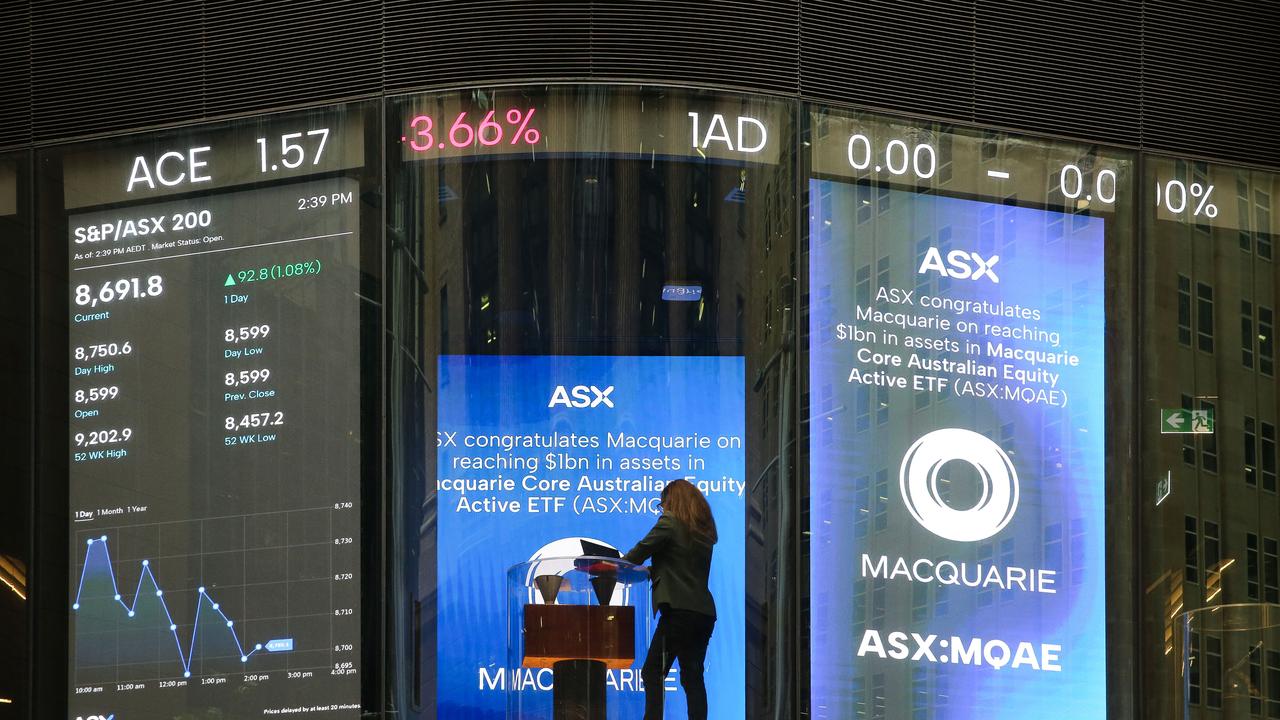
Australia’s financial markets demonstrated resilience Thursday as the ASX 200 stabilized following a period of significant volatility, closing marginally lower at 8,525.70 points despite mounting international pressures and energy sector uncertainties.
The benchmark index recorded a modest decline of 8.60 points (0.10%) while the All Ordinaries index settled at 8,740.10. Despite recent fluctuations, the market has posted a 0.33% gain over the past five trading sessions, though it remains 2.16% down year-to-date. The Australian dollar maintained its position near recent lows, trading at 69.54 US cents.
Sector performance revealed a divided market landscape. Materials and healthcare companies provided substantial support, effectively counterbalancing weaknesses elsewhere. Orica led gainers with a notable 5.25% surge to $20.56, followed by Droneshield’s 4.69% advance to $4.46. Infratil, Karoon Energy, and Dyno Nobel also posted significant gains ranging from 2.95% to 3.46%.
Energy equities showed modest strength with Ampol rising 0.39% and AGL Energy gaining 0.62%, despite Brent crude prices retreating below the psychological $100 barrier to $99.28 per barrel. Banking institutions presented a mixed picture, with Commonwealth Bank and Westpac recording modest gains while National Australia Bank and ANZ retreated.
Market analyst Kyle Rodda of Capital.com emphasized that current trading patterns reflect reactive behavior to geopolitical developments rather than fundamental economic data. He identified ongoing international negotiations and Middle Eastern resource mobilization as critical focal points for investors.
Rodda issued a sobering warning regarding potential economic consequences, noting that prolonged closure of the Strait of Hormuz could trigger disruptive energy market effects reminiscent of COVID-era economic shocks. He explained that elevated energy costs would likely propagate through supply chains, increasing prices for essential commodities including fertilizers, potentially reigniting inflationary pressures and compelling central banks to maintain restrictive monetary policies.
The analyst further cautioned that even with de-escalation of current tensions, market normalization would require extended time due to production disruptions, critical infrastructure damage, and persistently elevated pricing structures across multiple sectors.
Globally, markets exhibited divergent trajectories with the Dow Jones Industrial Average declining 0.66% while crude oil prices advanced nearly 2% to $92.08 per barrel.