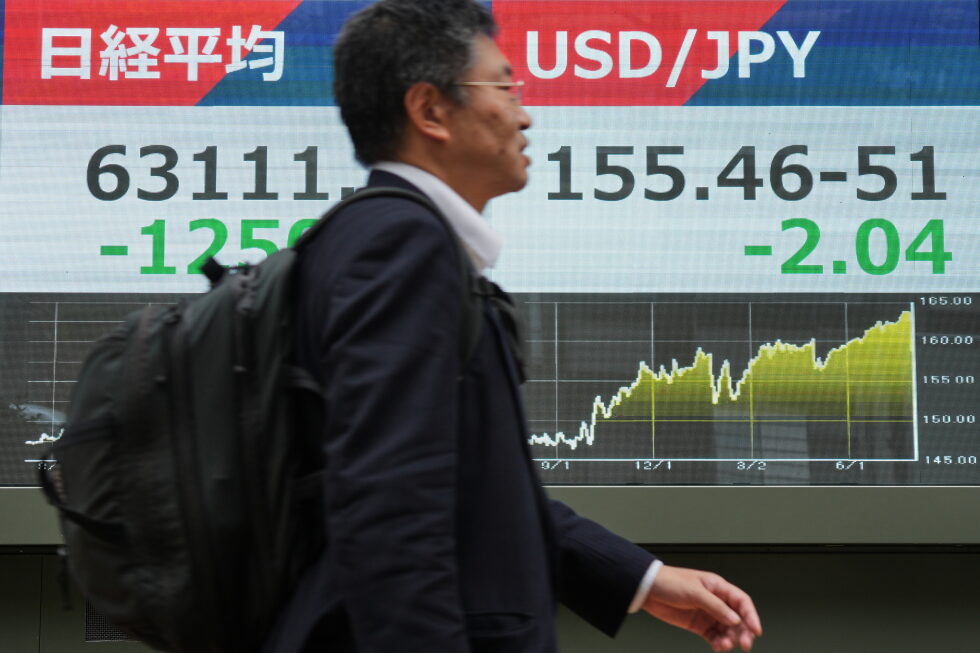
BANGKOK – Global financial markets kicked off the first trading day of the week in a state of uneven flux, driven by two major geopolitical and policy developments: coordinated currency intervention between the United States and Japan to stabilize the Japanese yen, and a sudden shift in U.S. posture toward Iran that has eased fears of open military conflict in the Middle East.
Following joint confirmation from U.S. and Japanese officials that the two governments intervened in foreign exchange markets last week to reverse the U.S. dollar’s surge to 40-year highs against the yen, the yen climbed to its strongest level against the greenback since the end of 2023. At its lowest point for the dollar, one U.S. dollar traded as low as 155.20 yen, a sharp pullback from last week’s peak near 164 yen. The euro, by contrast, posted a modest uptick, rising slightly from $1.1528 to $1.0933 against the dollar.
The shift in yen valuation creates mixed outcomes for Japan’s economy. A chronically weak yen has long benefited Japanese multinational corporations with large overseas operations, as their foreign earnings translate into more yen when converted back to the domestic currency. It has also drawn a boom in international tourism, as visitors from countries with stronger currencies enjoy amplified purchasing power inside Japan. But the downside of a cheap yen has been crippling: it erodes Japan’s overall national purchasing power, driving up import costs for critical commodities including oil and industrial inputs that the Japanese economy depends on.
Across Asian equity markets on Monday morning, trading results were deeply split. Japan’s benchmark Nikkei 225 index fell 1.9% to 63,140.68, reflecting investor expectations that a stronger yen will cut into the overseas profits that have driven the index’s recent gains. In South Korea, the Kospi plummeted 4.5% to 6,298.75, erasing much of the index’s historic 17.9% surge from Friday – its best single-day performance in recorded history. The Kospi, which is heavily weighted toward two major tech and semiconductor giants, Samsung Electronics and SK Hynix, saw both stocks rally more than 25% on Friday amid AI-driven optimism, but both pulled back sharply on Monday: Samsung traded 8% lower, while SK Hynix fell 7.8%.
Other regional markets posted more muted movements. Hong Kong’s Hang Seng Index gained 0.6% to reach 26,038.92, while China’s Shanghai Composite slipped 0.5% to 3,812.97. Australia’s S&P/ASX 200 edged down 0.2% to 8,961.30, and Taiwan’s Taiex index posted a 0.7% uptick.
The easing of military tensions in the Middle East drove a sharp drop in global oil prices. After U.S. President Donald Trump announced he would order American forces to hold off on new strikes against Iran, claiming a deal to end ongoing hostilities in the region was within reach, oil benchmarks fell roughly 5% by early Monday. U.S. benchmark crude dropped 4.8% to trade at $80.58 per barrel, while Brent crude, the global pricing standard, fell 5% to $83.87 per barrel.
The Monday open in Asia follows a volatile week for U.S. equities that ended on a positive note, wrapping up a turbulent July for Wall Street. The S&P 500 gained 0.7% on Friday, the Dow Jones Industrial Average added 0.5%, and the Nasdaq Composite rallied 1% – erasing an early 1.3% intraday loss to close higher. The gains pushed the S&P 500 into its first winning week in three weeks.
U.S. markets have swung wildly in recent weeks, buffeted by three key sources of uncertainty: spiking oil prices driven by the Iran conflict, ongoing debate over whether massive corporate investments in artificial intelligence will eventually translate into meaningful profits, and concerns that semiconductor stocks have rallied too far too fast amid AI euphoria.
Big tech led Friday’s gains after strong quarterly earnings signaled AI investments may already be paying off. Amazon led all gains with a 15.3% jump after reporting that its latest quarter profits tripled year-over-year, far outpacing analyst expectations. The strong results were fueled by accelerating growth in the company’s cloud computing division, leading analysts to conclude that Amazon’s heavy AI spending is beginning to deliver returns. The company also raised its full-year capital expenditure forecast in response to ongoing AI expansion. The results mirrored Microsoft’s strong earnings report a day earlier, which sent its stock soaring to its best single-day performance in nearly 18 years on similar signals of AI-driven profit growth.
Semiconductor stocks, which provide the processing power and memory chips that big tech “hyperscalers” are rushing to acquire for AI expansion, continued their volatile trajectory on Friday. Micron Technology, for example, swung wildly from an early 6.4% gain to an intraday loss of 6.5% before closing down 5.9% for the day. Even with the broader market rally, Apple closed down 7.4% on Friday, despite reporting better-than-expected quarterly profits. The sell-off was triggered by Apple’s lower-than-expected revenue forecast for the current quarter, which executives blamed on component supply shortages driven by overwhelming AI-related demand for semiconductors.