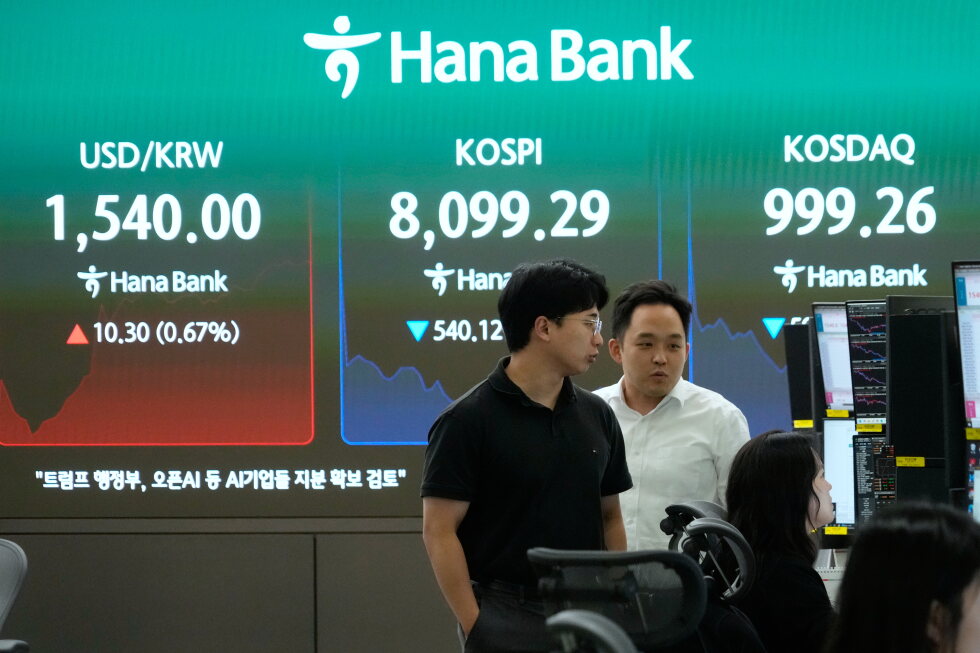
A widespread sell-off of artificial intelligence-linked stocks pulled major Asian equity markets sharply lower on Friday, triggered by underwhelming quarterly forecasts from top U.S. technology firms that stoked broader investor jitters over the red-hot AI sector. The sharp downturn in Asia came on the heels of mixed closes on Wall Street Thursday, where weakness in big tech was offset by gains across other sectors that pushed the Dow Jones Industrial Average to a fresh all-time high.
The market volatility began Thursday when U.S. chip giant Broadcom posted quarterly results that matched analyst expectations, but its revenue guidance for the current quarter fell short of investor projections. The shortfall sent its share price plummeting 12.6% by market close, dragging down other major players across the AI and tech ecosystem. U.S. memory chip manufacturer Micron Technology dropped 7.7%, while cloud cybersecurity firm CrowdStrike Holdings shed 3.8% in Thursday trading. Even with the tech sector pullback, the benchmark S&P 500 still managed a 0.4% gain, and the Dow Jones climbed 1.7% to set a new record close. The tech-heavy Nasdaq Composite bucked the broader upward trend, dipping just 0.1% by the closing bell.
When Asian markets opened for trading Friday, investors moved quickly to offload AI and tech holdings, sparking steep declines across the region. South Korea’s benchmark Kospi index led the losses, falling 5.1% to 8,185.62 by midday trading, a dramatic pullback after the index roughly doubled over the past 12 months on the back of booming demand for its leading chip manufacturers. SK Hynix, one of the world’s largest memory chip producers and a key supplier to AI hardware supply chains, plunged 8.4%, while industry peer Samsung Electronics shed 5.4% in morning trading.
Japan’s Nikkei 225, which has also hit repeated record highs in recent months driven by tech gains, slipped 1.2% to 66,532.35, with leading chip equipment manufacturer Tokyo Electron falling 7.2% to lead the downturn. The decline came even as separate government data released Friday confirmed Japanese real wages have risen for four consecutive months, a positive macroeconomic signal that failed to offset AI-related market jitters. Hong Kong’s Hang Seng Index declined 0.8% to 25,047.83, while mainland China’s Shanghai Composite Index bucked the regional trend to gain 0.4% to close at 4,075.31. Australia’s S&P/ASX 200 fell 0.5% to 8,639.50, Taiwan’s Taiex index gave up 1.5%, and India’s Sensex posted a minor 0.2% gain.
Beyond equity markets, global oil prices stabilized Friday after falling sharply in the previous session, as investors continued to weigh persistent Middle East geopolitical risks against tentative hopes for a diplomatic breakthrough that would reopen critical energy shipping lanes. International benchmark Brent crude rose 0.4% to $95.42 per barrel, after dipping to $95.03 on Thursday. U.S. benchmark crude ticked 0.1% higher to $93.15 per barrel, still far above the roughly $70 per barrel price recorded before the outbreak of the latest regional conflict.
For months, global energy markets have been roiled by the closure of the Strait of Hormuz, the narrow strategic waterway that carries roughly a fifth of global oil and natural gas supplies. The ongoing conflict has stoked fears that sustained energy disruptions will fuel global inflation and drag down economic growth across major economies. Even as strong corporate earnings and AI-driven enthusiasm have pushed many major stock indexes to multi-year or record highs, repeated volatility linked to Middle East tensions has created ongoing uncertainty for global investors.
Last week, American and Iranian negotiators reached a tentative framework to extend a ceasefire, but a final agreement has yet to be signed. Complicating prospects for a permanent end to hostilities, the Iran-backed Lebanese militant group Hezbollah rejected the latest proposed ceasefire between the Lebanese and Israeli governments earlier this week, raising fears of a wider regional escalation. In a note to clients, ING commodities strategists Warren Patterson and Ewa Manthey noted that the oil market has so far traded on expectations that a diplomatic deal will quickly reopen the Strait of Hormuz, but they warned that market hopes for a rapid breakthrough may be “overly optimistic” given the lack of tangible progress in negotiations.
In currency markets, minor fluctuations were recorded in early Friday trading. The U.S. dollar dipped slightly to 159.97 Japanese yen, down from 160.03 yen in the previous session. The euro edged marginally higher to $1.1614, up from $1.1610 at Thursday’s close. AP Business Writer Stan Choe contributed reporting to this article.