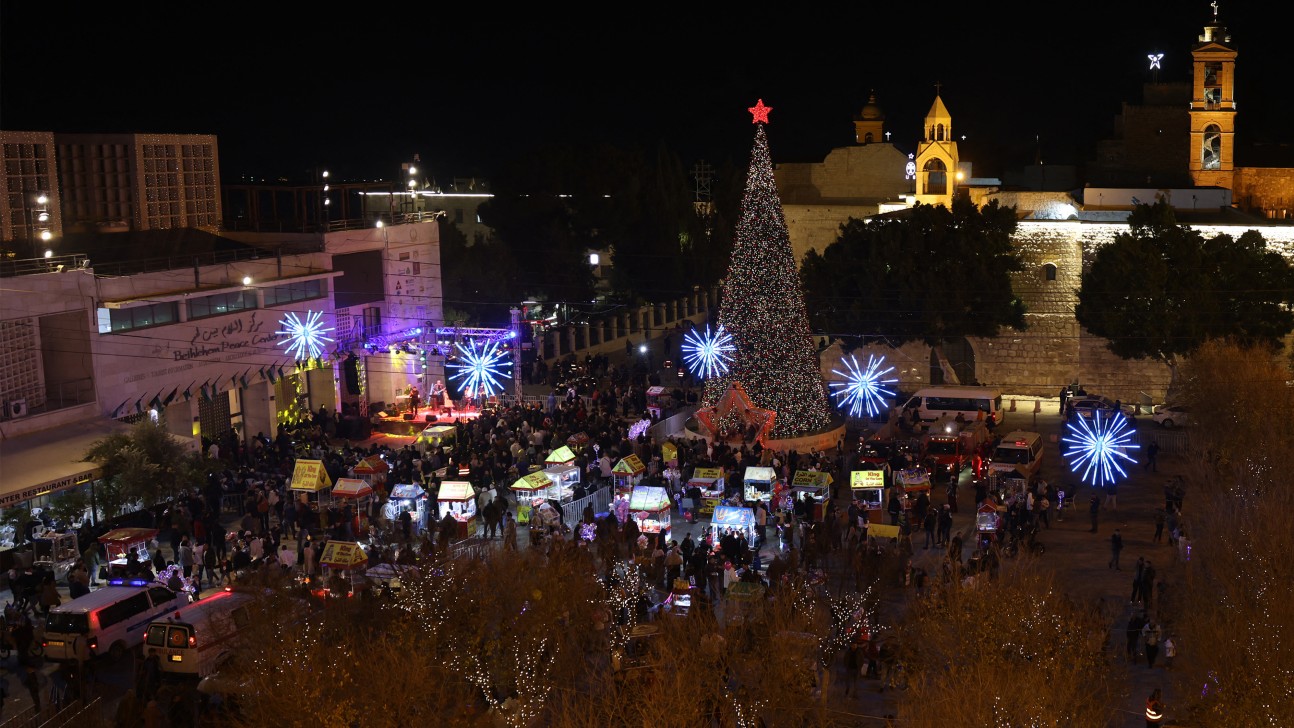
In the occupied West Bank city of Bethlehem, the traditional birthplace of Jesus Christ, Palestinian Christians are experiencing a Christmas season marked by fragile relief and profound contradictions. Following the implementation of a US-brokered ceasefire in Gaza on October 10th, 2025, the city has reactivated its Christmas illuminations and restored some public celebrations after previous years of solemn observances.
The temporary truce has provided Palestinians with limited respite from continuous aerial bombardments and the crippling blockade that restricted essential supplies. However, this reprieve remains tenuous—according to Gaza’s Government Media Office, Israeli forces have committed nearly 1,000 violations since the ceasefire began.
Reverend Munther Isaac of Bethlehem’s Evangelical Lutheran Christmas Church, who two years ago proclaimed that “Christ is under the rubble” alongside a nativity scene depicting Jesus swaddled in a Palestinian keffiyeh amid debris, now observes families continuing to emigrate due to deteriorating conditions. “We say goodbye to another family every other week or so,” Isaac noted, highlighting how persistent settler attacks and occupation policies undermine dignified existence in their homeland.
The symbolic dimension of this Christmas has drawn international attention. The U.S. Embassy in Jerusalem recently shared a video featuring Ambassador Mike Huckabee—a known Christian Zionist who has previously denied Palestinian existence—walking through Bethlehem’s streets while promising American support for worship rights. This gesture appears deeply ironic to many Palestinian Christians, given that 3% of Gaza’s Christian community has been killed in Israeli attacks since October 2023.
Palestinian-American Christians across the United States have articulated their complex perspectives on this paradoxical season. Lydia el-Sayegh of Atlanta reflects that Christmas represents “hope coming in darkness,” drawing parallels between Jesus’ family as refugees and contemporary Palestinian experiences. Philip Farah from Virginia expresses alienation from mainstream churches that avoid controversy, while Tariq Habash in Washington DC describes Christmas as arriving “heavy with contradiction”—celebrating Christ’s birth while children remain trapped under siege.
In practical terms, the occupation continues to intrude upon religious observance. Khalil Jahshan reports that family in Gaza still hear gunfire and drones during celebrations, while Israeli police disrupted Christmas parades in Nazareth and Haifa—where Santa Claus was reportedly arrested. Daniel Bannoura, a theologian in Indiana, notes that despite surface-level normalcy with decorations, land confiscation and settlement expansion around Beit Sahour create underlying despair.
The consensus among Palestinian Christians suggests that while the ceasefire has brought physical breathing room, it has failed to address fundamental injustices or create meaningful conditions for peace, leaving the community navigating a complex landscape of measured hope amid ongoing oppression.