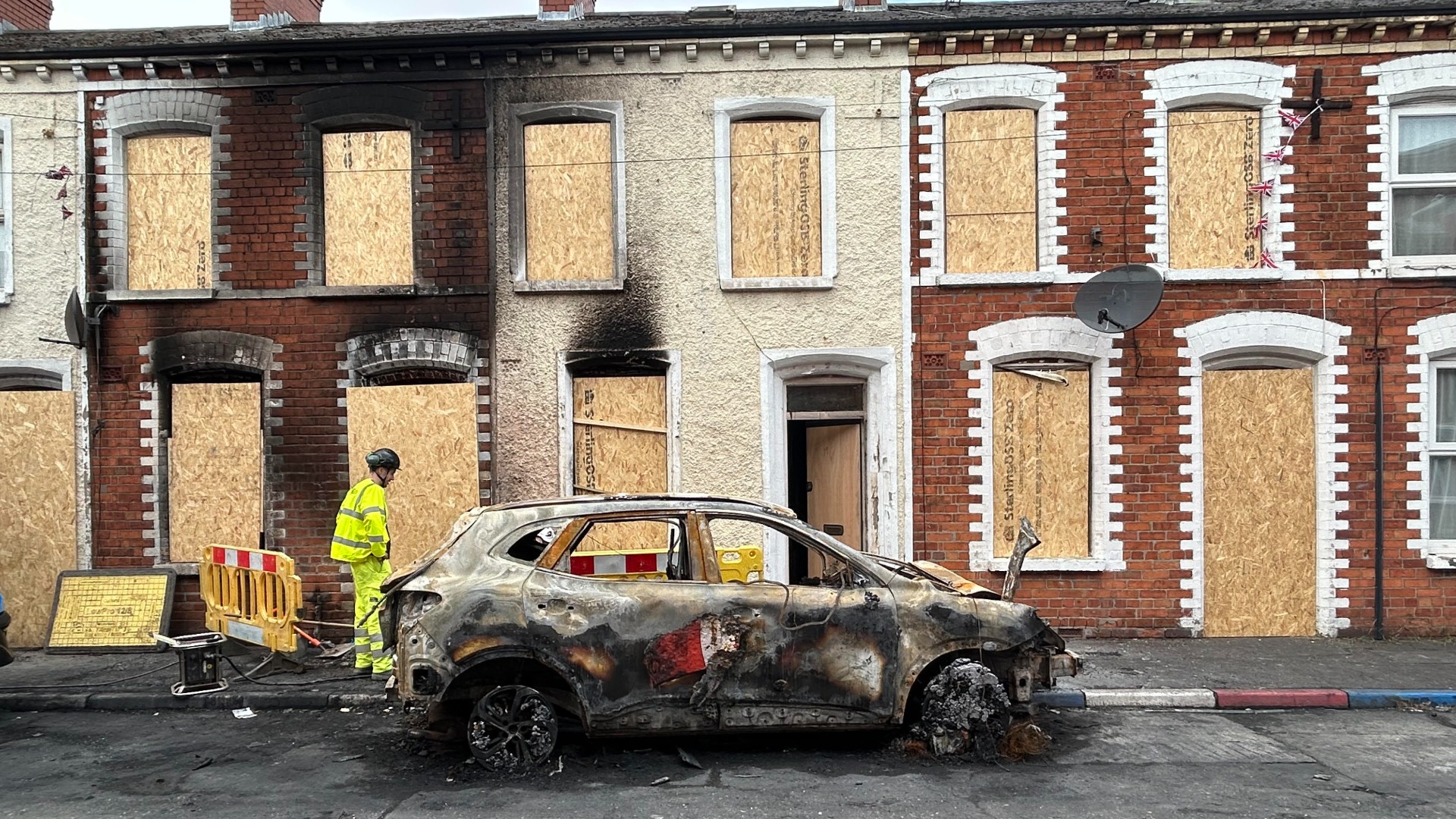
A wave of racially motivated violence has shaken Northern Ireland’s capital Belfast, leaving immigrant families from Sudan displaced and terrified, as local volunteer groups stepped in to fill the gap left by absent state authorities. Earlier this week, two Sudanese families living in Belfast’s Tiger Bay neighborhood were targeted in coordinated attacks by gangs of masked men, who broke into their properties and set fire to the homes and work vehicles parked outside.
One attack trapped a single mother and her two young children upstairs as flames consumed the floor below. Too afraid to confront the attackers who had explicitly targeted people perceived as foreign, the family hid in place while waiting for emergency response that took a full hour to arrive. Next door, a father shielding his two children waited out the violence, already wondering how he would explain the chaos to his wife, who was traveling overseas for work. Both heads of household work as translators for the UK’s National Health Service, and their work cars, left parked on a street decorated with loyalist murals, were completely destroyed in the arson.
The violence followed a stabbing incident in Belfast earlier that week perpetrated by a man of Sudanese descent, and quickly spiraled into targeted attacks against the city’s entire Sudanese immigrant community. Even before the worst unrest broke out, two Sudanese community leaders – Areej Fareh and Twasul Mohammed, who run the Belfast-based women’s collective Anaka – had been working to address growing safety risks for immigrant residents. When the first night of attacks erupted on Tuesday, members of the Anaka collective, most of whom are immigrant women from diverse backgrounds, took to the streets despite the danger of flying petrol bombs and makeshift checkpoints set up to target people who appear non-local.
With no sign of police, housing officials or other state agencies responding to the crisis, the grassroots organizers launched an independent evacuation effort. They first moved out 12 families whose homes and vehicles had already been destroyed by arson. When a leaked list of additional targeted addresses circulated on social media and WhatsApp groups the following night, the team expanded their operation: using a shared network of volunteer contacts, a centralized database of displaced people and a registry of local residents with spare rooms to offer, the group ultimately relocated more than 200 vulnerable families and individuals, many of whom remain unable to return to their neighborhoods.
Fareh and Mohammed’s experience organizing against authoritarian rule in their home country prepared them to step into this crisis. The pair became friends while studying at university in Sudan, where they both organized opposition to the 30-year dictatorship of Omar al-Bashir, who was ousted in a 2019 popular revolution. Mohammed relocated to Belfast in 2016, while Fareh remained in Sudan to take part in the uprising, an experience that left her with first-hand trauma from state repression. During a 2019 protest in Khartoum, she was arrested by al-Bashir’s security forces, harassed and abused. She had already watched a close friend, a young chemist, killed by gunfire during a 2013 protest crackdown led by the Rapid Support Forces (RSF), the Janjaweed-derived paramilitary now accused of genocide in Sudan’s ongoing civil war. By the time al-Bashir fell, Fareh made the decision to leave to protect her 15-year-old son, and resettled in Belfast.
For years after her arrival, Fareh said she felt entirely safe in her new home. “The first few years, until the attacks in 2024, I never worried that people on the street were racist,” she explained. “I was confident. Even if it was late and I was on my own I felt safe. Now I feel it all the time. If I see two men I feel worried.”
Today, a central Belfast church has been converted into a makeshift refuge for hundreds of people displaced by the violence, with volunteer organizers running a full kitchen serving hot meals to displaced residents. Even amid the trauma, small moments of community connection persist: as the World Cup kicks off, a local resident organized a casual pool on when the first tournament goal would be scored. Local organizers like Brenda, a 15-year veteran of film and television set production in Belfast, have streamlined operations at the refuge to ensure every displaced person has support.
Community housing organizer Conol Matthews, who has worked alongside the volunteer evacuation effort, argues that the anti-immigrant violence is stoked by manipulative forces that benefit from working-class division. When he encounters anti-immigrant sentiment among local working-class residents, he challenges them to ask who actually gains from the UK housing crisis that places asylum seekers and refugees in working-class neighborhoods, with private landlords charging the state inflated rents. “It’s those boys in suits,” he tells them. “They benefit. You have to live it. Maybe look not at the people living a life like yours.” Matthews has faced retaliation for his work: his phone number was leaked to loyalist extremist WhatsApp groups, and his call log is now flooded with endless anonymous threatening calls.
Despite the fear and trauma of recent attacks, both Fareh and Mohammed say they refuse to leave Belfast, drawing on their experience of resistance in Sudan to reject the narrative of collective punishment that blames the entire Sudanese community for the actions of one individual. Mohammed notes that while rising anti-immigrant sentiment is a problem across much of the West, Belfast has a unique context of colonial history that creates solidarity. “There are more good people here than bad,” she said. “It’s becoming like this all over the West, but at least here the Irish understand, they have the history of being colonized.”
For Fareh, the message to the racists targeting their community is clear: the Sudanese community will not be driven out. “We are not leaving it for them,” she said. “If you think you should leave then you have to think: no way.”