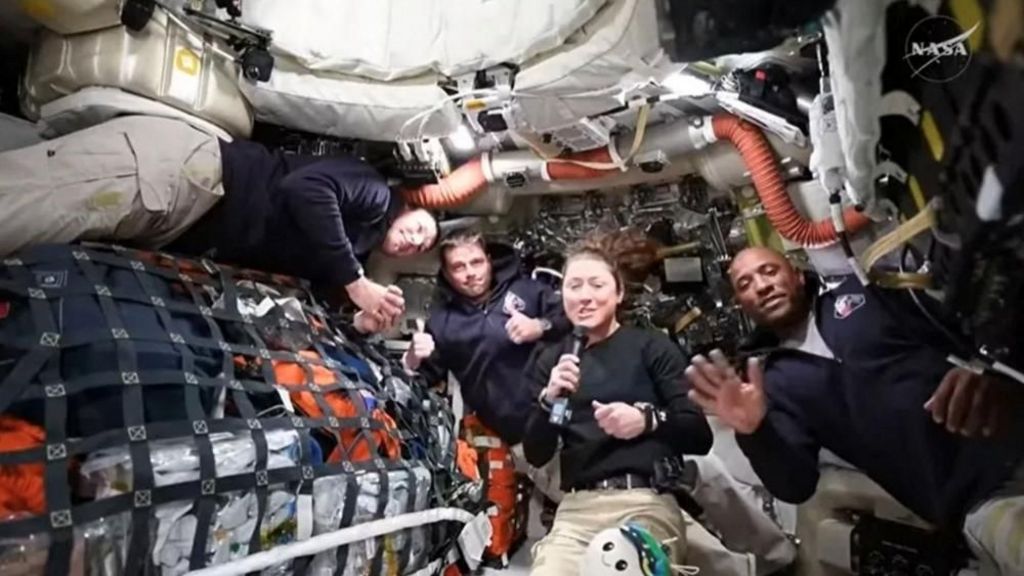
Nearly 54 years after the last Apollo mission left lunar orbit, NASA’s groundbreaking Artemis II mission is making history as it carries four astronauts deeper into space than any human mission in half a century. While the 10-day lunar flyby mission has hit a small, unexpected snag with intermittent malfunctions in the Orion capsule’s waste management system, the crew and ground teams have worked around the issue, keeping the historic mission on track.
Launched from Earth last Wednesday, Artemis II marked the first time humans have traveled beyond low-Earth orbit since NASA’s Apollo 17 mission in 1972. The four-person crew — NASA astronauts Reid Wiseman, Victor Glover, and Christina Koch, joined by Canadian Space Agency astronaut Jeremy Hansen — is housed in a compact Orion cabin roughly the size of a standard camper van, measuring just 5 meters wide and 3 meters tall.
Troubles with the capsule’s toilet emerged just days into the flight. Mission specialist Koch first noted a minor priming issue during a live video downlink with Earth on Thursday, joking that she was proud to claim the title of “space plumber” and calling the toilet “probably the most important piece of equipment on board.” By Saturday, the problem escalated when the wastewater vent line became clogged, likely due to frozen blockage that prevented the crew from dumping waste overboard, NASA confirmed in an official press release.
To resolve the blockage, ground controllers instructed the crew to reorient the capsule to point the clogged vent directly toward the Sun, leveraging solar heat to melt any accumulated ice. Engineers also activated dedicated vent heaters to clear the line. NASA officials emphasized that this temporary orientation adjustment did not alter the mission’s core trajectory around the Moon. While the maneuver freed up space in the waste tank, it did not fully resolve the clog. As a precaution, the crew was instructed to use backup collapsible plastic urine collection containers when needed overnight. As of mission day five, the wastewater tank remains well below capacity and the toilet remains partially operational, NASA reported.
The widespread public fascination with the space toilet issue did not go unnoticed by mission leadership. “I think the fixation on the toilet is kind of human nature,” John Honeycutt, chair of the Artemis II Mission Management Team, told reporters during a Saturday evening press briefing. “Everybody knows how important that is to us here on Earth. And it’s harder to manage in space.” NASA Administrator Jared Isaacman echoed that observation during a Sunday interview on CNN’s *State of the Union*, acknowledging that while the agency can accomplish extraordinary feats in deep space today, perfecting basic life support capabilities like waste management remains an area for improvement.
Beyond the unexpected life support snag, the mission is proceeding according to plan, and the crew has already gotten a first look at the little-seen far side of the Moon, an experience crew members have described as entirely unprecedented. “That is something we have never seen before,” crew members shared of the view.
Artemis II is currently traveling along a looping trajectory that will take it around the far side of the Moon before returning the crew safely to Earth. Unlike later Artemis missions, this flight will not attempt a lunar landing; instead, its core goal is to test Orion’s deep space performance and systems, including manual steering tests in orbit and alignment checks that will pave the way for the program’s first crewed lunar landing, currently planned for the coming years. For the first time in more than five decades, humans are back on a path to the Moon, and even a clogged toilet has not derailed that decades-long milestone.