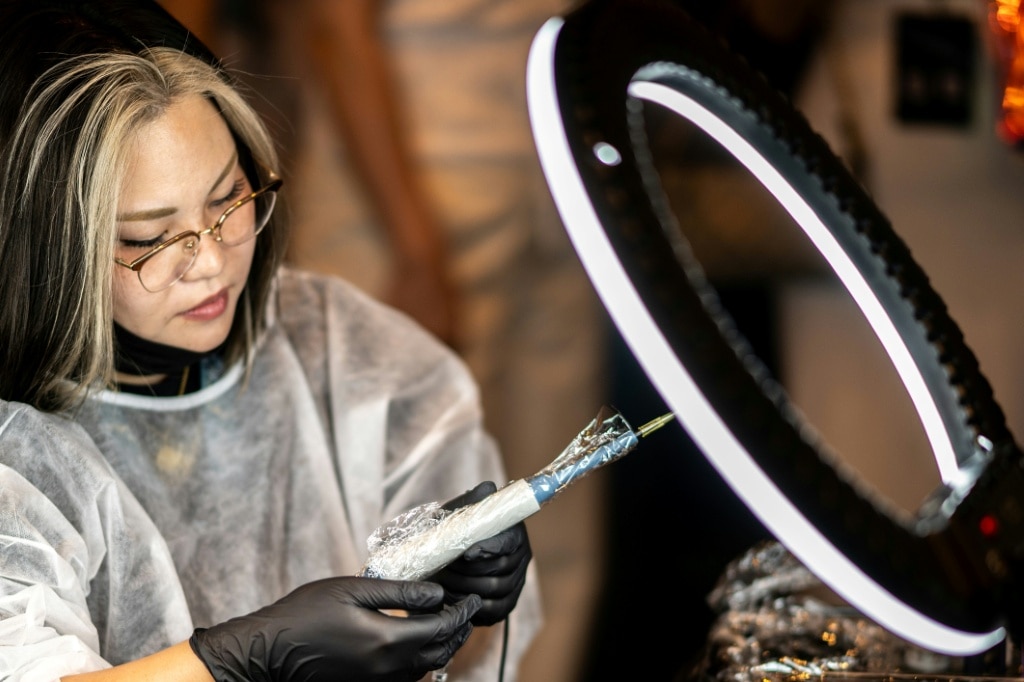
In a sunlit studio in Ginowan, Okinawa, veteran tattoo artist Remy leans over his client Koki Hatanaka, methodically pressing a fine needle to inject tiny dots of pigment into Hatanaka’s bald scalp. The procedure, called scalp micropigmentation (SMP), creates the illusion of dense hair follicles for people living with hair loss — but in Japan, this increasingly popular cosmetic treatment exists in an ambiguous legal grey zone, and non-medical practitioners like Remy now face growing threats of criminal prosecution.
Unlike most of the world, which classifies permanent cosmetics including SMP, eyebrow tinting, and lip blushing as beauty or artistic work, Japan reserves these procedures exclusively for licensed medical professionals. The crackdown has put hundreds of tattoo artists, hairstylists, and beauty specialists across the country in an impossible position: they argue their work relies on aesthetic skill far more than medical training, but regulators insist the use of needles makes it an inherently medical practice.
For Hatanaka, a 28-year-old marine sports instructor who developed sudden alopecia, SMP was life-changing. Before the procedure, the hair loss left him so self-conscious he avoided leaving his home. “If I hadn’t done this, I wouldn’t have become brave enough to strike up conversations with strangers,” he told AFP. “I’m more confident in myself now.” Remy defends the work, noting SMP is barely invasive, far less painful than many routine medical procedures, and often leaves clients relaxed enough to fall asleep mid-treatment. It requires precise artistic instinct to create a natural-looking result, he argues, a skill most medical doctors do not possess.
Japan’s stance on cosmetic tattooing sits in stark contrast to its own recent ruling on decorative body art. In a landmark 2020 decision, the Supreme Court classified traditional decorative tattooing as a non-medical creative practice, a win for artists who had long operated without clinical training. But regulators carved out an exception for cosmetic procedures like SMP, pointing to what they call a long history of physician involvement in the field. A Japanese health ministry official told AFP that needle-based procedures carry enough risk of bodily harm that they require medical expertise. In a warning issued most recently in December, the ministry confirmed it can file criminal complaints against unlicensed practitioners, a move healthcare law expert Akihiro Saotome says “essentially signals arrest” and has had a significant chilling effect on the industry.
Despite the legal threats, dozens of unlicensed cosmetic tattoo artists continue to operate openly, and many have organized to push for regulatory reform. Last month, Remy’s own SMP brand Scalp Ink hosted a large industry convention in Okinawa, drawing dozens of beauty specialists from as far as South Korea, Vietnam, and Sweden. Attendees demonstrated their techniques on models, surrounded by banners framing practitioners as creative innovators. They point out that cosmetic tattooing penetrates the skin far more shallowly than traditional decorative tattoos, meaning it carries even less inherent risk — so if decorative tattooing is classified as non-medical, cosmetic tattooing should be too. Both industries follow the same strict hygiene and safety protocols, they argue, making the legal distinction arbitrary.
“I’m doing nothing I should be ashamed of,” said Tatsuki Miyahira, an Okinawan tattooist who offers SMP without a medical license. If he were raided by authorities, he says he would openly show regulators his studio and walk them through every safety precaution he has in place. “If Japan officially declared SMP art, I think I can hold my head even higher,” he added.
Many in the industry trace the regulatory stigma back to Japan’s complicated cultural history of tattoos. For centuries, tattoos were associated with criminal punishment, and in modern decades they became closely linked to yakuza organized crime syndicates. Even today, tattoos are often banned from public spaces including hot springs and gyms, and far fewer Japanese people have tattoos than people in Western countries, though attitudes are slowly shifting. Industry operators say this lingering negative cultural association has spilled over to affect how cosmetic tattooing is perceived by regulators.
“Nowadays lots of people get their bodies inked just for fashion in Japan,” said Yasuaki Sameshima, a 41-year-old SMP business owner. “But tattoos of a different kind existed before. I think their negative image is spilling over and shaping the way SMP is perceived today.”
South Korea, another country that long penalized non-medical practitioners for offering permanent cosmetics, recently changed course: last year, Seoul passed a landmark law decriminalizing the practice. That leaves Japan as one of the only remaining developed nations with this strict ban in place. For practitioners like Michiko Shinmasu, a 50-year-old hairstylist who also does eyebrow tattooing, the legal limbo does not just hurt practitioners — it makes clients uncomfortable too. “The lack of legal endorsement makes my clients feel as though they’re doing something wrong,” she said. “They’re like, ‘this is grey-zone, right?’”
Even as practitioners push back against medical control of the industry, most agree that complete deregulation is not the answer. Remy, who has led calls for reform, acknowledges that poor practice can carry a risk of infection, and clients deserve protection. Instead of forcing cosmetic tattooing under medical regulation, he is calling for Japan to create a dedicated licensing framework specifically for all tattoo artists, both decorative and cosmetic. Currently, no such license exists in Japan, leaving the entire industry in an unregulated grey zone. To address this gap, Remy founded the Japan Tattoo Hygiene Association, which provides standardized training and accreditation for tattoo artists, with the goal of making its program mainstream and eventually mandatory for all tattoo parlors. “Every country has some kind of licence specifically for doing tattoos, but Japan hasn’t created that,” Remy said. “I believe that’s the best way to protect clients and to ensure that tattoos are done under proper hygiene management.”