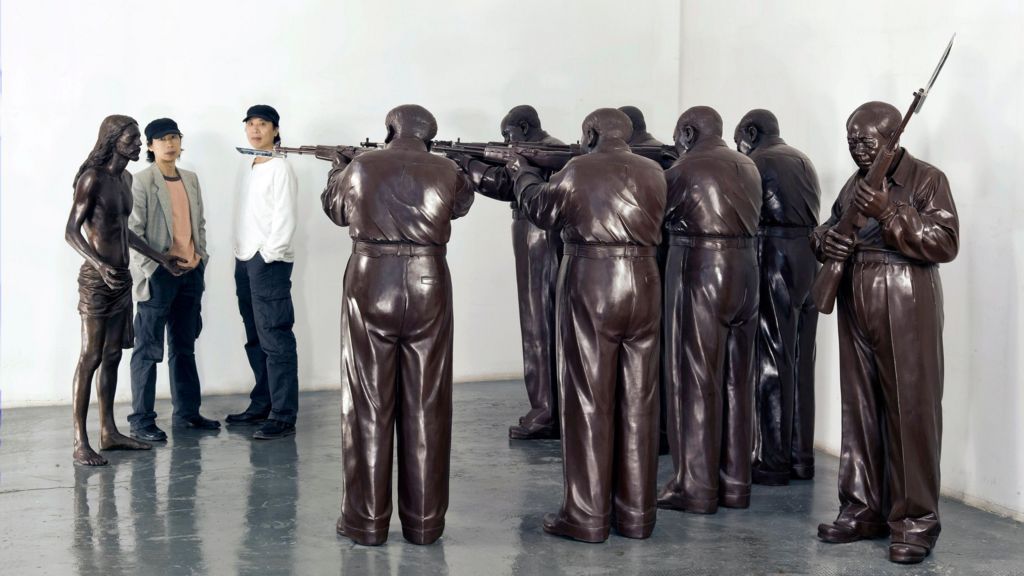
### Background: The Gao Brothers’ Decades of Provocative Artistic Practice
Gao Zhen and Gao Qiang, the sibling contemporary art duo, first rose to public attention in China’s domestic art circle during the 1990s and early 2000s, eventually building a global reputation for bold, satirical works that challenge the political legacy of their home country. For the brothers, the legacy of Mao Zedong – founder of the People’s Republic of China, whose rule oversaw decades of traumatic upheaval including the Great Famine and the Cultural Revolution that killed tens of millions – has been a persistent thematic core. Their own family bore direct trauma from that era: their father was labeled a class enemy during the Cultural Revolution and detained in an extrajudicial facility, a personal grievance that has shaped their creative output.
Among their most controversial works are two pieces created for exhibition in 2009: *The Execution of Christ*, a bronze sculpture that depicts Jesus Christ at gunpoint, with every member of the firing squad sculpted in the likeness of Mao, and *Mao’s Guilt*, a life-sized statue of the former leader kneeling in a pose of supposed contrition. For most of their decades-long career, these works did not draw severe official punishment. That landscape shifted dramatically after 2012, when Xi Jinping took power and began a widespread contraction of space for independent creative expression across China’s cultural sectors. In 2021, Beijing strengthened criminal statutes banning insult to the country’s “revolutionary heroes and martyrs,” a category that places Mao above all other figures as an untouchable symbol of the Chinese Communist Party (CCP)’s legitimacy. Soon after the amendment passed, Gao Zhen – who by that point had already relocated to New York as a permanent resident, leaving his brother based in China – left the country for the U.S. in 2022.
### The 2024 Arrest and Secret Trial
Fifteen years after the controversial sculptures were first exhibited, the long-simmering legal reckoning arrived. While visiting family in Beijing in mid-2024, 69-year-old Gao Zhen was taken into custody directly from his suburban studio. In the immediate aftermath of his arrest, Chinese authorities seized all of his stored artworks and imposed an exit ban on his wife and 7-year-old son, barring them from leaving the country. Last month, Gao was tried behind closed doors on charges of “insulting revolutionary heroes and martyrs” – a criminal offense that carries a maximum penalty of three years imprisonment.
The trial has received almost no uncensored coverage within China, where most domestic state-aligned media have framed Gao as a fraud who “caters to Western political interests” by producing work that defames revered national figures. But Gao Qiang, the younger brother who remains connected to the case, says the trial sends an unambiguous warning to all creators in China and beyond. “Even if a work was made 15 years ago, it can still be turned into a crime if today’s political climate changes,” he told the BBC in an interview, adding that the prosecution of his brother is part of a broad, accelerating crackdown on dissident expression that touches visual arts, cinema, music, literature and digital online content.
China’s central government has not issued any public comment on Gao’s case or the trial. But independent China analysts say the case exposes a growing pattern of increasingly extreme political control by the CCP, which now polices expression both retroactively – prosecuting work created years or decades earlier under new legal standards – and transnationally, targeting creators even when they reside outside of China’s borders.
### Broader Context: The Deepening Crackdown on Creative Dissent
Pulitzer Prize-winning journalist Ian Johnson, who has spent decades documenting political repression in China, argues that the current era represents “probably the darkest period of time in decades” for artistic and expressive freedom under CCP rule. “In the half-century since the Cultural Revolution ended in 1976, this is the most prolonged crackdown that we’ve seen – far eclipsing the period after the Tiananmen massacre in 1989,” Johnson notes, adding that the CCP is now less willing than ever to tolerate even mild criticism of its top leaders.
Many observers link the CCP’s growing boldness in cracking down on dissent to shifting global political norms. As democratic standards erode across much of the world, analysts say Beijing has calculated that it can pursue aggressive repression without meaningful pushback from Western nations that have increasingly stepped back from defending global human rights standards. This month, the United Nations Office of the High Commissioner for Human Rights joined a growing coalition of international advocacy groups to call for Gao’s immediate release, noting that his case “raises concerns with regard to retroactive application of criminal law and use of criminal sanctions to punish artistic expression.”
Beyond threats to expressive freedom, grave concerns have emerged over Gao Zhen’s physical health while in custody. Gao lives with multiple chronic conditions, including lumbar spine disease, arthritis, degenerative eye problems, and chronic urticaria, an inflammatory skin condition that causes persistent painful rashes. According to Gao Qiang, his brother has met with his legal counsel while confined to a wheelchair on multiple occasions, has frequently been too unwell to get out of bed, and has shown visible signs of malnutrition. Repeated requests from his legal team to grant him medical bail have all been rejected by authorities, leaving his younger brother warning that the risks to his life are “grave.”
For the CCP, the sensitivity around criticism of Mao stems from the ideological foundations of the party’s rule. While the party officially acknowledges some of Mao’s mistakes, it maintains his status as a sacred founding figure, and any public challenge to his legacy is seen as an implicit challenge to the CCP’s own right to rule. That dynamic has led to a steady stream of artists, writers and activists being targeted for violating unwritten rules around discussing national leaders: high-profile cases include Ai Weiwei, the internationally renowned artist detained on “economic crime” charges in 2011 after voicing support for pro-democracy protests, and Liu Xiaobo, a human rights activist and Nobel Peace Prize laureate who died in custody in 2017 after being imprisoned for organizing a pro-democracy manifesto.
In recent years, the CCP’s dragnet for dissident expression has expanded far beyond China’s own borders. “Artists and writers have long been in the Chinese government’s crosshairs – but the authorities are now extending that reach beyond physical borders,” explains Sophie Richardson, spokesperson for the Network of Chinese Human Rights Defenders. Beyond punitive measures like exit bans for family members of exiled creators, Richardson says Beijing now regularly pressures foreign cultural institutions to censor works critical of the CCP, part of a global campaign to curtail independent artistic expression.
### The Unprecedented Nature of Gao’s Case
Gao Zhen’s prosecution is notable even in the context of the CCP’s ongoing crackdown because of its retroactive application: the works in question were created and exhibited 15 years ago, years before the strengthened legal statute under which he is now prosecuted. What is more, observers note that Gao never directly called for the overthrow of the CCP or openly criticized current leader Xi Jinping, placing him outside the category of “classic dissidents.”
“Even if he’s not a classic dissident, the Party is now so sensitive toward history that it felt it had to detain and try him,” Johnson explains.
That growing boldness is felt acutely by exiled dissident artists already living outside China. Badiucao, a Shanghai-born artist based in Melbourne who has built a global reputation for works critical of the CCP and Xi Jinping, says the arrest of Gao Zhen demonstrates that the CCP no longer hesitates to wield power openly even when it draws international attention. “It is really determined to wield power without hesitation, compared with old times,” he says, adding that the shift is rooted in global political changes. “I do not feel safe every day, because now I know the Chinese government do not care about international reputation anymore.”
Beijing’s decision to hold Gao’s trial entirely behind closed doors, barring even family members and foreign diplomats from attending, exposes the regime’s discomfort with public scrutiny, according to Gao Qiang. “If exposed to public view, the legal weakness, political vindictiveness, and symbolic nature of the prosecution would become impossible to hide,” he says. Badiucao echoes that analysis, noting that an open trial would paradoxically bring global attention to the very works Beijing is trying to suppress: “That’s the paradox when you’re trying an artist. Because at the end of the day, the reason why we create art is we want it spreading one way or another. A public trial is almost like a national or international show in MoMA: now the whole world will know which work is particularly offensive to what leader.”
Despite Beijing’s efforts to sidelined the case, Gao Qiang is calling on the global community to keep attention on his brother’s prosecution. “This is about far more than the fate of one Chinese artist – it is a test of freedom of expression, historical memory, and the most basic boundaries of the rule of law,” he says. If the international community responds to Gao’s prosecution with silence, he warns, it will set a dangerous global precedent: “that a state may retroactively redefine the meaning of art and turn satire, reflection, and memory themselves into crimes. Gao Zhen is under threat today; tomorrow it could be any writer, filmmaker, musician, or critic.”