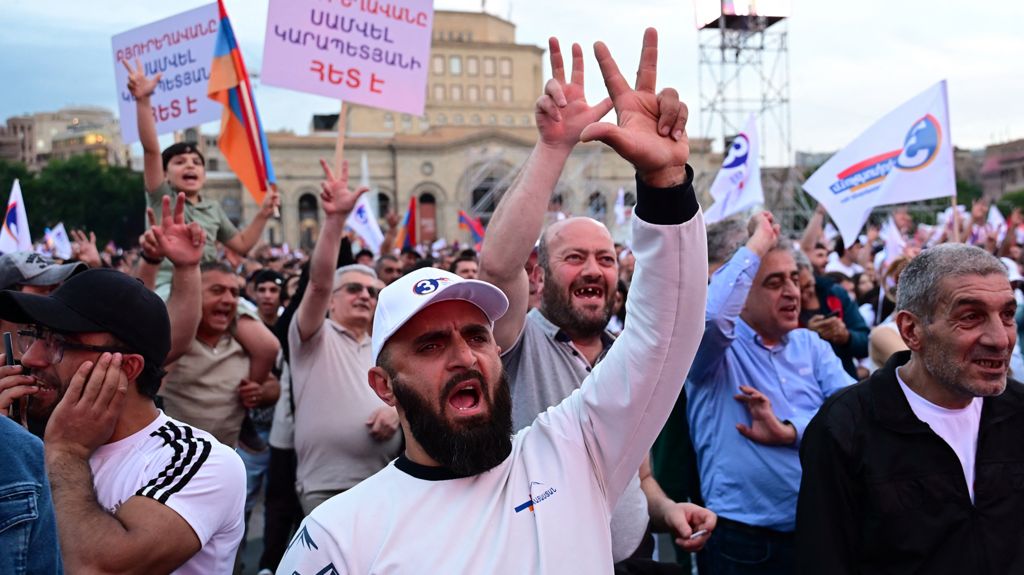
As Armenia prepares for its critical parliamentary election on June 7, the small South Caucasus nation of 3 million people finds itself caught in a sharp geopolitical standoff between Moscow and the Western bloc. At the center of the contest is incumbent Prime Minister Nikol Pashinyan, who is seeking re-election on a platform of deeper European integration, a policy that has drawn escalating economic pressure from Russia, Armenia’s longstanding largest trading partner.
Pashinyan’s shift toward the West has defined his tenure since he rose to power in the 2018 revolution. Over his time in office, he has overseen a steady reorientation of Armenia’s foreign policy: passing legislation to launch the EU accession process, advancing a US-brokered peace deal with neighboring Azerbaijan that earned him an endorsement from former US President Donald Trump, and hosting a high-profile summit of EU leaders and Ukrainian President Volodymyr Zelensky in Yerevan earlier this year. But his policy concessions to Azerbaijan over the disputed Nagorno-Karabakh region have become his biggest domestic liability.
The mountainous enclave, once home to 120,000 ethnic Armenians, was seized by Azerbaijani forces in 2023. Pashinyan’s willingness to cede control of the region and his refusal to push aggressively for the release of detained former Nagorno-Karabakh leaders has left a deep rift in Armenian politics. Recent polling shows public opinion on the peace deal is deeply split, with 44% supporting the agreement and 41% opposing it. Pashinyan’s approval rating has plummeted from 54% in 2021 to roughly 30% today, opening the door for a fragmented but formidable opposition.
The opposition bloc is led by two former Armenian presidents, Robert Kocharyan and Serzh Sargsyan, both fixtures of the pre-2018 political order that maintained close alignment with Moscow. Their core platform calls for a full restoration of deep military and economic ties with Russia, framed as the only guarantee of Armenia’s national security. Pashinyan’s most high-profile challenger is Russian-based billionaire Samvel Karapetyan, who is currently under house arrest on charges of plotting to overthrow the government and is running his campaign through his nephew.
Latest polling from the International Republican Institute puts Pashinyan’s Civil Contract party ahead with 32% of the vote, while nearly 40% of registered voters report trusting no political candidate at all. While the combined opposition could match Pashinyan’s support if unified, their fragmented structure leaves them unlikely to defeat the incumbent on election day.
Looming largest over the vote is direct interference from the Kremlin. In the lead-up to June 7, Russian President Vladimir Putin has explicitly warned Armenia of the economic consequences of moving closer to the West, drawing a parallel to the crisis in Ukraine that he linked to EU accession efforts. Those warnings have been followed by tangible trade measures: in the two weeks before the election, Russia banned imports of key Armenian exports including flowers, cognac, mineral water, and fresh produce.
Russia remains Armenia’s top trading partner, accounting for 36% of the country’s total foreign trade in 2025. Haykaz Fanyan, a senior analyst at the Armenian Centre for Socio-Economic Studies, confirmed that Moscow’s actions are a deliberate attempt to sway the election outcome. “The only way Russia can impact Armenia now is economic,” Fanyan explained, noting that Armenia has already dramatically reduced its dependence on Russian military equipment, with 95% of recent military imports coming from India, France, China and other partners. Still, economic leverage remains a powerful weapon for the Kremlin: Russia supplies Armenia with natural gas at $177.50 per 1,000 cubic meters, far below the European market price of more than $600 that Pashinyan would face if ties with Moscow break down completely.
Putin has also publicly pressured Pashinyan to hold a national referendum on whether Armenia should leave the Russian-led Eurasian Economic Union (EAEU) — a customs bloc that delivers significant economic benefits to the country — to pursue EU membership. Pashinyan has avoided the challenge, noting that Armenia has not yet secured EU candidate status and full membership remains a distant long-term goal. “We will continue to work within the EAEU until the choice between its current membership and the EU becomes unavoidable,” he said, framing the current referendum call as purely theoretical.
The EU has not remained on the sidelines in the face of Russian pressure. Shortly before the election, European Commission President Ursula von der Leyen pledged €50 million in new support for Armenia, explicitly accusing Moscow of “weaponising economic relations for political pressure” and announcing that the EU would ease trade barriers for the Armenian goods targeted by Russian import bans.
Pashinyan has centered his campaign around the slogan “Stand for Peace!”, but the election cycle has been marked by bitter domestic confrontation, most notably between the prime minister and displaced ethnic Armenians from Nagorno-Karabakh. One high-profile incident saw Pashinyan use offensive language against civil activist Artur Osipyan, who was subsequently arrested on charges of obstructing the campaign and launched a hunger strike in protest. Opposition figures have accused Pashinyan of increasingly authoritarian tactics, including misusing state resources to pressure civil servants into attending his rallies and spreading a climate of fear among voters. “I cannot remember any campaign as tense as this one,” said Artur Khachatryan, an opposition MP from the Armenia Alliance.
For Pashinyan, the campaign rests on his vision of a “Real Armenia”: a country at peace with Azerbaijan, integrated into European institutions, and free from the corruption and authoritarianism that marked the pre-2018 order. While his support has fallen sharply, many voters still see him as the only alternative to a return to the old Kremlin-aligned system. For ordinary Armenian voters heading to the polls, the core question transcends simple geopolitical framing: are they willing to bear the immediate economic costs of Pashinyan’s pro-Western shift, costs that Russia has deliberately amplified, for a European future that remains years or decades away? On June 7, Armenian voters will deliver their answer.