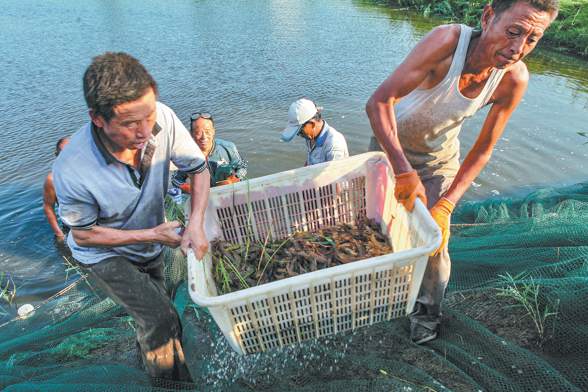
In Boxing County, Shandong Province, vast stretches of once-barren saline-alkaline land have been ingeniously transformed into a flourishing modern aquaculture base. This remarkable transformation is a result of coordinated development efforts in low-lying areas along the Yellow River, turning ecological challenges into lucrative economic opportunities. Over the past two decades, Boxing County has accelerated the large-scale conversion of these unproductive lands, constructing standardized ponds, industrial aquaculture facilities, and essential infrastructure such as water conservancy systems, roads, and power supply networks. This has led to the establishment of integrated modern fisheries zones. Qiaozhuang Town, a pioneer in this initiative, began experimenting with shrimp farming as early as 2001. By mixing Yellow River water with local saline groundwater, farmers successfully adapted shrimp to the local conditions. ‘Our village sits on reclaimed coastal land which is highly saline, where only weeds grew and crops barely survived. We were once known for poverty,’ said Song Chun, Party secretary of Wangping Village in Qiaozhuang. ‘Now, nearly every household raises shrimp, and lives have improved dramatically,’ he added. Qiaozhuang has established a complete industrial chain, from seedling acclimation and feed supply to disease control, cold storage, processing, and sales. On average, each household manages two or three shrimp ponds, with annual earnings exceeding 100,000 yuan ($14,055). The town continues to innovate, introducing an intelligent recirculating aquaculture system that automates feeding, waste removal, and harvesting. An online water-quality monitoring system tracks key indicators in real time, ensuring a healthy aquatic environment. Today, Qiaozhuang boasts 38,000 mu (about 2,533 hectares) of shrimp ponds, generating an average annual income of 17,000 yuan per mu. Wang Jingdong, deputy director of the Shandong Provincial Department of Agriculture and Rural Affairs, emphasized the provincial strategy: ‘We adhere to a coordinated approach that balances grain, economic crops, and forage production, while promoting agriculture, animal husbandry, and fisheries in parallel. By developing distinctive saline-alkaline agriculture, we are turning a ‘barren crust’ into ‘golden nuggets.’