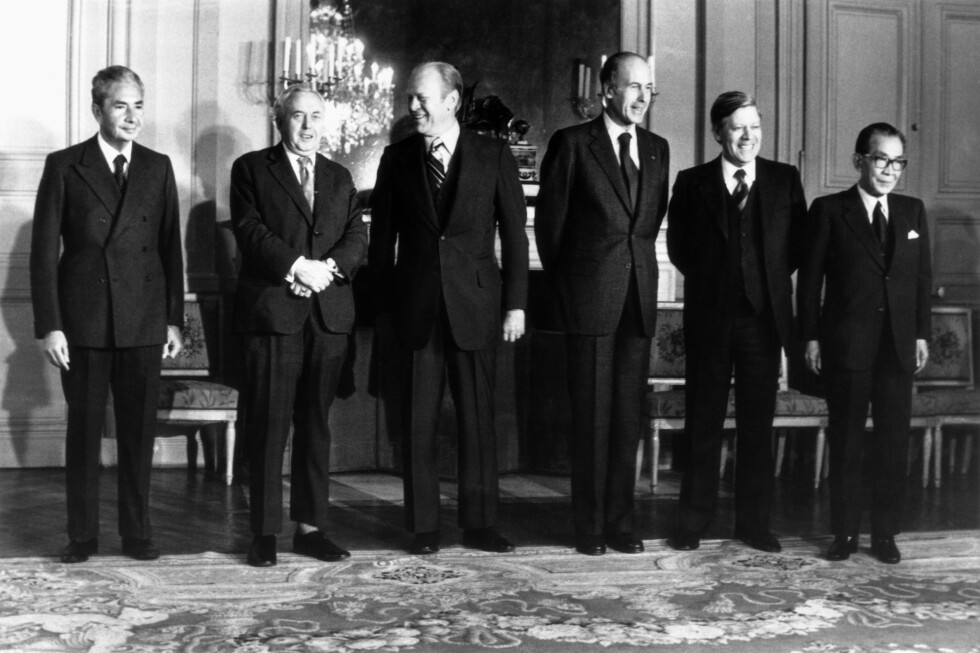
Fifty years after the first gathering of top Western industrial leaders that laid the foundation for one of the world’s most influential global policy blocs, the upcoming G7 summit in France has drawn fresh attention to the historic 1975 meeting that started it all. On November 15, 1975, U.S. President Gerald Ford joined the heads of government from France, West Germany, the United Kingdom, Italy, and Japan for three days of closed-door economic brainstorming at the Château de Rambouillet, a sprawling 14th-century royal retreat 30 miles outside Paris. That initial gathering of six nations would expand one year later with the addition of Canada, giving rise to the Group of Seven, a bloc that would shape global economic, diplomatic and security policy through the Cold War and beyond. To mark the upcoming 2024 summit, the Associated Press is republishing key excerpts of its original on-the-ground reporting from the 1975 inaugural summit, filed by veteran correspondent Arthur L. Gavshon.
Opening the first session of the summit against the backdrop of Rambouillet’s gilded royal history—where Louis XV once relaxed and Napoleon Bonaparte spent his final night in France before exile to Saint Helena—President Ford laid out an ambitious goal for the assembled leaders: pull the global economy out of a crippling mid-1970s slump and return to full prosperity by 1977. A senior presidential aide told reporters that Ford categorically rejected the growing narrative that major industrial economies could never return to the pre-recession growth rates that had defined the post-war decades. He added that the U.S. economic recovery was already outpacing early forecasts, projecting that American growth would hit between 6% and 7% through 1976.
After nearly three hours of open, informal talks, the leaders adjourned for dinner, and host French President Valéry Giscard d’Estaing offered an early optimistic assessment to waiting reporters. “I am optimistic. I think we can arrive at something concrete,” he said. A French presidential spokesperson echoed that positivity, noting that the leaders had already achieved a “remarkable convergence of views” on core challenges. Senior British officials signaled a growing consensus among attendees that the worst of the global downturn had already passed, while U.S. Secretary of State Henry A. Kissinger echoed the upbeat tone, telling reporters the first day of talks “went very well.”
True to the French government’s deliberate low-key framing of the event as a working seminar rather than a lavish state occasion, the opening night dinner was intentionally simple, a stark departure from the opulent banquets that usually mark high-level French state events. Stuffed chicken served with solid but unexceptional French wine was the featured main course, a deliberate choice aligned with the gathering’s focus on practical problem-solving over pomp. Even the attire of the participating leaders reflected this casual working tone: Giscard d’Estaing wore a soft greenish tweed weekend suit, West German Chancellor Helmut Schmidt opted for a casual light gray suit, and only Ford dressed in more formal attire—a dark blue three-piece suit paired with a white shirt.
The event’s organizers pulled out all stops to prepare the historic chateau for the high-profile gathering, hauling priceless art, furniture and statuary from the Louvre Museum in Paris to restore the chateau’s stately rooms, with moving crews working into the early hours of Saturday morning to finish setup. More than 3,000 armed French police officers were deployed across the chateau’s hundreds of acres of wooded grounds and manicured gardens to secure the meeting. Each leader was assigned a custom-furnished private apartment in the chateau: Ford took the top suite in the Francois I tower, the chateau’s most comfortable quarters, outfitted with a Spanish-made bed, a working fireplace and a direct hotline to the White House. Harold Wilson of the UK received a mahogany-and-satin suite overlooking the garden ponds, Takeo Miki of Japan took a wood-beamed apartment with period Louis XVI furniture, Helmut Schmidt stayed in a Directoire-style suite, and Aldo Moro of Italy was assigned rooms decorated in Empire-era furnishings.
A number of key priorities emerged from the first day of discussions. Japanese Prime Minister Takeo Miki, who opened his remarks by noting that Japan’s export-reliant economy had been hit particularly hard by collapsing global trade, immediately pushed the group to prioritize commitments to expand and liberalize cross-border international commerce. British Prime Minister Harold Wilson, working through senior aides, called on fellow leaders to back a new, strengthened global non-proliferation framework to slow the spread of sensitive nuclear technology, equipment and weapons. On the second day of the summit, Ford was set to join Giscard d’Estaing and Moro for a religious service at the local Roman Catholic church in the nearby village of Poigny la Forêt, a short 10-minute drive from the chateau.
Unlike large multilateral summits that target binding final agreements, the 1975 Rambouillet gathering was framed from the start as a collaborative working retreat, where leaders would not reach firm final decisions but instead align on shared policy directions to tackle the era’s most pressing economic challenges: double-digit inflation, rising unemployment, and shrinking global trade. White House Press Secretary Ron Nessen told reporters aboard Ford’s transatlantic flight to the summit that the meeting could ultimately deliver tangible benefits to American consumers, noting that the president had always framed the gathering through the lens of practical impacts for everyday households.
Four core policy domains anchored the talks, each highlighting deep shared interests and occasional disagreements between the six nations. The first was long-running Franco-American tensions over reform of the global monetary system: French officials opposed the existing regime of floating exchange rates and pushed for a return to a more rigid fixed-rate system, while the U.S. and UK favored retaining the flexibility of floating rates. Second, leaders aligned around the need for a coordinated common energy policy, with Ford earning broad backing for his argument that industrial democracies could not allow their economic and political futures to be held hostage by oil-producing nations, calling for rapid joint development of new energy supply sources and collective conservation programs. Third, the group discussed the broader global economic outlook and coordinated strategies to curb inflation, which was already eroding political stability in dozens of countries. Finally, leaders debated how to structure more cooperative relationships between three tiers of the global economy: advanced Western industrial nations, newly wealthy oil and raw material exporting states, and the world’s lowest-income developing countries.
Over the decades since that 1975 retreat, the G7 has grown into one of the world’s most consequential global forums, with rotating annual hostings that consistently draw global headlines thanks to the bloc’s combined economic, industrial, military and diplomatic weight.