On a quiet July evening in midtown Manhattan, while much of New York City and the global public were fixated on pop icon Taylor Swift’s star-studded wedding at Madison Square Garden, a shocking act of political protest unfolded on the steps of the United Nations headquarters that went largely unremarked in mainstream U.S. media.
Fifty-two-year-old Lobga Rangzen, a lifelong Tibetan independence activist and long-time U.S. resident, died after setting himself on fire outside the UN building, becoming the first Tibetan to carry out such an act of self-sacrifice on American soil. None of his closest confidants, including a 30-year monk friend and his niece who lived with him in Queens, had any inkling of his plan that day. His niece, 21-year-old Tenzin Choekyi, was watching the World Cup at her home when a friend called with news that her uncle had been burned. Initially assuming it was a minor accident, the full realization of what had happened hit her with overwhelming terror.
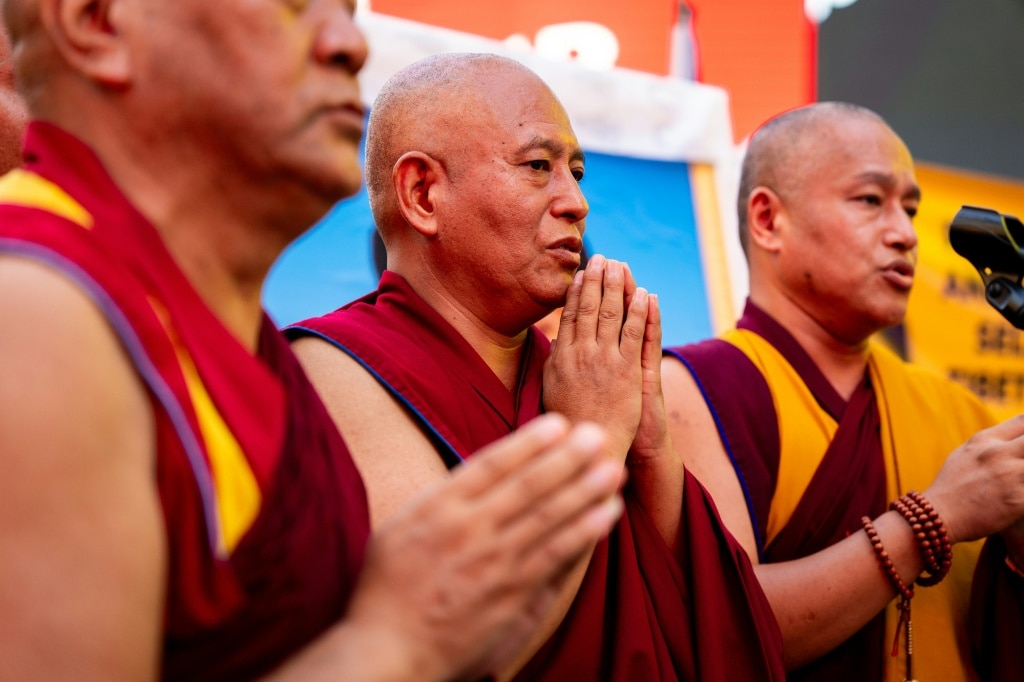
In the hours after his death, fellow exiled Tibetans gathered at the protest site to build a makeshift memorial, piled high with fresh flowers and traditional ceremonial white khata scarves. What began as a space for mourning quickly transformed into a gathering point for Tibetan activists, who have spent decades pushing for global attention to their cause opposing Chinese rule over Tibet. For the exile community, Rangzen’s death carried both deep anguish and profound respect, with many saying his act has reignited their commitment to political action. “His passing has left many of us Tibetans with the fervor to act,” explained Jampa Choedup, a Tibetan monk who first met Rangzen in 1997 and saw him just one day before his death.
Rangzen’s act was not without precedent. He followed in the footsteps of more than 170 Tibetan activists, mostly based inside Chinese-controlled Tibet but also some in Nepal and India, who carried out self-immolations between 2009 and 2022. These acts of last-resort protest began after a bloody Chinese government crackdown on widespread pro-independence demonstrations across Tibet in 2008. Since that time, Beijing has only tightened its political and social control over the region, which China claims as an inalienable part of its sovereign territory. Just one day before Rangzen’s death, Beijing passed a new national “ethnic unity” law that critics warn will further erode basic human and cultural rights for China’s Tibetan and Uyghur minority populations.
Unlike many of his contacts assumed, Rangzen’s act was not a spontaneous impulse, but a carefully planned action rooted in a lifetime of activism. Jigme Ugen, president of the exile Tibetan National Congress, where Rangzen led the New York and New Jersey chapter and was a core organizer of regular protests outside the UN and the Chinese consulate, noted that the activist had spent decades preparing for this step. Footage broadcast live by Rangzen during his protest captures the heavy-set man walking across the street outside the UN wearing a traditional Tibetan chuba robe, planting a Tibetan independence flag in the ground, before bursting into flames that rose twice his height, with thick black smoke billowing into the sky. A UN security guard rushed to intervene with a fire extinguisher, but it was too late. Rangzen was pronounced dead around an hour later at a nearby Manhattan hospital. New York police have confirmed they are still conducting an investigation into the death.
Rangzen was born Lobsang Palden in Tibet, and fled the region as a young man, spending 14 years living as a monk in southern India before resettling in the United States in 2006. He settled in Queens, New York, home to a large community of exiled Tibetans, and changed his name to Rangzen – the Tibetan word for “independence” – to reflect his core political goal. Fluent in Tibetan but not in English, he worked a series of casual jobs before becoming an Uber driver to support himself. Those who knew him remembered him as a joyful, warm person who loved joining weekly traditional Tibetan circle dances called gorshey. He often told friends he was “married to the movement”, and his activism was rooted in family history: two of his uncles fought for Chushi Gangdruk, an anti-China guerrilla force founded in 1958 with CIA backing, with one dying in combat and the other dying in a Chinese prison after being captured. “He grew up with these stories,” Ugen explained.
In a six-minute pre-recorded farewell video released after his death, Rangzen expanded on his motivation, sitting cross-legged as sweat dripped from his brow. “Today, if I engage in alarming activism, it is not because I do not have food, or clothes or out of sadness. I do it for the Tibetan nation,” he said in Tibetan. The day before his death, he had spoken at length with Choedup about the individual responsibility all Tibetans share to work for freedom.
Rangzen’s death has sparked a complex, divided reaction across the global Tibetan exile community. Self-immolation as a protest tactic has placed the Tibetan spiritual leader the Dalai Lama, who has lived in exile in India since 1959 and counts most of the 25,000 Tibetans living in the U.S. as his followers, in a deeply difficult position. Beijing, which argues that Chinese rule has brought dramatic economic and social development to the Tibetan plateau, has long accused the Dalai Lama of glorifying these acts of self-sacrifice. While the Dalai Lama has repeatedly expressed sorrow over self-immolations and questioned whether they advance the Tibetan cause, some scholars have criticized him for failing to take stronger action to discourage the practice.
Following Rangzen’s death, Penpa Tsering, the head of the internationally recognized Tibetan government-in-exile, issued a statement urging all Tibetans to “cherish” their own lives. “While we honor his devotion, human life is precious and must be preserved to serve the long-term struggle for Tibet,” Tsering said. In his own farewell message, Rangzen echoed a similar call, urging exiled Tibetans to continue working to build a free future for their people, adding, “There is no need to mourn for me.”