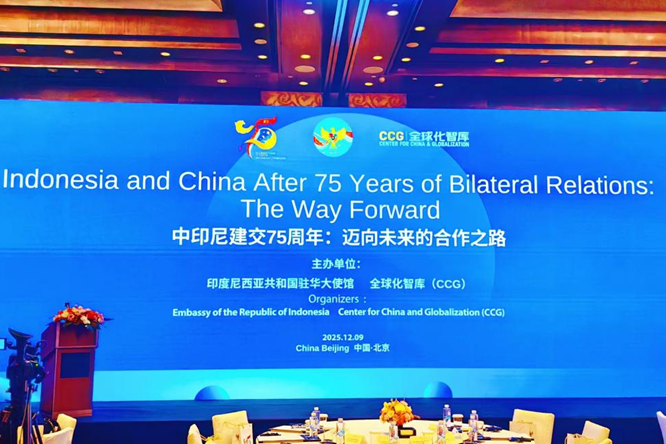
Senior officials and policy experts convened in Beijing this week to chart the future course of Sino-Indonesian relations, marking 75 years of diplomatic engagement between the two nations. The forum, jointly organized by the Indonesian Embassy and the Center for China and Globalization, highlighted the substantial progress achieved through their comprehensive strategic partnership established in 2013.
Indonesian Ambassador to China Djauhari Oratmangun emphasized the remarkable expansion of bilateral cooperation across five fundamental pillars: political coordination, economic collaboration, maritime partnership, cultural exchanges, and security cooperation. Trade relations have demonstrated particularly robust growth, surging from $79 billion in 2019 to $147 billion in the previous year, while China has consistently ranked among Indonesia’s top three investment sources throughout the past five years.
The recent state visit by Indonesian President Prabowo Subianto, who selected China as his inaugural overseas destination following his inauguration, further underscores the strategic significance both nations attribute to their bilateral relationship. Ambassador Oratmangun noted that Indonesia’s recent accession to BRICS presents additional opportunities for enhanced cooperation within this multilateral framework, potentially advancing the collective interests of developing nations while promoting a more balanced global economic architecture.
Academic perspectives from both countries highlighted the relationship’s resilience amid global uncertainties. Xue Song, a researcher at Fudan University’s Institute of International Studies, identified China’s evolving role as Indonesia’s principal partner not only in traditional infrastructure projects but increasingly in downstream industries and digital economy initiatives. The successful implementation of flagship projects like the Jakarta-Bandung High-Speed Railway was cited as evidence of tangible benefits delivered to local communities.
Experts addressed the broader geopolitical context, with Rizal Sukma of Indonesia’s Centre for Strategic and International Studies advocating for continued commitment to inclusive regionalism. He emphasized that Southeast Asia and the wider Asia-Pacific should remain zones of peaceful cooperation rather than arenas for unilateralism or great-power competition.
Xu Liping, Director of the Center for Southeast Asian Studies at the Chinese Academy of Social Sciences, emphasized the shared responsibility of both nations as major Global South countries to contribute to more equitable global governance frameworks. The consensus among participants pointed toward deepened political dialogue, expanded economic cooperation, and enhanced people-to-people exchanges as essential components for future bilateral progress.