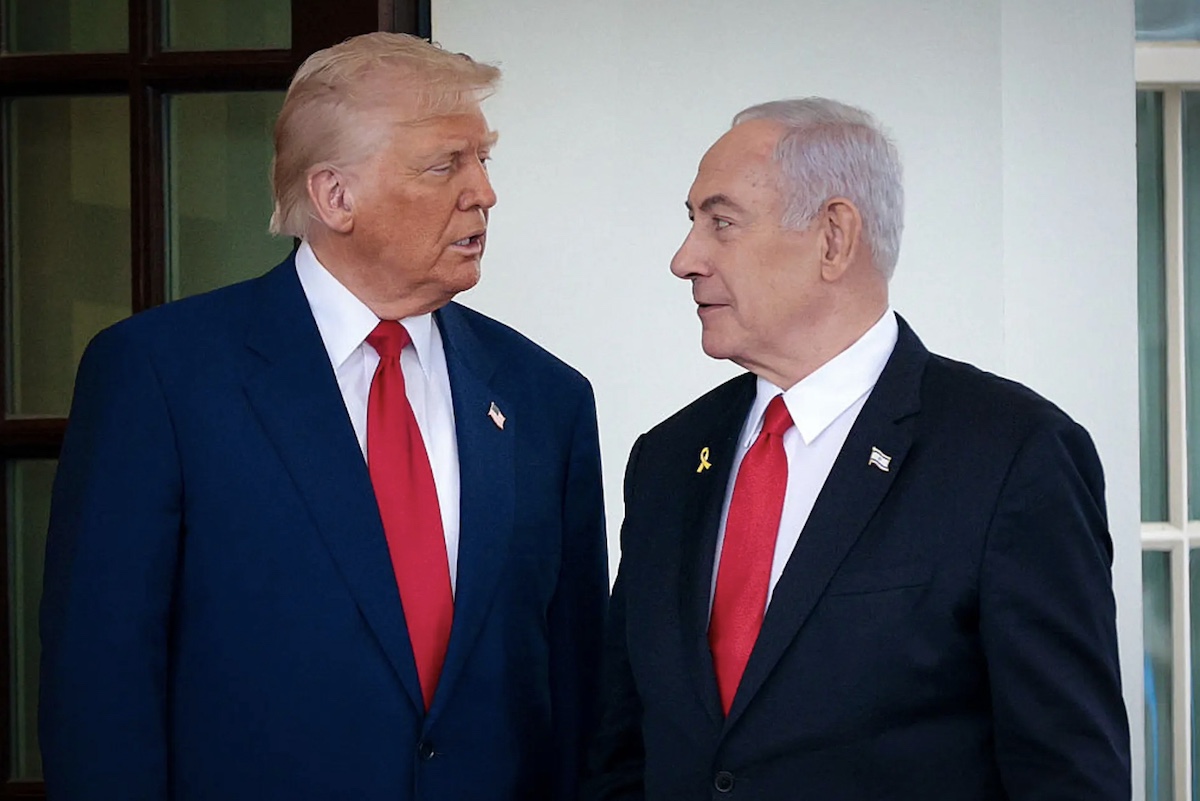
For decades, a familiar ritual has played out between Washington and Jerusalem following every regional crisis, ceasefire agreement, and tense high-stakes conversation between U.S. presidents and Israeli prime ministers. Phrases like “The bond is unshakeable” and “Our commitment to Israel’s security is ironclad” have been repeated across every sitting U.S. administration so many times that they have devolved into diplomatic liturgy: familiar and reassuring on the surface, but largely disconnected from the practical reality of how U.S. policy actually unfolds. The essay argues that Israel’s strategic leadership would benefit from a far more honest examination of this longstanding gap than it has been willing to conduct in the past.
Since Israel’s founding in 1948, the country has occupied a recurring paradox: it is a militarily powerful state that remains deeply diplomatically dependent on its closest, indispensable ally, the United States. For generations, this dynamic has created a persistent gap between what Israel deems critical to its national survival and what Washington is willing to allow. Today, a critical, rarely openly discussed question looms: are shifting structural trends in U.S. domestic politics and grand strategy widening that gap further?
To contextualize this dynamic, look back to a defining moment from 1973. During the Yom Kippur War, after Israeli armored forces had encircled Egypt’s Third Army and the Israeli government was poised to deliver a decisive, war-ending military blow, the Nixon administration intervened to stop the offensive, setting a pattern that would repeat for decades. Henry Kissinger brokered a ceasefire that saved Anwar Sadat’s battered Egyptian forces, cemented Washington’s role as the indispensable regional mediator, and left Israel with a hard lesson it has had to relearn repeatedly: when U.S. and Israeli strategic priorities diverge, Israel is always the side expected to defer.
Operation Nickel Grass, the large U.S. airlift that resupplied Israeli forces during the war, was a meaningful and consequential show of support. But it also locked in a relationship of dependency: a state cannot accept critical military resupply from a patron and then reject the political terms that come attached to that aid. This is not an inherent critique of U.S. statecraft, but rather a straightforward observation of how great-power patronage has always functioned. Ancient Athens relied on client states, Rome governed through client kings, and modern Washington maintains a network of allies that ultimately advance the patron’s core interests, not the other way around.
What has shifted dramatically in recent decades is the strategic context in which U.S. patronage is offered. Washington’s current grand strategy is focused on great-power competition with China, requiring that it redirect the vast majority of its military resources and diplomatic attention to the Indo-Pacific, rather than remaining entangled in open-ended conflicts in the Middle East. This shift is not tied to a single ideological stance or political administration; it is a fiscal and strategic reality that has persisted across changes in partisan control of the White House. Every recent Pentagon planning framework, regardless of who occupies the Oval Office, prioritizes potential flashpoints in the Indo-Pacific: the Taiwan Strait, the South China Sea, and the broader arc of competition with Beijing. What was once the central, consuming obsession of U.S. foreign policy, the Middle East, has been reclassified as a secondary distraction from the primary great-power competition.
Even among proponents of a close U.S.-Israel relationship, Israel’s value as a strategic partner is increasingly being questioned by pragmatic, realist analysts who note that core U.S. interests in the region—from energy security to counterterrorism to great power competition—can often be advanced more effectively through alliances with Arab states that do not carry the same domestic political baggage that comes with the U.S.-Israel relationship. This line of thinking is expected to gain more traction in coming years, regardless of which party controls power in Washington.
Beyond the shifts in global strategy, deep domestic political changes in the U.S. are also reshaping the alliance, and these shifts may prove the most consequential of all. For decades, U.S. support for Israel rested on a solid bipartisan consensus that has now fractured visibly. American public opinion, particularly among younger generations of voters and racial minority groups, has grown increasingly skeptical of unconditional, blank-check support for any foreign nation, Israel included. In democratic politics, demographic change drives long-term political outcomes, and the demographic cohorts most skeptical of unwavering support for Israel are the groups that will shape the future of both major U.S. political parties.
Currently, the U.S. provides Israel with $3.8 billion in annual military aid under a bilateral memorandum of understanding that expires in 2028. When the agreement comes up for renegotiation, it will take place in a domestic political environment dramatically different from the one that produced the original deal. While the current aid package remains politically untouchable in today’s Washington, it is exactly the type of foreign spending that America First-aligned voters and political movements have increasingly called into question.
None of these shifts mean that the United States is on the verge of a sudden, complete break with Israel. The relationship is too deeply embedded in U.S. institutional, cultural, and political structures to collapse overnight. The U.S. will remain Israel’s closest ally for the foreseeable future, and its support remains a core pillar of Israel’s national security, granting access to advanced weapons systems, intelligence sharing, defense technology cooperation, and critical diplomatic protection at the United Nations Security Council.
But a guarantee that the U.S. will not abandon Israel is not equivalent to a guarantee of unconditional support on every issue. Israel’s leaders must recognize this critical distinction and adjust their long-term strategic planning accordingly. The lesson from every past crisis is clear: Washington will support Israel up to the point that support conflicts with its own broader national interests. At that juncture, calls from the U.S. Secretary of State grow more insistent, military resupply shipments come with new strings attached, and the so-called “ironclad commitment” is revealed to have practical limits.
What conclusion should clear-eyed Israeli strategists draw from this analysis? It does not mean the alliance is worthless—on the contrary, it remains enormously valuable to Israel. But its value is contingent, transactional, and subject to change driven by forces outside of Jerusalem’s control: shifts in U.S. electoral politics, changing generational attitudes toward foreign policy, intensifying great-power competition, and the enduring U.S. ambition to act as the primary Middle Eastern mediator, a role that often requires concessions from Israel.
For Jerusalem, every ceasefire ultimately brings a morning of reckoning. What strategic gains did Israel secure? What critical goals were left unmet? What long-term costs will stem from the terms Washington imposed? These are the questions that outlast any immediate crisis.
Israel’s long-term security cannot be built on the assumption that any U.S. administration will always prioritize Israeli needs over its own core national calculations. A clear, unsentimental reading of the historical record offers no support for that assumption. The uncomfortable, unavoidable answer to the question of whether Israel can count on U.S. support over the long run is this: yes, as a reliable partner—but never as an unconditional guarantor.
This distinction carries enormous stakes for Israeli national strategy. The sooner Israel’s strategic establishment internalizes this reality, the sooner it can prioritize the critical work of building alternative strategic foundations: deeper diplomatic and economic ties with regional partners, greater strategic self-sufficiency, and a more diversified foreign policy that does not rely on a single patron whose top priorities will always be its own.