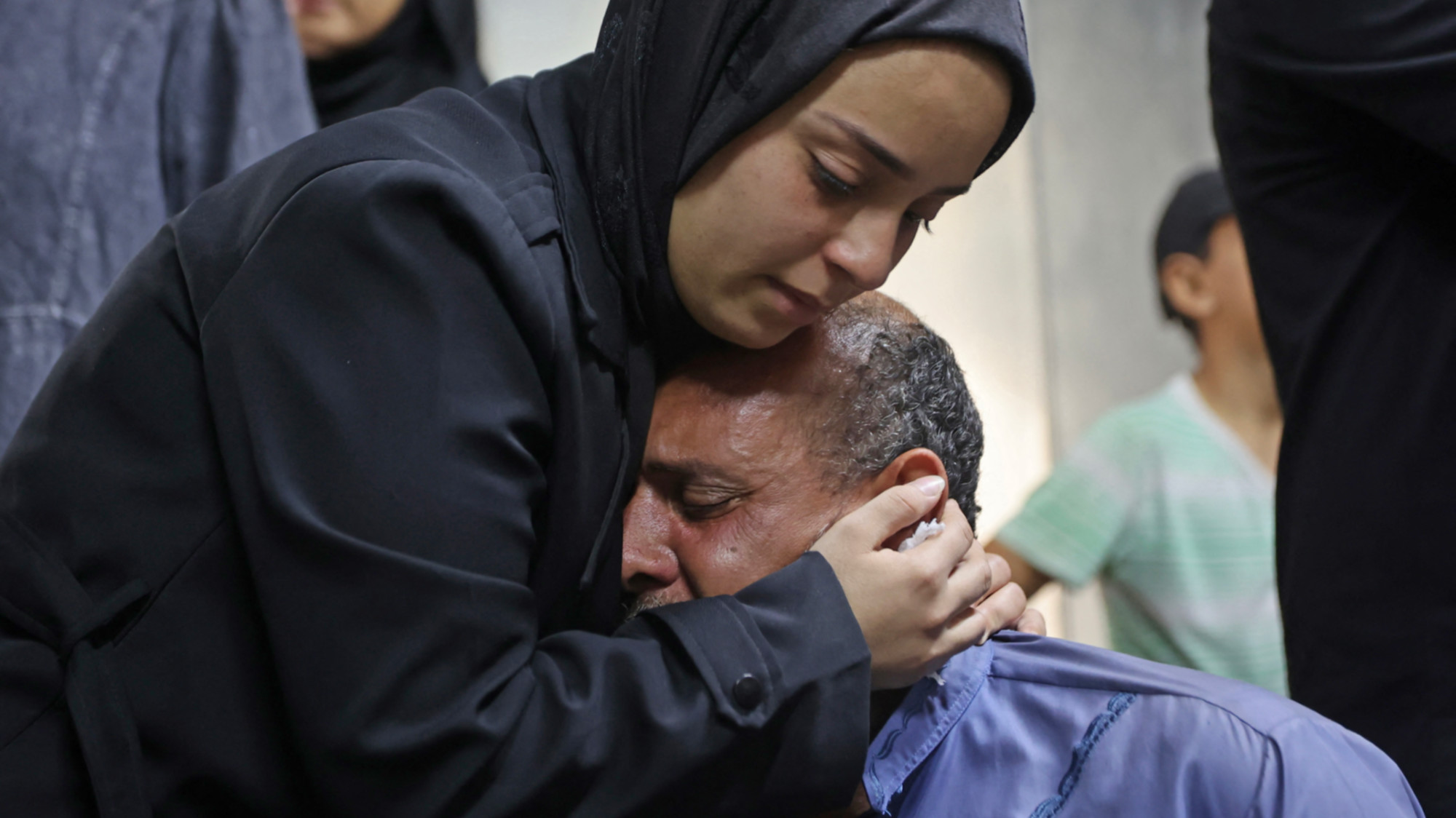
The tragic case of Muhammed Abu Khammash, a 29-year-old Palestinian father of three with long-standing severe psychosis, lays bare the deadly human cost of Israel’s post-October 2023 military controls and territorial division of the Gaza Strip, even after the formal ceasefire took hold.
For years before the war began, Muhammed’s family managed his condition — marked by paranoia, delusions, and unpredictable episodes — with consistent care from the Gaza Community Mental Health Centre. During acute episodes, he would receive 2 to 4 weeks of inpatient monitoring and treatment that kept his symptoms stable. But when Israel launched its military campaign in October 2023, relentless airstrikes and widespread attacks on Gaza’s healthcare infrastructure destroyed access to this life-sustaining care. Forced to flee their home and live in overcrowded displacement tents, Muhammed’s relatives became his sole caregivers.
As the war dragged on, Muhammed’s mental state deteriorated dramatically. Two devastating family losses pushed his condition past the breaking point: first, 20-year-old brother Marwan was killed by Israeli forces while trying to collect flour for the family during Gaza’s worsening hunger crisis, and four months later, another younger brother Osama died in an Israeli airstrike while securing aid for a local orphanage. Grief unmoored Muhammed completely. He began repeatedly begging for death, shouting Osama’s name, and attempting to slip away to the Yellow Line — the de facto boundary that splits Gaza into Israeli-controlled and Palestinian-held territories — saying he wanted to find his brother or avenge his death.
Nine family members took turns standing constant watch over Muhammed to stop him from entering the restricted zone, a precaution that reflected the well-known risk: any Palestinian who approaches or crosses the Yellow Line is routinely shot on sight by Israeli soldiers. Yet even round-the-clock care could not hold him forever. One day, Muhammed slipped away from his family’s camp. He never came back.
The Yellow Line, established by Israeli forces on October 10, 2023, divides more than 60% of Gaza’s total territory off-limits to most Palestinians, confining the enclave’s population of roughly 2 million people to a shrinking sliver of land where overcrowding and humanitarian need have reached catastrophic levels. Israeli forces have marked the boundary with yellow concrete blocks, in some cases extending the restricted zone further into Palestinian-held territory than the original line. Dozens of Palestinians have been killed along the boundary since the ceasefire went into effect, and the true death toll remains unknown because Israeli restrictions bar families and humanitarian workers from recovering most victims’ remains, leaving bodies to decompose in open areas for weeks or months.
Three days after Muhammed disappeared, his father Oda Abu Khammash received the devastating confirmation: Muhammed had walked toward the Yellow Line, and Israeli soldiers had fired a shell that killed him instantly. What followed was a weeks-long ordeal to retrieve his body that Oda says was more painful than the loss of his son itself.
Access to the killing zone was completely blocked by the Israeli military, so the family turned to intermediaries with connections to Israeli-backed armed militias that operate along the Yellow Line. First acknowledged publicly by Israeli Prime Minister Benjamin Netanyahu in June 2025, these militias were activated by Israel to undermine Hamas in controlled areas of Gaza, and have been widely accused of human rights abuses against Palestinian civilians, including extrajudicial killings, abductions, and looting of humanitarian aid. Though the militias were able to locate Muhammed’s remains, they told the family they could not recover the body without formal approval from the Israeli army — a request that was initially denied.
As Muhammed’s body lay exposed in the open for nine days, his mother refused to accept the impasse. Defying explicit orders to stay away and the constant threat of being shot, she carried a white flag and walked to the Yellow Line every day at dawn, staying until sunset to search for her son’s remains. Again and again, Israeli forces ordered her to turn back, warning they would open fire if she advanced. Each time, she refused: “If you want to shoot me, then shoot me. I’m not leaving until I bring back my son’s body,” she told soldiers through a quadcopter loudspeaker. She returned to a relative’s home near the line each night empty-handed, her anguish captured in a Facebook post by Oda, who wrote, “I haven’t seen her for two days. Before that, I avoided seeing her so she wouldn’t ask me: ‘What kind of life is this that we have, and what meaning does it hold?’ I am tired of being pitied.”
Nine days after Muhammed was killed, the Israeli army finally granted approval for his remains to be retrieved. The family was able to bury his remains in a grave that had been left open, waiting, for days. Photographs from local journalists show Muhammed’s mother clutching a black plastic bag holding his decomposed remains, the trauma of the ordeal still raw for the entire family.
“ I don’t exaggerate when I say the ordeal of recovering him was even harder than losing him,” Oda told Middle East Eye, a story that reflects the widespread, underreported suffering of Gaza’s families trapped between post-ceasefire military restrictions and unrelenting loss.