Ahead of Hungary’s crucial national parliamentary election on April 12, generative artificial intelligence has emerged as a dominant and deeply controversial tool of political manipulation, with Prime Minister Viktor Orbán’s long-ruling Fidesz party and its allied groups deploying deepfakes to smear opposition leader Péter Magyar, who is currently leading in most pre-election opinion polls.
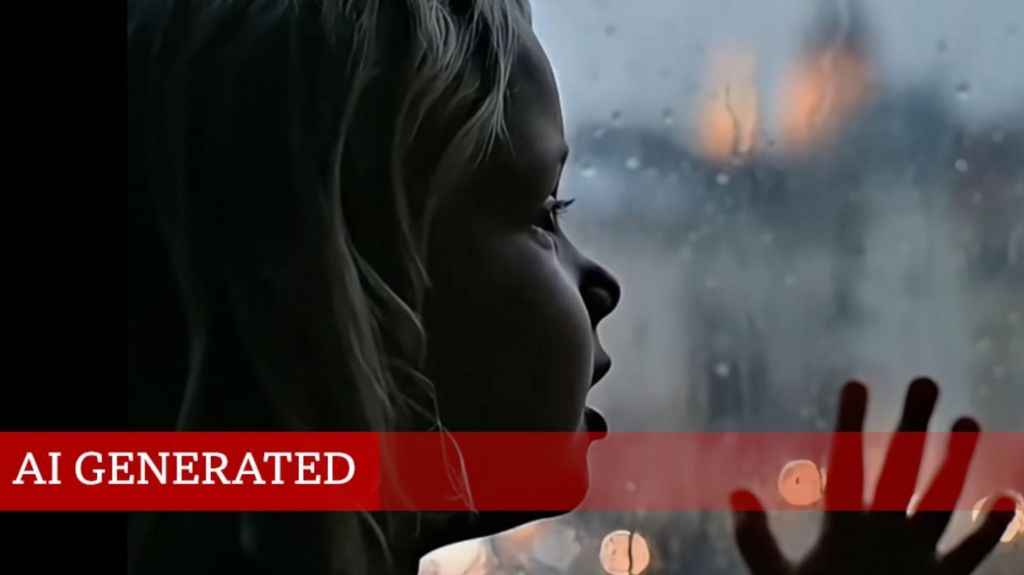
The most disturbing example of this AI-fueled disinformation campaign emerged in February, when Fidesz shared a fake AI-generated video across its official social media channels. The clip opens with a sentimental scene of a young girl waiting by a window for her father, a Hungarian soldier deployed to war, to come home. It quickly cuts to a graphic execution sequence: the bound, blindfolded father is shot dead by enemy captors. Though Fidesz openly labels the video as AI-generated, the party frames the fake footage as a warning of what will come if Magyar’s center-right opposition party Tisza wins the election.
In the video’s caption, Fidesz claims Magyar seeks to hide the true horrors of war and accuses the opposition leader of pushing policies that would drag Hungary into the ongoing conflict in Ukraine. Fidesz has amplified a series of unsubstantiated claims against Tisza, alleging that a Magyar government would use Hungarian pension funds to send military aid to Kyiv and reintroduce forced military conscription to deploy Hungarian troops to the front lines. Magyar and Tisza have repeatedly rejected these claims, noting that the party’s official election manifesto explicitly pledges not to send Hungarian troops to Ukraine and has no plans to bring back conscription.
When contacted for comment on the fabricated execution video, Fidesz did not respond to media inquiries. Támas Menczer, communications director for the ruling Fidesz-KNDP alliance, addressed the video in a public Facebook interview, reiterating that the greatest threat to Hungarian security is a Tisza victory because of the party’s stated support for Ukraine. Menczer declined to comment on the party’s choice to use AI-generated violent footage for political gain. For his part, Magyar has condemned the clip as a crossing of all ethical lines, calling it a heartless act of political manipulation designed to spread fear among Hungarian voters.
Fidesz is not the only pro-government group leveraging AI disinformation. Last month, the National Resistance Movement (NEM), a pro-Fidesz activist organization, shared a deepfake video depicting a fake phone call between European Commission President Ursula von der Leyen and Magyar, in which the pair allegedly discuss plans to funnel Hungarian public funds to Ukraine. The clip amassed more than 3.7 million views, and NEM did not disclose that it was generated by AI. The fake video was quickly shared across pro-government media outlets and by Fidesz politicians, including Orbán himself. While Orbán acknowledged the footage was AI-generated, he warned it could represent a real future if Magyar wins office. NEM also declined to comment on the video when contacted by reporters.
Independent observers warn that the widespread use of AI disinformation marks a new escalation of misinformation tactics in Hungarian politics, even as aggressive anti-opposition and anti-Ukraine narratives have long been a staple of Fidesz election campaigning. Zsófia Fülöp, a journalist at Lakmusz, Hungary’s only independent dedicated fact-checking outlet, notes that while ruling party fear-mongering is not new, the mass deployment of generative AI to create convincing fake content is unprecedented. Generative AI disinformation is omnipresent across this election cycle, particularly in the communication of the ruling party, its state-aligned media empire, and affiliated political groups, Fülöp explained. While small scale uses of AI in campaigning occurred in past cycles, this election has seen a massive surge in its use.
The AI disinformation push has unfolded alongside another controversial incident that has stoked tensions between Hungary and Ukraine. Several weeks before the election, Hungary’s counter-terrorism police detained seven Ukrainian bank workers who were transiting through Hungarian territory en route from Austria to Ukraine, carrying $80 million in cash and 9 kilograms of gold in licensed cash-transport vehicles. The Ukrainian Foreign Ministry accused the Orbán government of taking the workers hostage and stealing the funds, while Ukraine’s state-owned Oschadbank confirmed the shipment had all necessary legal permits and was a routine transfer. Hungarian authorities claimed the shipment was tied to potential money laundering and suggested the funds could be used to finance pro-Ukraine political activity inside Hungary. Though the seven workers were eventually released without any criminal charges filed, Hungarian authorities have still not returned the seized cash and gold.
Pro-government Hungarian media outlets again turned to AI to cover the arrest, publishing hyper-realistic AI-generated images of the raid that were presented as authentic on-the-ground footage. When compared to official photos and videos of the arrest published by the Hungarian government itself, the AI images contain multiple obvious inaccuracies, from incorrect police uniform details to wrong descriptions of the clothing worn by the detained Ukrainian citizens. Meta’s third-party fact-checking partnership has already labeled the post containing the fake AI images as “partly false.”
Hungary’s relationship with Ukraine has shifted dramatically over the past two years. Until late 2023, Budapest supported Kyiv’s bid for European Union membership and maintained relatively cordial bilateral ties, but relations have deteriorated sharply as Orbán has doubled down on his long-standing close political and economic alliance with Russian President Vladimir Putin. Polling from Hungarian research institute Policy Solutions finds that anti-Ukraine sentiment has reached near parity with anti-Russian feeling among Hungarian voters: 64% of respondents hold a negative view of Ukrainian President Volodymyr Zelensky, compared to 67% who hold a negative view of Putin.
Éva Bognár, a researcher at Central European University’s Democracy Institute, describes the entire 2026 election campaign as a disinformation hall of mirrors, built around a completely false narrative that Hungary is on the brink of being dragged into war. Bognár notes that Fidesz holds an unprecedented structural advantage in the campaign, controlling unlimited resources ranging from public state funds to government agencies and a massive state-aligned media conglomerate that operates as a full-time propaganda machine, including all public service media.
Against this lopsided media landscape, Magyar has managed to cut through Fidesz’s propaganda by building a strong direct connection with voters through social media platforms. Data from 20k, an independent Hungarian election integrity watchdog tracking political social media activity during the campaign, shows that Magyar’s posts across Facebook, TikTok, and Instagram generate twice the level of public engagement as posts from Orbán and Fidesz. Magyar’s social media strategy mixes formal policy content with casual, relatable personal content that portrays him as a younger, more approachable alternative to the 16-year incumbency of Orbán: his feed includes clips of him playing volleyball, flipping burgers at casual restaurants, partying with young supporters, and enjoying water sports.
However, independent fact-checkers have also found that Magyar has occasionally leaned into misleading rhetoric of his own, echoing some of Fidesz’s populist playbook. He has spread inaccurate claims about the number of Hungarian babies born to citizens living outside the country to stoke nationalist anxiety over eroding national pride, and has even flipped Fidesz’s own conscription claim against the ruling party, falsely alleging that Fidesz, not Tisza, plans to reintroduce compulsory military service. Reporters found no evidence to support this claim beyond a single brief discussion by two Fidesz politicians back in 2016.
Political analysts note that Magyar’s lead in the polls is driven largely by widespread public anger at Orbán’s 16-year incumbency, particularly among younger voters. Péter Krekó, director of independent Hungarian political research institute Political Capital, explains that Magyar has successfully tapped into deep-seated public resentment toward the Orbán government, a sentiment that is strongest among Hungarians between the ages of 18 and 40. Pre-election polling from Median agency confirms this divide: Tisza holds its strongest support among voters under 40, while nearly half of voters over 65 back Fidesz.
Despite trailing in most polls, Fidesz has continued to hammer its anti-Ukraine narrative across every available platform, with public campaign posters even showing Zelensky and Magyar side-by-side under the bold warning: “They are dangerous!” Krekó predicts that if Fidesz secures another term in office, the party will continue to use these AI-fueled disinformation tactics long after the election concludes. If Fidesz is defeated, however, Krekó says Hungary can expect a far more tumultuous rebalancing of the relationship between political power and the media. Regardless of the outcome, the 2026 Hungarian election has already set a troubling precedent for the use of generative AI as a tool of systemic political disinformation in European democratic contests.