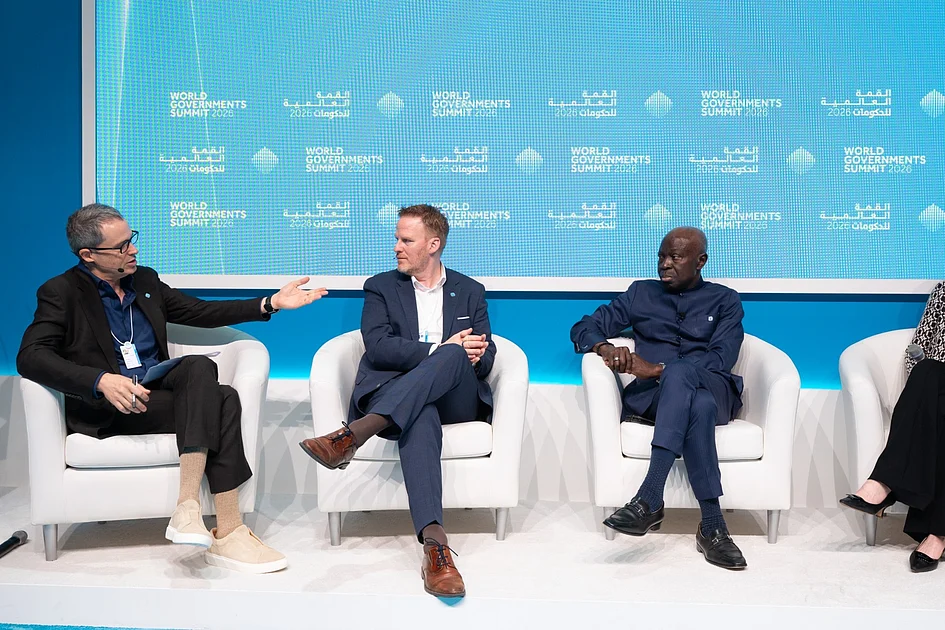
DUBAI – At the World Government Summit, a distinguished panel of global experts delivered a transformative vision for the future of work, emphasizing that artificial intelligence, economic volatility, and demographic shifts are permanently dismantling traditional career structures. The session, moderated by Ted Kemp of Khaleej Times, featured Gilbert Houngbo (International Labour Organization), Robyn Scott (Apolitical), and David Bach (IMD Business School), who collectively argued that adaptation must become humanity’s core competency.
In a significant departure from conventional workforce planning, Gilbert Houngbo asserted that governments must embrace uncertainty as the new constant. ‘Predicting the labor market’s landscape in five, ten, or twenty years is increasingly challenging,’ he stated, advocating for resilient, flexible institutions instead of rigid long-term plans. He issued a critical warning regarding AI’s productivity paradox: while automation delivers efficiency gains, these benefits are not automatically translating into improved wages or job security. ‘The widening gap between productivity and compensation demands proactive policy intervention to prevent deepening inequalities,’ Houngbo emphasized, noting that continuous skill investment has transitioned from optional to fundamental.
Robyn Scott presented a compelling case for governmental AI adoption, identifying a staggering $1.75 trillion productivity opportunity within bureaucratic systems. She championed human-AI collaboration where algorithms handle repetitive tasks while humans focus on complex judgment-driven work. ‘The crucial distinction lies in whether humans operate above or below the algorithm,’ Scott cautioned. ‘Surrendering全部 human agency to automated systems creates a zero-sum dynamic that poses profound societal dangers.’ She reframed retraining as an ongoing ‘change management muscle’ rather than a one-time initiative.
David Bach addressed the psychological dimension of workplace evolution, identifying fear—not technology—as the primary obstacle. Contrasting global optimism levels, he noted significantly higher confidence in the UAE compared to Western nations. ‘Pessimism paralyzes skill investment and stifles experimentation,’ Bach observed. ‘True leadership involves articating optimistic visions that acknowledge risks while mobilizing collective action.’
All experts concurred that ‘good work’ must be redefined beyond job titles in an era of non-linear careers. Houngbo emphasized AI’s role in reducing hardship while ensuring decent wages and social protections, particularly for women in automation-vulnerable roles. Scott noted the shrinking ‘half-life’ of professions, urging a shift from external job identity to internal meaning. Bach illustrated this with the example of a hospital cleaner deriving profound purpose from supporting cancer patients, demonstrating that meaningful work transcends technological prestige.
The panel anticipated fundamental organizational redesign, with AI enabling individual contributors to achieve massive impact without becoming managers. Scott advocated replacing role-based thinking with task-oriented workflows, while Bach emphasized creating environments where experimentation and safe failure become institutional norms. As the experts concluded, the future belongs to those who can navigate perpetual transformation with purpose and adaptability.