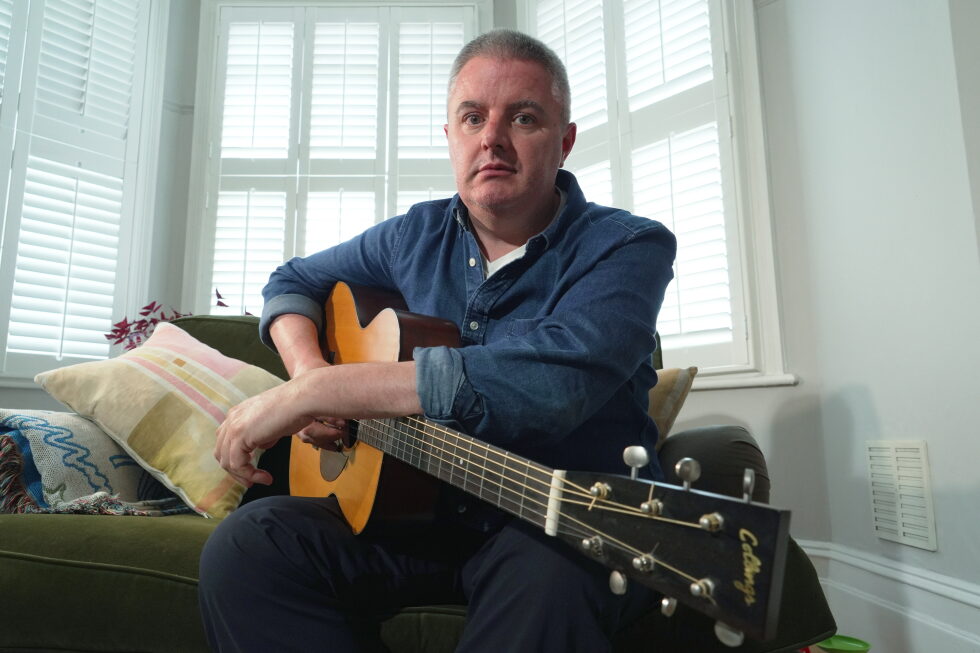
For years, British singer-songwriter Samuel Smith crafted original Americana music with a guitar permanently in his hands. But after a 2020 Parkinson’s disease diagnosis left him unable to play his instrument consistently due to the neurological disorder’s progressive symptoms, he turned to a surprising tool: generative artificial intelligence, to keep his creative practice alive. Now, with the release of his second full-length album *The Art of Letting Go*, Smith is opening up about how AI has unlocked new possibilities for artists living with disabilities — even as it remains one of the most divisive issues in the modern music industry.
Parkinson’s disease, which causes progressive nerve damage, commonly leads to muscle tremors, stiffness and chronic fatigue that erode fine motor control, skills critical for playing string instruments like guitar. By the time Smith began work on his 8-track album more than a year before its release, his ability to play had deteriorated significantly. Faced with the choice of abandoning songwriting entirely or adapting to his new physical limitations, he chose to adapt.
For his instrumental track *Horizon*, Smith leaned on popular AI music generation platforms Suno and Udio to translate his creative vision into shareable demos for the session musicians recording the final studio track. His process begins with humming rough melodic ideas into his smartphone, then uploading those recordings to the AI tools alongside text prompts that detail the track’s desired instrumentation, mood and musical style. He stressed that the AI-generated demos are never used in the final master of his songs; instead, they act as a communication tool to show professional players exactly what he hears in his head, when he can no longer demonstrate it on guitar. Producing a demo that matches his distinct artistic voice often takes dozens of attempts and extensive manual editing, Smith explained.
Unlike the narrative of AI replacing human creators that dominates much industry debate, Smith frames the technology as an enabling tool, not a replacement. “AI is not replacing anything for me. It’s unlocking, it’s enabling. It’s allowing me to keep writing. I upload my lyrics; AI doesn’t create my lyrics. I upload my music; AI does not create my music,” he said. “It then brings it to life in a way that I can play to session players and say, ‘Here, that’s what I’m thinking, that is what I’m hearing.’”
The album, recorded in Nashville with a roster of award-winning roots and bluegrass musicians including 16-time Grammy winner Jerry Douglas, banjo artist Alison Brown and Grammy-nominated guitarist Julian Lage, includes one particularly poignant moment: a guitar duet between Smith and Lage on *Horizon*. After months of being unable to play, Smith had a 10-minute window of reduced symptoms in the studio that let him record his part, a moment he calls the “last breath of my guitar playing.” Working alongside musicians he has admired for decades, he said, was an extraordinary, career-defining experience. Smith released his debut album *In the Springtime* in 2023, in part to create a tangible musical legacy for his two young sons that would preserve his creative voice even as his disease progresses.
Generative AI has split the global music industry in recent years. Major record labels including Sony Music Entertainment, Universal Music Group and Warner Records sued Suno and Udio in June 2024, arguing the platforms illegally used copyrighted recorded music to train their AI models. Since the lawsuit, Universal has reached a settlement and partnership deal with Udio, and Warner has done the same with Suno. Much of the public debate has centered on copyright disputes and artist displacement, but experts say Smith’s experience highlights a less discussed, potentially transformative use case for the technology: expanding creative access for musicians living with disabilities and chronic illness.
Ruaidhri Mannion, a composer and music technology scholar at Brunel University of London, noted that affordable digital recording tools democratized music creation over the past few decades, and AI could follow the same path by lowering barriers for creators with physical limitations. “If these tools are able to enable people to be able to participate with other creative groups and encourage more people to feel confident to be able to reach out to an ensemble or an orchestra or something, then I think that is all for the better,” Mannion said. He added a caveat, however: overreliance on AI could erase the messy, iterative process of trial, error and collaborative synergy that shapes artistic development. “What makes a lot of music-making meaningful is the collaborative element. There’s a lot of experimentation and development and failure that’s part of musical discovery,” he explained.
Critics of unregulated generative AI in music, including a group of independent artists who signed an open letter titled “Say no to Suno” earlier this year, argue that the technology erodes artist royalties and enables creative fraud when it scrapes existing copyrighted work without permission. The letter acknowledged that responsible AI use can benefit creators, but called for clearer protections for working artists. Both Suno and Udio have denied copyright infringement claims and stated they are committed to collaborating with the music industry, rather than operating against it.
Smith believes his experience makes the case for responsible, targeted AI development that benefits marginalized creators. His message to AI music platforms is clear: “if these companies want to show they’ve got a place, a role in society, then step up. Engage with health professionals, engage with music therapists, engage with society and show us what you can do.” In May 2024, Smith partnered with the Berklee Music and Health Institute for a New York event bringing together industry leaders, clinicians and researchers to explore how music and technology can support people living with neurological conditions. For Smith, continuing to create music is about more than art: it is about refusing to let Parkinson’s define his identity or the legacy he leaves for his children. “My 4-year-old is probably never going to remember me playing, and it’s heartbreaking,” he said. “But I’ve been able to pull this into something and refuse to be defined by this disease.”