Three days after a catastrophic 7.8-magnitude earthquake tore through southern Mindanao in the Philippines, rescue teams searching for trapped victims were forced into a frantic emergency evacuation Wednesday when a powerful aftershock shook a partially collapsed grocery building in General Santos, bringing more crumbling concrete debris down on the site.
The chaotic scene, captured by an Associated Press video journalist, unfolded as a safety officer blew a warning whistle and rescuers shouted to alert roughly 30 firefighters and coast guard personnel, who scrambled out of the leaning three-story structure to safety before more of the building gave way. The grocery lost its two upper floors in the initial quake on Monday, and crews have been searching for one remaining missing employee trapped in the rubble.
“It was a strong aftershock and an alarm was immediately sounded so those inside and under the damaged building can run out for a headcount,” explained Ressa Mia Tactaquin-Betoya, a spokesperson for the firefighting contingent leading the search. “It was scary because we don’t want our rescuers to be harmed so the area must be secured before they can go back in,” she told the AP.
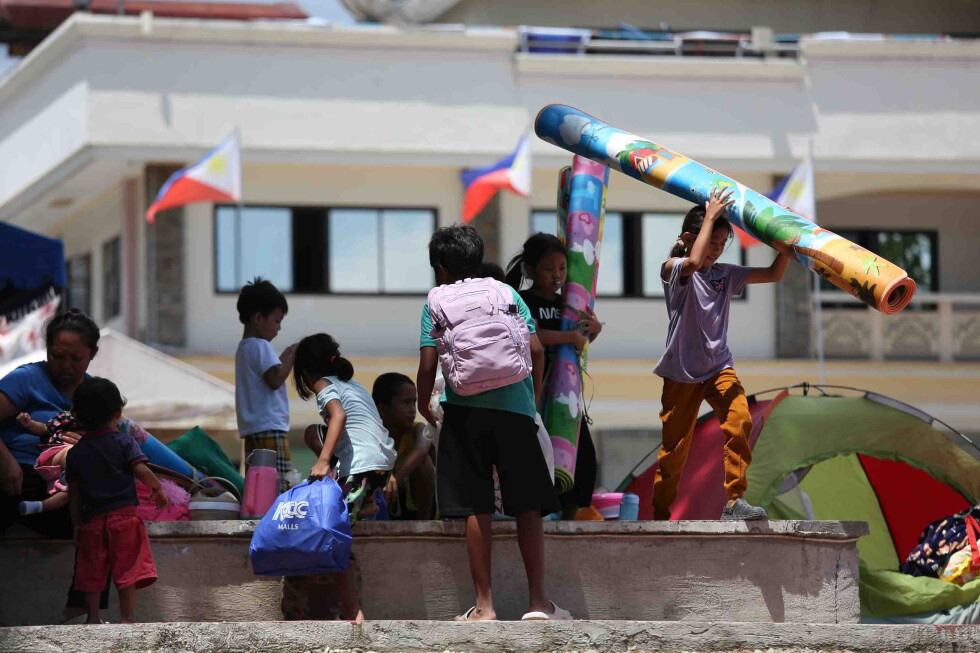
General Santos, a bustling coastal commercial hub known nationally as the Philippines’ tuna capital, has borne the brunt of the destruction from the quake, which has already claimed at least 45 lives and left 17 others unaccounted for across the affected region. The disaster has displaced more than 25,000 people, according to local officials, with thousands hunkered down in 45 state-run emergency shelters, too shaken by the event to return to their damaged or destroyed homes.
Data from the Philippines Institute of Volcanology and Seismology (PHIVOLCS) shows more than 2,100 aftershocks have rattled the region since the main quake, several of which have registered as high as magnitude 6.4 — strong enough to inflict additional casualties and worsen existing damage to already unstable structures.
Monday’s temblor ranks among the most powerful seismic events to strike the Philippines in 50 years. Official damage assessments confirm at least 630 people were injured, more than 3,100 residential homes were damaged or destroyed, along with 29 public roads, 11 bridges, and more than 100 government facilities.
General Santos’ international airport, a key transport hub for the region, sustained significant structural damage that has forced indefinite closure to all commercial traffic, with only government and military flights carrying emergency aid and response personnel allowed to operate, said Civil Aviation Authority of the Philippines spokesperson Eric Apolonio.
The quake struck on the first day of national classes after a two-month summer break, adding an extra layer of tragedy to the disaster. Around 6,000 public school buildings across quake-hit provinces now require full structural safety assessments before classes can resume, and many of those injured in the quake were young students who had gathered for traditional morning flag-raising ceremonies.
Most fatalities stemmed from falling debris in collapsed structures and landslides across General Santos and the adjacent provinces of Sarangani, South Cotabato, and Davao Occidental. One person was swept out to sea by post-quake tsunami surges that reached up to 1.4 meters above normal tide levels across the southern Philippines. Smaller tsunami waves were recorded as far afield as Indonesia, Palau, and southern Japan before all tsunami warnings were lifted.
In the immediate minutes after the quake, seven swimmers along the General Santos coastline were pulled out to sea by unusually strong currents. The Philippine coast guard confirmed three have been rescued, one swam back to shore independently, one drowned, and two remain missing. PHIVOLCS chief Teresito Bacolcol confirmed the anomalous currents were almost certainly triggered by the seismic shift.
Geologists confirm the quake was caused by tectonic movement along the Cotabato Trench, an undersea fault line that generated an even larger 8.1-magnitude quake in August 1976. That historic event triggered massive tsunami waves that killed an estimated 8,000 people across the region.
The Philippines sits along the Pacific “Ring of Fire”, a global network of active seismic faults that circles the Pacific basin, making it one of the most disaster-prone nations on Earth, regularly battered by both destructive earthquakes and volcanic eruptions.