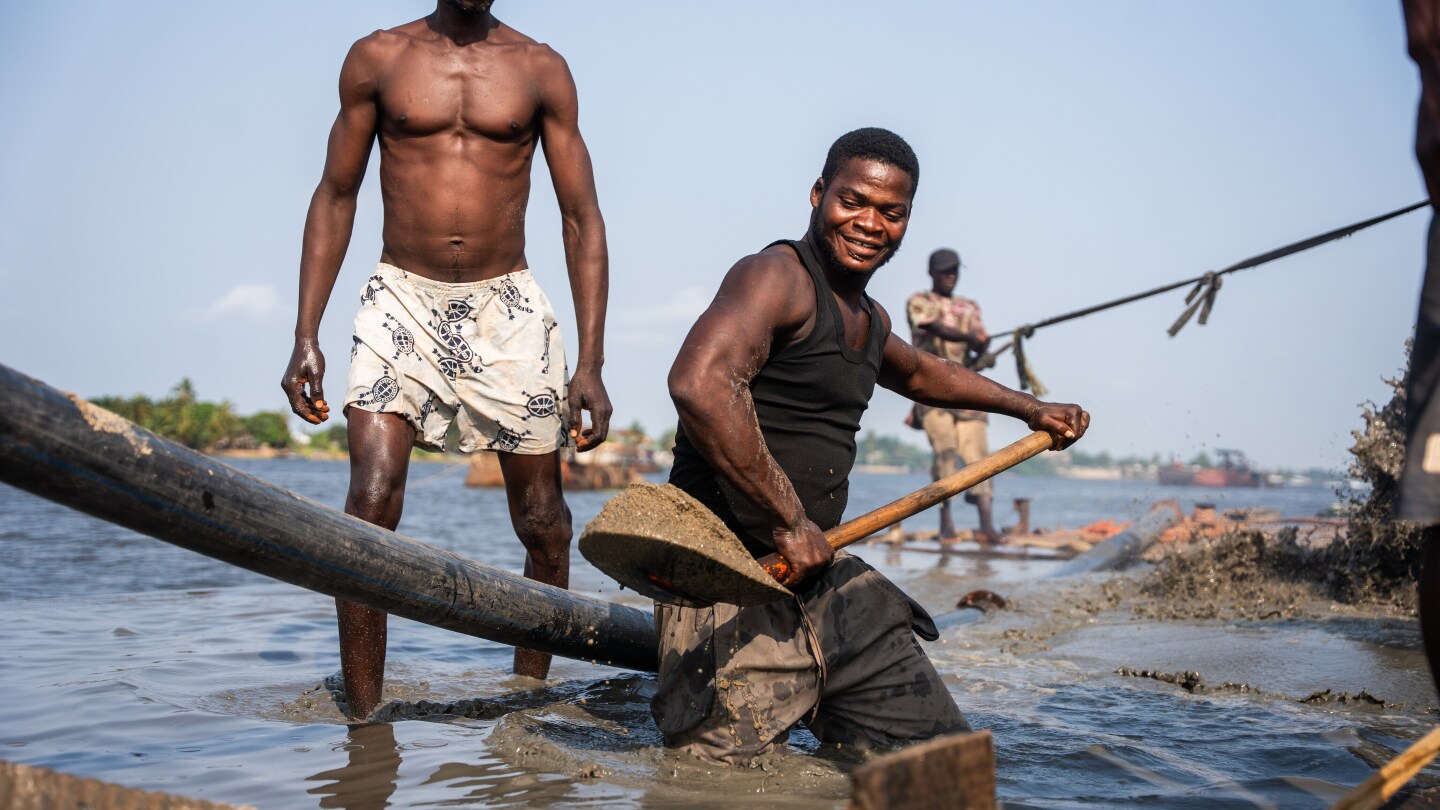
LAGOS, Nigeria — Along the bustling waterways of Lagos, Africa’s most populous metropolis, a stark economic dichotomy unfolds beneath the surface. Teams of Nigerian dredgers stand immersed in the Lagos Lagoon’s murky waters, harvesting sand bucket by bucket to feed the city’s insatiable construction appetite. This underwater gold rush is dramatically reshaping the coastline while simultaneously eroding traditional fishing grounds that have sustained communities for generations.
The manual dredging process reveals the human cost of urban development. Artisanal sand miners like 34-year-old Akeem Sossu dive repeatedly for 15-second intervals, filling wooden boats over three-hour shifts that yield approximately $8 per worker. Formerly a tailor, Sossu now depends on this hazardous work to support his household, beginning his days as early as 5 a.m. based on tidal patterns.
Market dynamics reflect Lagos’s construction explosion, with a standard 30-ton truckload of coarse ‘sharp sand’ now commanding roughly $202—a price surge driven by massive demand for concrete. Industry analysts estimate annual consumption reaches tens of millions of cubic meters, equivalent to approximately 16,000 Olympic-sized swimming pools.
The environmental transformation is unmistakable. Previously open waterways now display fragmented sandy patches, narrowed channels, and altered currents. The changes are particularly evident near Makoko, one of Lagos’s oldest fishing communities where stilt homes face encroachment from dredging barges and upscale waterfront developments.
‘Dredgers have spoiled the entire waters,’ laments Baale Semede Emmanuel, a Makoko community leader. ‘Anywhere dredging is happening, there’s no fish. The noise drives them away and their reproduction grounds have disappeared.’
Scientific research corroborates these observations. Nigerian studies along the Ajah–Addo-Badore dredging corridor document water turbidity levels exceeding national safety standards, disrupting fish feeding and migration patterns. Researchers also note unstable seabeds, erosion-prone zones, and bacterial contamination in groundwater samples.
The ecological damage has forced fishermen to choose between dangerous extended voyages with prohibitive fuel costs or abandoning their livelihoods entirely. Joshua Monday, who transitioned from fishing to mechanics, encapsulates the community’s plight: ‘Big men are stressing us. When they come, you have no option. You pack your things and leave.’
Despite government pledges to curb illegal dredging, enforcement remains inconsistent. Dredging operators describe making regular payments to authorities including the Marine Police and National Inland Waterways Authority to maintain operations. Environmental advocates argue these arrangements blur legal boundaries while exacerbating flooding risks and coastal degradation.
Scientists warn that removing natural buffers like wetlands and shallow areas reduces the lagoon’s capacity to absorb floodwaters, increasing vulnerability for Lagos’s approximately 17 million residents. As the city continues building on reclaimed land, the tension between development ambitions and environmental sustainability creates an increasingly precarious future for both the coastline and its traditional communities.