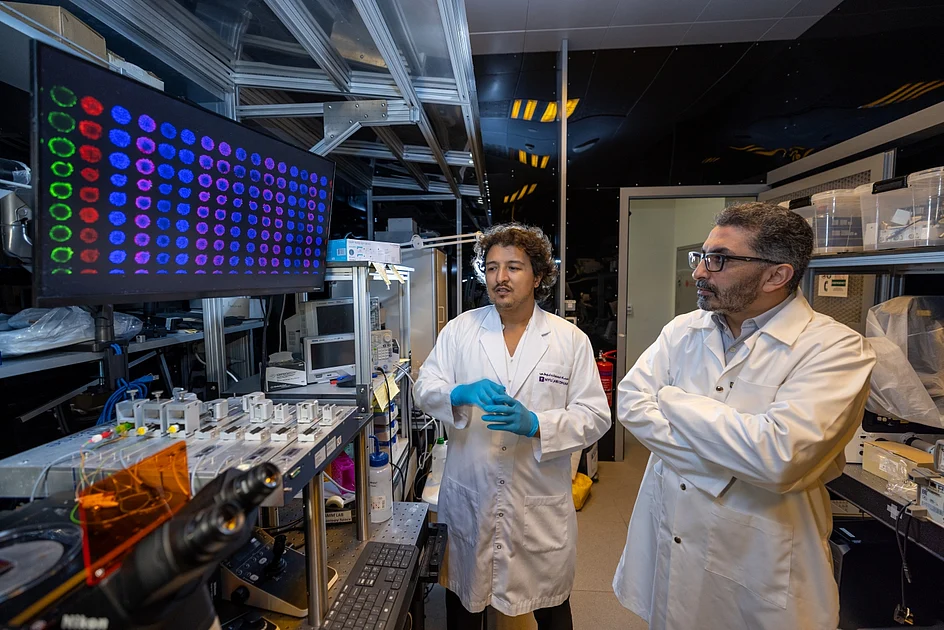
Researchers at New York University Abu Dhabi have unveiled a groundbreaking paper-based technology that promises to transform cancer research methodologies. The innovation, named Spheromatrix, utilizes a specialized filter paper system to cultivate three-dimensional tumor models that closely mimic human cancer behavior.
Led by Associate Professor Mohammad Qasaimeh of Mechanical Engineering and Bioengineering, with postdoctoral researcher Ayoub Glia as first author, the team at NYUAD’s Advanced Microfluidics and Microdevices Laboratory has developed a cost-effective alternative to traditional drug testing approaches. The platform enables scientists to grow miniature tumors, preserve them through freezing for extended periods, and conduct repeated drug sensitivity experiments on demand.
The fiber-based architecture of Spheromatrix provides an optimal biocompatible environment that allows tumor models to develop characteristics remarkably similar to actual human cancers. This technological advancement addresses significant challenges in pharmaceutical development by creating reproducible, scalable systems for preclinical drug screening while substantially reducing dependence on animal testing and human trial subjects.
In validation studies, the research team applied commercial chemotherapy drugs to preserved brain tumor models, observing response patterns that closely mirrored those seen in actual patient cancers. Crucially, the system demonstrated consistent drug response fidelity both before and after the freezing process, confirming its reliability for long-term research applications.
The innovation represents part of NYUAD’s expanding portfolio of significant scientific contributions, which recently includes rapid infectious disease detection devices and astrobiological research concerning cosmic rays’ potential role in supporting extraterrestrial life. The Abu Dhabi institution continues to establish itself as a hub for cutting-edge biomedical research with global implications.