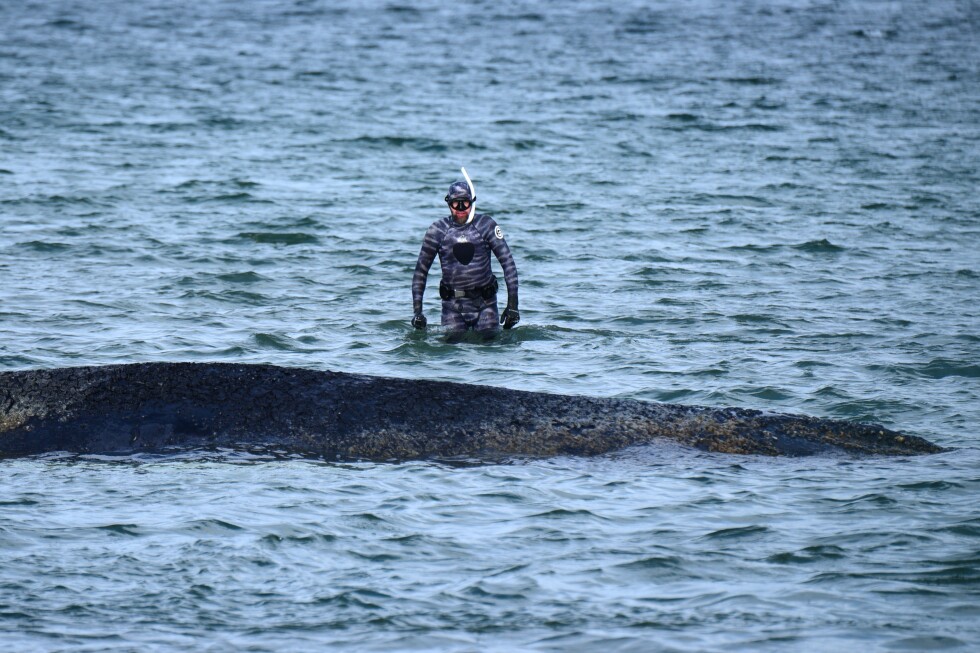
BERLIN — A dramatic multi-day rescue operation has successfully freed a humpback whale stranded in shallow Baltic waters near the German resort town of Timmendorfer Strand. The massive marine mammal, measuring approximately 12-15 meters (39-49 feet), escaped through a specially dug channel overnight Thursday into Friday after intensive efforts by marine experts and rescue teams.
The rescue operation reached its critical phase on Thursday when marine biologist Robert Marc Lehmann and his team employed excavators to dig an escape trench in front of the whale’s head. Working until after sunset, the team created a pathway that ultimately enabled the whale’s escape from the underwater sandbank where it had been trapped since Monday.
Despite this significant achievement, experts caution that the whale’s ordeal is far from over. The young male whale now faces a treacherous journey of several hundred kilometers through German and Danish waters to reach the safety of the North Sea and ultimately the Atlantic Ocean—its natural habitat. The Baltic Sea’s unique characteristics, including minimal tidal movements that might have naturally freed the whale, present ongoing navigation challenges.
Early Friday morning, the whale was observed making progress out of Lübeck Bay, accompanied by a coast guard vessel and several support boats. Marine researchers from the Institute of Terrestrial and Aquatic Wildlife Research are monitoring its movement, noting that the whale had been previously spotted in the port of Wismar in recent weeks, indicating a pattern of unusual migration for a species not native to the Baltic region.
The successful intervention highlights both the dedication of marine rescue teams and the growing phenomenon of whale strandings in non-native waters, raising questions about changing marine ecosystems and navigation patterns among marine mammals.