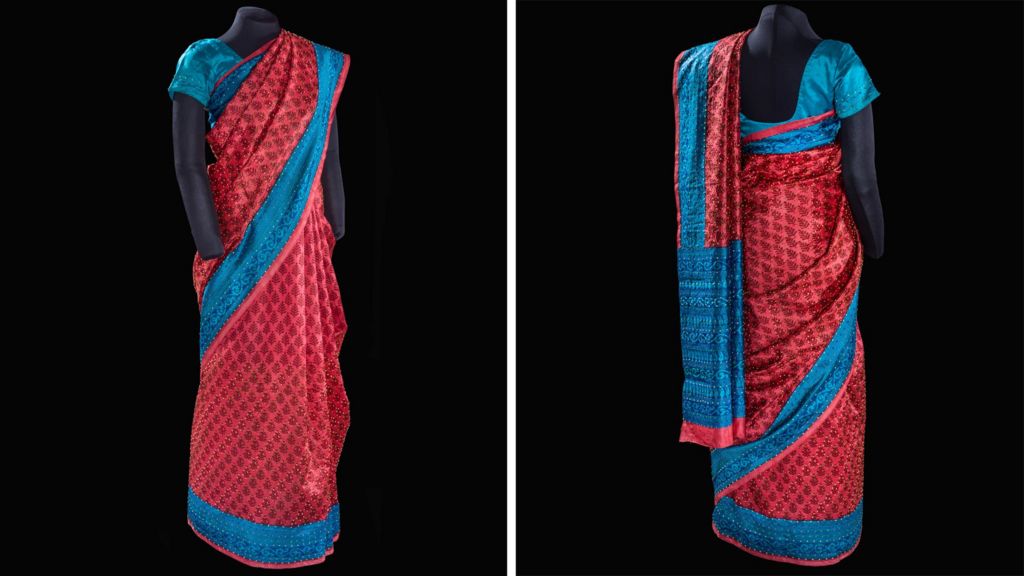
A garment deeply tied to one of India’s most groundbreaking space milestones is now a featured exhibit at one of the world’s most prestigious science museums, bringing the story of women in global space exploration to tens of thousands of annual visitors.
Nandini Harinath, a leading Indian space scientist who served as Deputy Operations Director for the Mangalyaan mission—India’s first ever attempt to place a spacecraft in Martian orbit—donned a vibrant red and blue silk sari, a gift from her father, on what she calls the most critical day of the entire project. That day, 1 December 2013, Harinath and her team at the Indian Space Research Organisation (ISRO) gathered in the mission control room to execute the trans-Mars injection maneuver, pushing the Mangalyaan probe out of Earth’s orbit and onto its 300-month journey to the Red Planet. In a 2016 interview, Harinath described the moment as a do-or-die juncture: every decision the team made that day would determine whether the years of work that went into the mission would end in success or failure. To Harinath, saris have always been her go-to attire for major professional moments and events where she represents India’s space program, making this silk piece the natural choice for the mission’s most high-stakes day.
Mangalyaan successfully entered Martian orbit in September 2014, cementing India’s place in history as just the fourth national or geopolitical entity to accomplish the feat. When a photograph of sari-clad women from ISRO celebrating the mission’s success went viral across global social media, it upended long-held stereotypes that framed aerospace engineering and space science as male-dominated fields in India. While ISRO later clarified that the women pictured were administrative staff, the agency also emphasized that multiple female scientists, including Harinath, held core roles on the mission and were present in the control room for the critical injection maneuver.
That viral image caught the attention of Matt Shindell, curator of space history at the Smithsonian’s National Air and Space Museum in Washington, D.C., who found the story of India’s “Rocket Women” deeply compelling. In 2020, Shindell reached out to Harinath via email to discuss adding an artifact tied to the Mangalyaan mission to the Smithsonian’s collections. After discussing what object could best capture the spirit of the mission and Harinath’s role in it, the pair settled on the iconic sari she wore that day in 2013.
Once the sari and its matching blue blouse arrived at the museum, a textile conservator even turned to YouTube tutorials to learn how to properly drape the traditional garment for display on a museum mannequin. Shindell draws a parallel between Harinath’s sari and another iconic artifact in the museum’s collection: the flight vest worn by NASA Flight Control Chief Gene Kranz during the 1970 Apollo 13 mission, when he led the emergency operations that brought the imperiled crew safely back to Earth. Both garments are tangible reminders of the human decision-makers who stood at the center of historic space milestones, rather than just the technology that made those milestones possible.
While the Smithsonian already holds a small number of Indian artifacts in its collections, most are tied to India’s air force or commercial aviation industry, and the museum counts a 2007 commemorative silver tray ISRO presented to science fiction author Arthur C. Clarke for his 90th birthday among its existing ISRO-related holdings. Harinath’s sari marks the first artifact from India added to the museum’s interplanetary science collection, and it is also the first sari of any kind in the museum’s permanent holdings.
Today, the sari is on display in the museum’s “Futures in Space” gallery, positioned directly alongside the iconic blue t-shirt worn by Sally Ride when she became the first American woman to travel to space on the 1983 Space Shuttle mission. The exhibit is also surrounded by space-themed toys, games, and movie posters, all curated to engage visitors with recent developments in space exploration and spark conversation about the future of human activity beyond Earth.
Shindell explains that the “Futures in Space” exhibit is designed to prompt visitors to grapple with core questions about modern space exploration: Who gets to participate in space travel? What drives nations and individuals to explore beyond our planet? What will we do once we reach other celestial bodies? For Shindell, Harinath’s sari answers these questions in two powerful ways. First, it stands as a symbol of national pride for India and the remarkable success of the country’s growing, cost-effective space program. Second, it carries a deeply personal, inspiring story that Shindell hopes will encourage more young women around the world to pursue careers in science, technology, engineering, and math. The exhibit includes an interactive touchscreen that allows visitors to learn more about Harinath, the Mangalyaan mission, and the role of women in global space exploration.
Shindell says he is delighted by the public response to the new addition, calling the sari a fantastic asset to the museum’s collection that brings a fresh, important perspective to the story of modern space exploration.