Deep in the forested fringe of Kinshasa, the capital of the Democratic Republic of Congo, sits a one-of-a-kind safe haven for the world’s most threatened great apes: Lola ya Bonobo, the only sanctuary on Earth dedicated exclusively to rescuing and raising orphaned bonobos. For 24 years, Micheline Nzonzi has served as a foster mother to these vulnerable young primates, and she currently cares for a sleepy 1-year-old orphan whose life depends on her care. With consistent maternal attention, bottle feeding, and regular social play with other rescued young bonobos, this tiny ape stands a strong chance of survival. “Without me, without us, these bonobos cannot survive,” Nzonzi explained. “They survive thanks to human affection.”
Bonobos, one of humanity’s closest living genetic relatives sharing 98.7% of our DNA, have existed as a distinct species only since 1933, when American zoologist Harold Coolidge formalized the classification first proposed by German anatomist Ernst Schwarz four years earlier. Found only in the dense equatorial rainforests south of the Congo River, these apes are famously known for their female-led social structures, peaceful temperament, and high emotional intelligence, earning them the nickname “hippie apes” for their conflict-resolution and social behaviors. A 2025 study from Johns Hopkins University even suggests bonobos may possess a capacity for imagination, cementing their status as one of the most fascinating species on the planet.
Yet today, the species faces imminent collapse. Population estimates have plummeted from 100,000 wild bonobos in the 1980s to roughly 20,000 today, landing the species on the International Union for Conservation of Nature’s endangered list. The primary threat driving this decline is the unregulated commercial bushmeat trade. While bonobos are legally protected from hunting across the DRC, demand for wild game extends far beyond the Congo Basin, and the iconic apes fetch a premium price on black markets. Poachers often use captured baby bonobos as live bait: when adult bonobos approach to investigate the cries of the trapped infant, they are shot and killed for their meat. The surviving infants are then trafficked, sometimes kept as pets or sold into the exotic pet trade before being rescued by sanctuary workers.
Cultural beliefs have compounded conservation challenges in the DRC, unlike neighboring Uganda where great apes are not hunted for consumption. “In Congo, they believe that you can become as strong as the primate you eat,” explained primatologist Gladys Kalema-Zikusoka, founder of Uganda-based conservation group Conservation Through Public Health. To curb hunting and protect bonobo habitat, Congolese authorities launched a novel proposal last year: “bonobo credits”, a market-based conservation model modeled after carbon credits that would reward local communities for preserving old-growth forest. As of early 2025, the program has not yet been implemented.
In Kinshasa, the illegal primate meat trade has been pushed underground after a nationwide ban aimed at preventing the spread of zoonotic diseases like Ebola. Local vendors confirm that open sales of monkey and ape meat have ceased, though unregulated trade in other wild game from giant rodents to pythons continues openly in city markets. For sanctuary staff, the work of rescue and education remains an ongoing battle. “The bonobos are in danger. We are educating people to not kill the bonobos,” said Arsène Madimba, an educator at Lola ya Bonobo. “We can’t kill them, we can’t keep them as pets at home, we can’t eat them. Because of poaching, we see large-scale trafficking of orphaned bonobos across the entire country.”
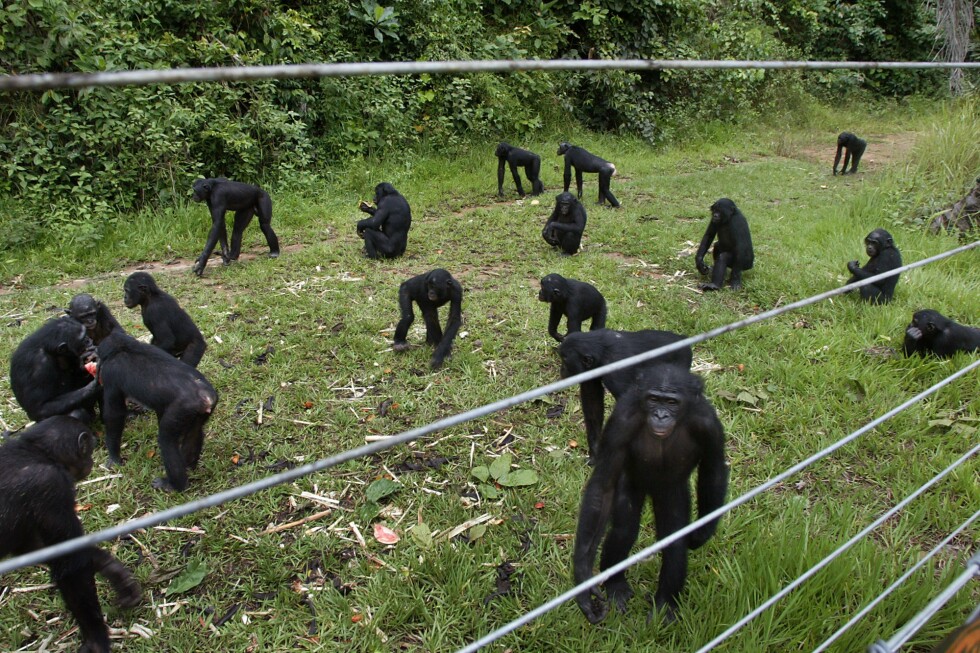
Today, Lola ya Bonobo, run by the Congolese conservation nonprofit Les Amis des Bonobos du Congo, houses dozens of adult bonobos, some of whom have lived at the sanctuary since it opened in 2002, plus 11 orphaned infants in its on-site nursery, with the most recent arrival arriving earlier this year. Each baby is paired with a long-term foster caregiver who will care for it for three to five years – matching the slow reproductive and developmental cycle that makes bonobos particularly vulnerable to population loss – before the young ape is integrated into a larger social group open to visitors. In rare, carefully planned cases, rehabilitated bonobos are eventually reintroduced to protected wild habitats, a process that requires years of preparation.
For the sanctuary staff that works with the apes daily, the human-bonobo bond is tangible. Feeder Frank Lutete, who paddles across the sanctuary’s waterways to deliver fruit to the social groups, says the apes regularly show their gratitude. “Some bonobos thank me,” he explained, “tapping their chests in a gesture of gratitude.”