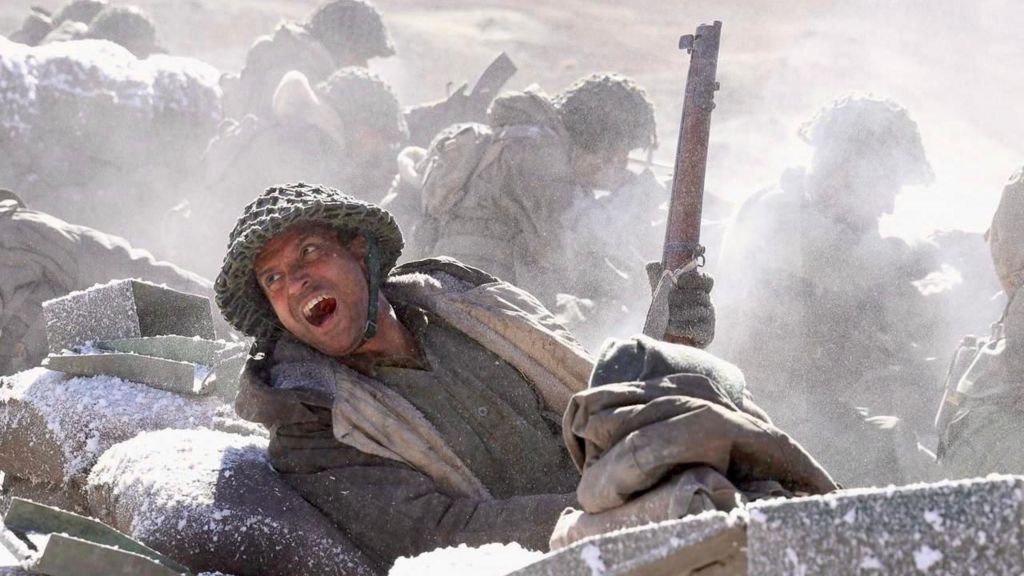
A new Bollywood production titled ‘120 Bahadur’ (Hindi for ‘120 Bravehearts’) has brought renewed attention to one of the most heroic yet overlooked engagements of the 1962 Sino-Indian War. Starring Farhan Akhtar as Major Shaitan Singh, the film dramatizes the legendary last stand of Indian soldiers at the Rezang La pass in Ladakh’s freezing Himalayan heights.
Despite underperforming commercially, the cinematic portrayal has successfully highlighted what military historians consider the only redeeming chapter in an otherwise disastrous conflict for India. Dialogue writer Sumit Arora explained the production’s motivation: ‘We felt it was profoundly important to tell this story and honor those who lived it. While taking some cinematic liberties, our film remains fundamentally faithful to historical events.’
The historical context reveals deepening tensions between the neighboring nations, fueled by border disputes and India’s granting of asylum to the Dalai Lama following the 1959 Tibetan uprising. China’s month-long offensive, which it characterized as a ‘self-defense counter-attack,’ resulted in devastating losses for India—approximately 7,000 casualties and 38,000 square kilometers of territory surrendered before China’s unilateral ceasefire.
The Battle of Rezang La, fought at 16,000 feet on November 18, 1962, saw 120 soldiers from the Charlie Company of the 13 Kumaon battalion face overwhelming Chinese forces estimated at 3,000 troops. Despite being poorly equipped with semi-automatic rifles and limited ammunition, and lacking proper cold-weather gear, the company mounted an extraordinary defense from 3:30 AM to 8:15 AM.
Tragically, initial reports of their valor were met with skepticism by military command amid the broader defeat. As author and former naval officer Kulpreet Yadav notes, ‘Morale was catastrophically low following the war’s outcome, with thousands captured as prisoners—including a brigadier. Nobody believed such a heroic last stand was possible.’
The truth emerged three months later when a shepherd discovered the frozen battlefield—bodies preserved in snow, destroyed bunkers, and empty shell casings telling the story of the ferocious engagement. Only five soldiers survived. Major Singh received posthumously India’s highest military honor, the Param Vir Chakra, while twelve others were awarded gallantry medals.
Journalist Rachna Bisht’s research reveals heartbreaking details: soldiers from plains regions had never experienced snow, suffered from altitude sickness, and fought in inadequate clothing against temperatures of -24°C. Survivor accounts describe Major Singh, despite multiple stomach wounds, continuing to command until ordering his subordinates to leave him behind.
The company’s sacrifice prevented Chinese forces from capturing the strategically vital Chushul airstrip, potentially altering the map of Ladakh significantly. Today, the pass remains disputed territory, but the soldiers’ legacy endures through memorials, renamed military units, and now through cinematic tribute—ensuring that what Bisht calls ‘great glory achieved in a war mostly remembered with shame’ is not forgotten.