It has been exactly 12 months since a brutal militant attack targeting tourists in the scenic Himalayan town of Pahalgam, Indian-administered Kashmir, snatched 26 innocent lives and shattered dozens of families forever. The attack, counted among the deadliest assaults on civilians in the restive region in decades, did not just trigger a dramatic escalation of cross-border tensions between nuclear-armed neighbors India and Pakistan – it also left a generations-long trail of private pain that time has not erased, only reshaped. For the widows and parents of the victims, learning to live with absence has become a daily, quiet act of resilience, carried out in vastly different ways that all bear the weight of unthinkable loss.
The contested region of Kashmir has been claimed in full by both India and Pakistan since the 1947 partition of the subcontinent, with the two nations splitting control of the territory and fighting multiple full-scale wars over it. On April 22, 2025, militants opened fire on civilians visiting Baisaran Valley, a stunning alpine meadow that draws thousands of tourists to Pahalgam every year. Most of those killed were young Hindu men, many of whom were at the very start of their adult lives: newlyweds, rising professionals, whose futures were cut down in an act of targeted violence.
In the immediate aftermath, New Delhi formally accused Pakistan of enabling the attack, claiming the assault was carried out by a militant group based on Pakistani soil – a claim Islamabad quickly and firmly denied. Two weeks after the killings, India launched preemptive air strikes targeting what it said were militant group training bases inside Pakistani territory. The strike set off four days of intense cross-border shelling and aerial exchanges that pushed the two nuclear-armed powers to the brink of full-scale conflict, until a widely unexpected ceasefire was announced to de-escalate tensions. While international attention has long moved on from that crisis, for the families of the 26 victims, the grief remains an unshakable daily presence.
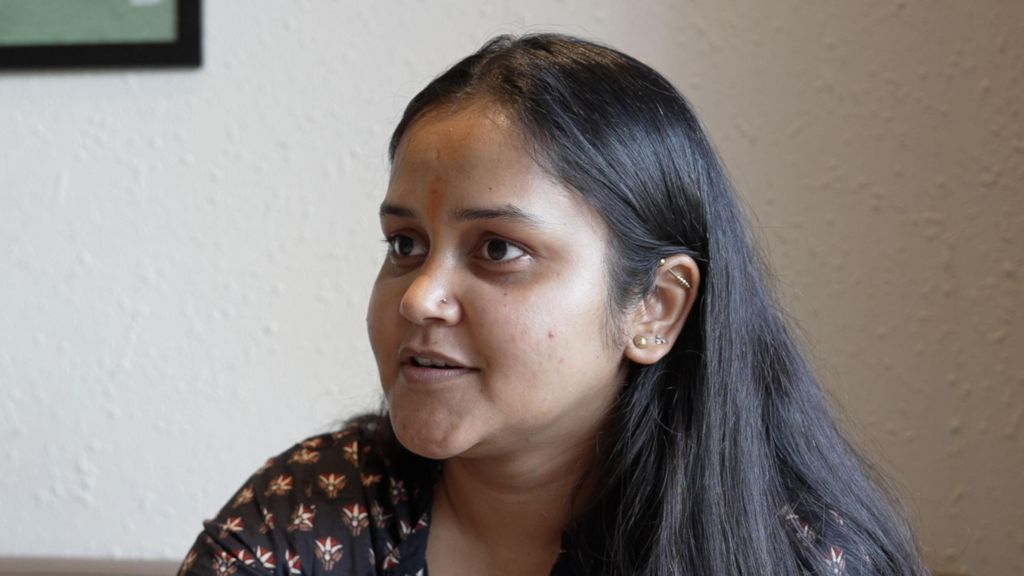
For 26-year-old Aishanya Dwivedi, the attack stole her husband Shubham just two months after their wedding. Today, in the Kanpur home she once shared with Shubham, the bedroom they lived in remains frozen in time. Every item – the unmade bed, the standing cupboard, even the small wall mirror Shubham installed after she joked about the empty space above their dresser – sits exactly where it was the day they left for their Kashmir holiday. “That side of the bed is still Shubham’s,” Aishanya explains, gesturing to the unused half she keeps piled with pillows. “I never sit or lie there. I even avoid it in my sleep.”
Aishanya still recalls the day of the attack in sharp, unwavering detail. After arriving in Kashmir with a group of 11 family members, the couple ventured alone to the Baisaran Valley meadow while the rest of their group stayed behind in Pahalgam. As they walked through the grass, a man approached them, asked Shubham what his religion was, and opened fire. Aishanya says she begged the attackers to kill her too, but they left her alive, alone with the grief that would shape the rest of her life.
“I didn’t get enough time to build a lifetime of memories with him,” Aishanya told BBC Hindi in an interview marking the one-year anniversary. “But the memories he did give me are enough to carry me through the rest of my life.” Her phone lock screen still holds an unposed candid from their wedding day, and she often scrolls through her photo gallery to find old pictures of Shubham, replaying old voice notes and videos to hold onto the smallest details: the sound of his laugh, the way he would giggle at bad jokes.
In the months after the attack, Aishanya found that speaking publicly about Shubham and her grief became a form of quiet therapy. What started as answering questions from reporters and family friends became a way to keep his memory alive, even when it drew harsh online backlash. After she publicly called out Prime Minister Narendra Modi for failing to name the Pahalgam victims in his parliamentary address following India’s air strikes, she was targeted by online trolls who criticized her public grief. But the harassment has not silenced her. “I will speak, I will go out, I will do everything I want,” she says. “Those people have no right to tell me how to grieve my husband.”
Every evening, Aishanya sits with her in-laws for an hour, and the three of them talk about Shubham, circling back to the same small stories and memories, each time softening the edge of the pain just a little. She has started writing down her feelings, and even though she often ends up crying mid-entry, she says releasing the pain is a necessary part of healing. A trained classical dancer, she has not yet been able to return to the stage – “My feet just won’t move,” she says – but she holds out hope that she will find her way back to the art one day. Small, unexpected moments still feel like signs Shubham is with her: a rainbow visible from a plane window while playing one of his favorite songs, a glance at the full moon from her balcony that brings a split second of feeling he is right beside her. “The grief of losing a husband will never go away completely,” she says. “But that doesn’t mean we have to stop living.”
For another family, grief takes a far quieter form. Rajesh Narwal lost his 26-year-old son Vinay, an Indian naval officer who was just six days into his honeymoon in Kashmir when he was killed in the attack. In the hours after the shooting, a photograph of Vinay’s bride sitting motionless beside his body spread virally across Indian social media, becoming a searing symbol of the attack’s senseless brutality. Today, back at the Narwal family home, none of Vinay’s belongings have been unpacked from the bags he brought on his honeymoon. Most family members still cannot bring themselves to say his name out loud, and the family has not hung a single photograph of him anywhere on the walls.
“None of us can find the courage to talk about it,” Rajesh says. “We can’t even bear to put his photo up.” But the memories do not stay buried. Rajesh still finds himself automatically falling into old routines: when he comes home from work every day, he still half-expects Vinay to be waiting in the courtyard, ready for their daily game of cricket, a ritual they kept from Vinay’s childhood through his early adulthood. “We just don’t know how to process this pain. We’re still grieving, every single day,” Rajesh says. “I can distract myself at work, but the second I walk through the front door, it feels like someone presses on a raw nerve. The pain is unbearable.”
One year after the attack that upended their lives, both families have carved out different ways to live with the hole the violence left behind. One keeps memory alive through open, unapologetic speech; the other holds it close through silence. Both are learning to rebuild their lives around the absence of the people they loved, carrying their memories forward even as they learn to breathe again. The attack that shook South Asia and brought two nuclear powers to the edge of war is now remembered most vividly not in official statements or security briefings, but in the frozen bedrooms and quiet courtyards of the families who will never be the same.