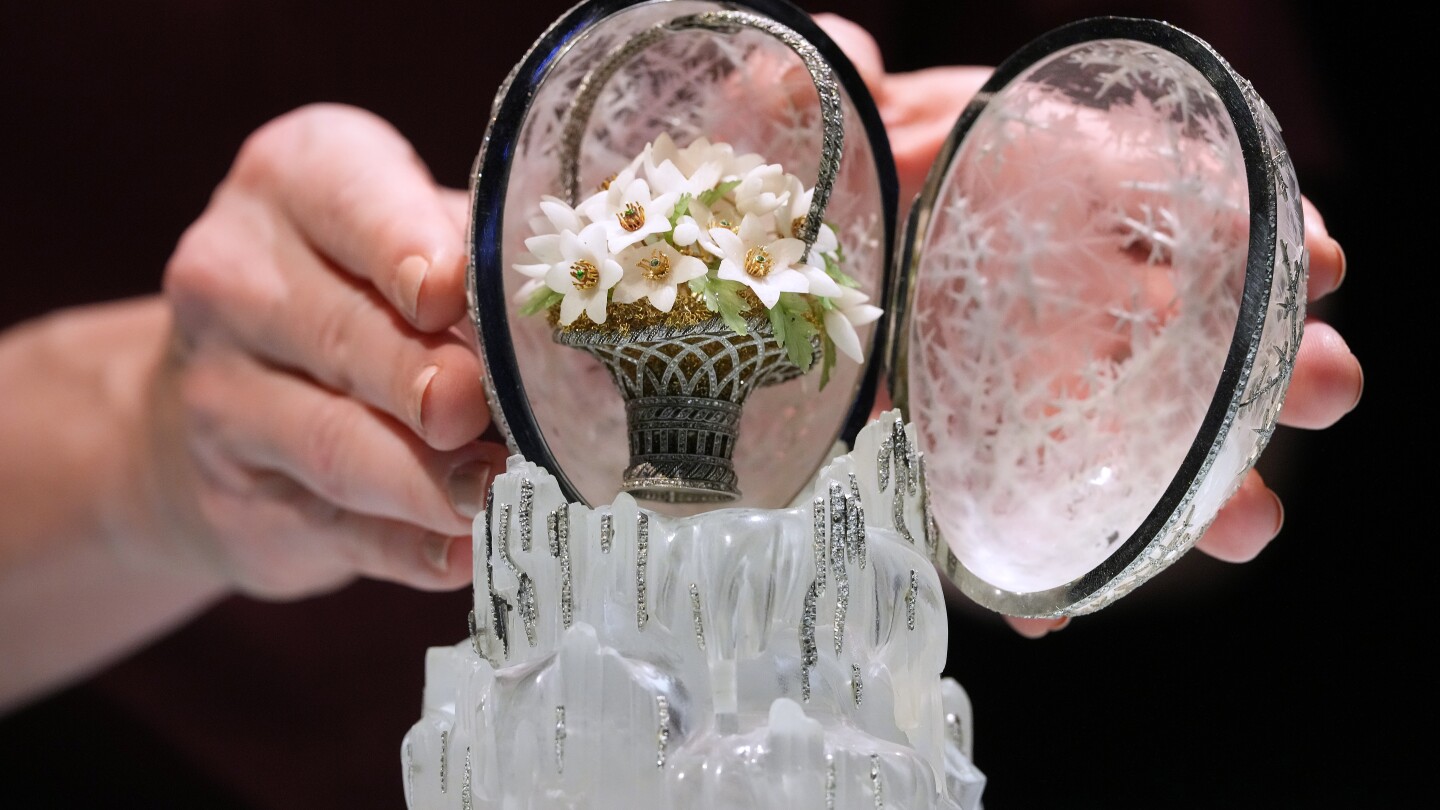
A rare and exquisite Fabergé Winter Egg, crafted for Russia’s imperial family before the 1917 revolution, is set to be auctioned at Christie’s London headquarters. Valued at over £20 million ($26.4 million), this opulent piece is one of only seven remaining in private hands. Standing at 4 inches (10 centimeters) tall, the egg is meticulously crafted from finely carved rock crystal, adorned with a platinum snowflake motif and embellished with 4,500 tiny diamonds. Its interior reveals a removable basket of bejeweled quartz flowers, symbolizing spring. Margo Oganesian, head of Christie’s Russian art department, described it as the ‘Mona Lisa’ of decorative arts, likening its allure to a luxurious Kinder Surprise chocolate. Commissioned by Czar Nicholas II in 1913 as an Easter gift for his mother, Dowager Empress Maria Feodorovna, the Winter Egg was designed by Alma Pihl, one of only two female designers to create Fabergé eggs. Pihl’s other creation is owned by Britain’s royal family. The Fabergé eggs, numbering over 50, were crafted for Russia’s imperial family between 1885 and 1917, each uniquely elaborate and containing a hidden surprise. The Romanov dynasty, which ruled Russia for 300 years, was ousted during the revolution, leading to the execution of Nicholas II and his family in 1918. The Winter Egg’s journey began when it was purchased for £450 by a London dealer during the 1920s, when Communist authorities sold off Russia’s artistic treasures. After being lost for two decades, it resurfaced at a Christie’s auction in 1994, fetching over 7 million Swiss francs ($5.6 million). It was sold again in 2002 for $9.6 million and is now expected to surpass the $18.5 million record set by another Fabergé egg in 2007. Of the 43 surviving imperial Fabergé eggs, most are housed in museums.
A crystal Fabergé egg crafted for Russian royalty is expected to sell for more than $26 million