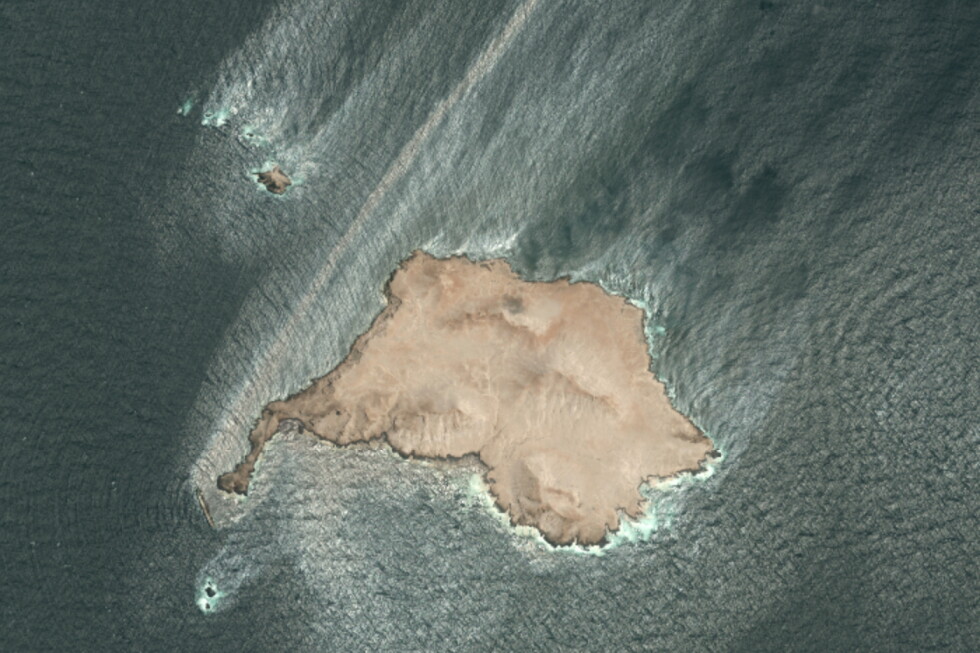
A United Kingdom-based maritime emergency firm has been contracted to launch a high-stakes salvage operation for a grounded Russian shadow fleet tanker off Oman’s southwestern coast, where a rapidly expanding oil spill has already reached shore and threatens one of the region’s most biodiverse protected marine habitats.
The 247-meter vessel, the Caroline Bezengi, has been stranded near Qabiliyah Island since early June, when an explosion of unknown origin disabled the tanker. The ship was carrying more than 800,000 barrels of Russian crude when it ran aground after departing Russia’s Black Sea port of Novorossiysk in May. Classified as part of Moscow’s shadow fleet of unregulated oil tankers, the Caroline Bezengi is currently sanctioned by both the British government and the European Union, and it remains unflagged with no clear confirmation of insurance coverage. Geospatial analysts link the vessel’s ownership to entities based in Shanghai, China.
Over recent weeks, stormy conditions driven by the annual Khareef monsoon season, which peaks between July and August, have accelerated the spread of leaking oil from the damaged tanker. Satellite imagery confirms the spill has expanded exponentially across hundreds of square kilometers of ocean, and now the slick is increasingly encroaching on critical coastal ecosystems. On Wednesday, Omani environmental authorities confirmed oil has already reached the shore at Ras Madrakah, located more than 200 kilometers north of the grounded tanker. Officials warn the spill could travel another 100 kilometers further north to reach Masirah Island in the coming days. New satellite data also shows the Caroline Bezengi is slowly submerging, with experts warning that a full structural break or total sinking could release the vessel’s entire cargo, triggering what would be an unprecedented environmental catastrophe for the region.
Ambrey, the London-headquartered maritime risk and response firm leading the operation, announced Thursday that its assessment team had already boarded the tanker with air support from Omani authorities to stabilize the vessel after completing an initial damage survey. In an official statement, Ed Wollaston, Ambrey’s global response director, described the operation as uniquely difficult, noting that ongoing monsoon storms have created exceptionally challenging working conditions. As of Thursday, the company had not released public estimates for either the timeline or total cost of the full salvage and cleanup effort.
Environmental advocates warn that the spill’s spread to shore dramatically increases the long-term risk to ecosystems and complicates cleanup efforts. “It is extremely concerning that the oil has spread from an offshore spill to the shoreline where it can contaminate coastal sediments,” explained Hanen Keskes, a campaigner for global environmental organization Greenpeace. Once oil reaches coastal habitats, she noted, “cleanup becomes significantly more complex than containment at sea, and even after the visible slick is removed, environmental damage can persist for decades.”
The Qabiliyah Island marine protected area at the center of the crisis is one of the Arabian Sea’s most ecologically important regions. It hosts fragile coral reef systems, extensive seagrass meadows, critical nesting grounds for endangered sea turtle species, and breeding habitats for dozens of species of migratory seabirds. The area is also one of the only known habitats for the rare and critically endangered Arabian Sea humpback whale. Compounding challenges, the remote location of the spill has very limited existing infrastructure, requiring additional safety protocols and complicating access for salvage and response teams, Keskes added.
This oil spill crisis is not the only environmental emergency unfolding in the strategic Gulf region. Just across the Strait of Hormuz off Iran’s Qeshm Island, Iranian authorities are already working to contain a separate large oil spill, with blame for the incident remaining contested. Iranian officials have linked the spill to rising tensions between Iran and the United States and are demanding compensation for cleanup costs, but maritime tracking firm TankerTrackers.com published satellite evidence on social media platform X indicating the spill likely originated from an Iranian attack on a commercial bulk carrier off Oman’s coast, with the slick drifting across the strait to reach Iranian shores.