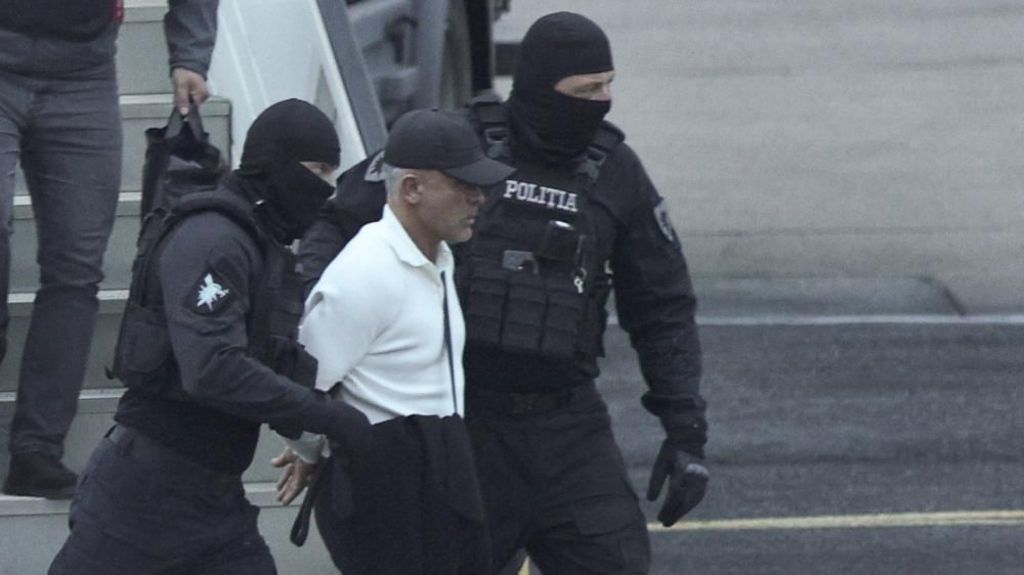
Vladimir Plahotniuc, a prominent Moldovan oligarch and former political figure, has been extradited from Greece to Moldova, facing allegations of involvement in a $1 billion bank fraud case. The 59-year-old tycoon, who fled Moldova in 2019 after his Democratic Party lost power, was escorted by masked Moldovan police and Interpol officials upon his arrival at Chisinau airport on Thursday morning. Plahotniuc, who has repeatedly denied any wrongdoing, was swiftly transported to a detention center in the capital. His extradition occurs just days before Moldova’s pivotal parliamentary elections on September 28, which will determine the country’s future alignment—either toward European integration or a return to Russian influence. Moldovan President Maia Sandu, a staunch pro-European leader, has warned of Russia’s attempts to destabilize the nation through violence and disinformation. In a social media post, Sandu emphasized the importance of perseverance in the fight for justice, stating that even seemingly invincible criminals can be held accountable. Plahotniuc’s lawyer, Lucian Rogac, criticized the extradition as a politically motivated spectacle orchestrated by Sandu’s government. The oligarch is a key suspect in the 2014 “theft of the century,” where $1 billion—equivalent to over 10% of Moldova’s GDP—was siphoned from three banks. The case has long symbolized the country’s struggle with corruption and oligarchic influence. Meanwhile, Sandu has accused Russia of pouring significant resources into Moldova to undermine its democratic processes. Recent investigations by the BBC have exposed a disinformation network linked to Moscow and fugitive Moldovan businessman Ilan Shor, aimed at destabilizing the government ahead of the elections. Ukrainian President Volodymyr Zelensky, speaking at the UN General Assembly, highlighted the broader geopolitical stakes, warning that Europe cannot afford to lose Moldova to Russian influence. Pro-Russian parties in Moldova have accused Sandu’s government of intimidation and insufficient anti-corruption efforts, while Russia’s SVR intelligence service has baselessly claimed that the EU plans to falsify election results and deploy troops. Moldova, which declared independence in 1991, remains a battleground for geopolitical influence, with its Russian-speaking population and the Moscow-backed breakaway region of Transnistria adding to the complexity.