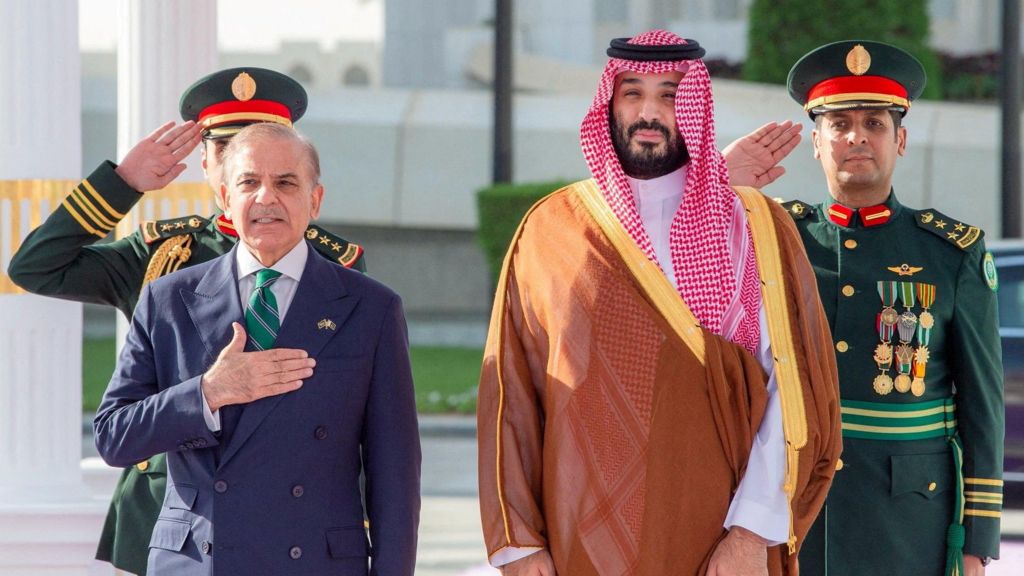
In a significant geopolitical development, Saudi Crown Prince Mohammed bin Salman and Pakistani Prime Minister Shehbaz Sharif inked a landmark strategic mutual defense agreement last week in Riyadh. The pact, described as an “institutionalization of long-standing and deep cooperation” by a senior Saudi official, has stirred considerable debate, particularly in India, which views the agreement as a potential threat to its national security. The agreement stipulates that “any aggression against either country shall be considered an aggression against both,” a clause that has unsettled Indian analysts. Brahma Chellaney, an Indian strategist, argued that the pact reflects Saudi Arabia’s ambitions rather than Pakistan’s strength, binding a “chronically dependent” partner to gain manpower and nuclear “insurance.” Former Indian foreign secretary Kanwal Sibal labeled the agreement a “grave misstep,” warning of its implications for India’s security. While India’s government has adopted a cautious stance, stating it will study the pact’s implications, the move has reignited tensions between India and Pakistan, who have a history of conflicts, particularly over Kashmir. Some analysts, however, downplay the immediate risks, noting Saudi Arabia’s extensive economic ties with India, its second-largest trading partner. Michael Kugelman, a foreign policy analyst, suggested that the pact does not directly hinder India but embeds Pakistan in the Middle East’s security architecture, leaving India facing a coalition of Pakistan, China, Turkey, and now Saudi Arabia. Husain Haqqani, a former Pakistani ambassador, warned that the pact could position Saudi Arabia as a Cold War-style patron for Pakistan, bolstering its military capabilities against India. The agreement also signals Saudi Arabia’s broader strategic shift, diversifying its security partnerships amid declining faith in the US security umbrella. Ahmed Aboudouh of Chatham House noted that the pact is more about signaling intent than battlefield commitments, reflecting Saudi Arabia’s perception of threats from both Iran and Israel. For India, the pact’s broader geopolitical implications could complicate its ‘Look West’ strategy, potentially hardening into an “Islamic Nato” that challenges its trade and investment interests in the Gulf. While the immediate security threat to India remains unclear, the pact has undoubtedly reshaped regional alignments, leaving Delhi to recalibrate its diplomatic and strategic approach.