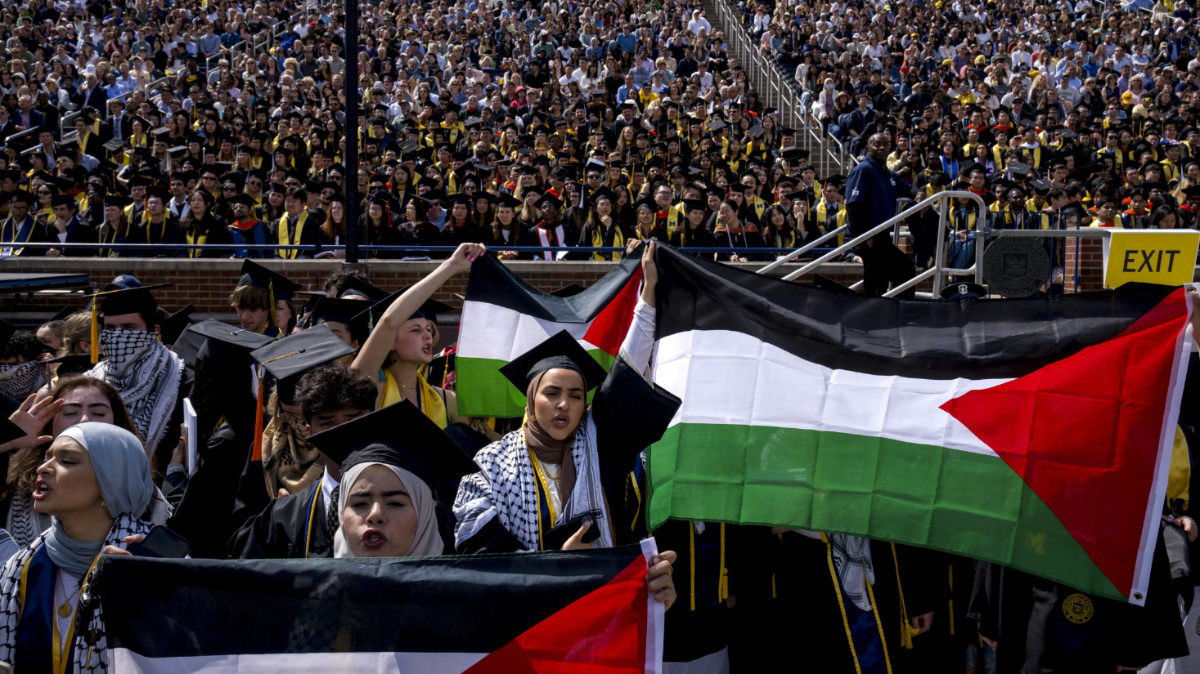
In a landmark show of collective stance, 58.2% of the roughly 8,000-member University of Michigan (UM) Faculty Senate has voted to pass a formal resolution backing 12 former students and staff, now facing federal criminal indictments over their participation in 2024 pro-Gaza anti-war campus encampments. Beyond its symbolic weight, the vote lays bare the prevailing ideological position of a large share of the institution’s teaching staff on ongoing debates over Palestine solidarity and free speech on U.S. campuses. The adopted resolution frames the U.S. Department of Justice (DOJ)’s recent indictments as part of a wider nationwide campaign targeting both Palestine solidarity movements and organized labor in the country. It also explicitly names the University of Michigan Police Department (UMPD) as a participant in the repression of students’ constitutionally protected speech – a specific claim that drew sharp public pushback from Faculty Senate chair Kentaro Toyama. In an internal email circulated to faculty, Toyama conveyed his deep dismay over the inclusion of UMPD in the resolution’s language, arguing that even if the allegations against the department were accurate, UMPD operates under the direct oversight of UM’s president, and rank-and-file officers are only following standard civilian-led law enforcement protocols unless they act in open defiance of university leadership or professional ethical guidelines. He further noted that the complex, legally ambiguous nature of the issues covered by the resolution raised significant procedural concerns. The resolution was formally introduced earlier this month by Adi Saleem, an assistant professor of Romance Languages & Literatures and Judaic Studies, who shared with Middle East Eye (MEE) that proponents of the measure faced immediate, targeted backlash in its aftermath. Saleem, a Muslim academic, reported that he and a colleague were publicly labeled “Nazis” by resolution opponents, and that critics had deployed bad-faith accusations of antisemitism to discredit the initiative, a line he dismissed with pointed sarcasm given his own Jewish studies appointment. In the weeks following the resolution’s passage, supporters became the target of a coordinated right-wing and Zionist social media campaign, with their faces featured in dozens of online videos falsely accusing them of antisemitism. Yarden Azoulay Katz, an assistant professor of American Culture and Digital Studies who was targeted in the campaign, argued that Toyama’s critical public statement was not made independently, but came in response to intense political pressure from UM’s board of regents, wealthy right-wing donors, and pro-Israel lobbying groups. Katz outlined that Toyama’s remarks aligned perfectly with the pre-approved narrative pushed by those external stakeholders: equating Hamas with unqualified terrorism, framing Israeli state legitimacy as non-negotiable, limiting Palestinian territorial claims solely to the West Bank and Gaza, and positioning campus law enforcement as an unassailable force for public safety. He added that Toyama’s statement even implied the 12 indicted activists were guilty of wrongdoing despite a complete lack of formal vandalism convictions against them, and criticized the Faculty Senate leader for refusing to disclose the full scope of external pressures that prompted his public rebuke. MEE confirmed it has reached out to University of Michigan administration for an official response to the ongoing controversy. The developments mark the latest chapter in a nearly two-year pattern of disciplinary action, firings, and intimidation targeting pro-Palestine voices at UM, as previously documented by MEE’s on-the-ground reporting. As recently as June 2025, FBI agents carried out high-profile, forceful home raids targeting UM students and alumni who participated in the 2024 Gaza encampments. The crackdown predates the 2025 inauguration of the Trump administration, which has openly pledged to escalate legal action against pro-Palestine activists and critics of Israeli state policy. Back in September 2024, then-Michigan Attorney General Dana Nessel filed state-level criminal charges against 11 UM students and alumni, labeling their encampment participation as “violent and criminal conduct” – charges that were fully dismissed by May 2025 after Nessel announced her office no longer considered the cases a productive use of public resources. The new round of federal indictments was filed just last month by the DOJ, now led by Todd Blanche, a former personal attorney for President Donald Trump, naming 12 additional 2024 encampment participants. The sweeping charges include counts of conspiracy to transmit institutional threats, conspiracy to tamper with witnesses, and destruction of property to prevent seizure. U.S. Attorney for the Eastern District of Michigan Jerome F. Gorgon Jr. went so far as to publicly claim the defendants had “terrorized Jewish communities” through their protest activities. Katz pushed back sharply against the legitimacy of the charges, noting that the core of the prosecution’s case rests entirely on social media communications, with no tangible, substantive evidence to back up the conspiracy allegations. He further pointed out that none of the alleged property damage cited in the indictments involved federal buildings, making the DOJ’s intervention in what would otherwise be a local minor vandalism case legally unwarranted. The DOJ’s formal indictment documents also cited a purported nationwide surge in pro-Hamas sentiment on U.S. college campuses during the 2024 encampment wave, which unfolded between March and May 2024 – a period when Israeli military forces were killing an estimated 200 Palestinian civilians per day in their ground assault on Gaza, and then-President Joe Biden refused to leverage U.S. military aid to pressure Israel to end the offensive. Zainab Hakim, a former UM student turned university staff member who is named as one of the indicted “Michigan 12,” previously told MEE that the federal government’s efforts to frame peaceful First Amendment-protected protest as violent criminal activity is a deliberate tactic to dismantle the U.S. Palestine solidarity movement. Hakim emphasized she holds no regrets for her advocacy work, and warned that failure to push back against the current wave of repression could lead to far more severe crackdowns on free speech nationwide. A dedicated community legal fund has since been established to cover legal costs for the 12 indicted activists facing federal prosecution.
Majority of University of Michigan faculty vote in support of pro-Palestine students facing charges