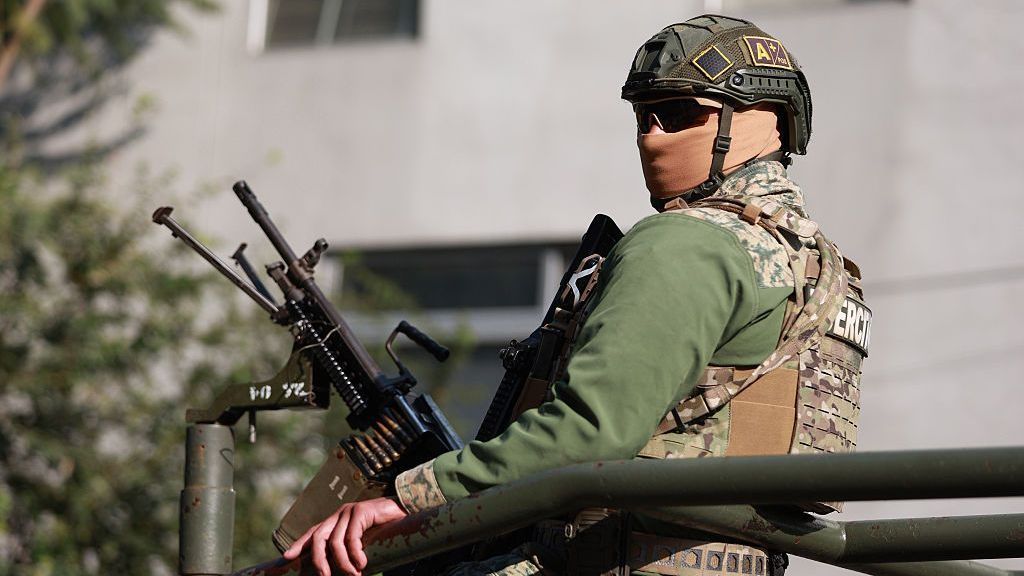
Following the high-stakes Friday apprehension of Fausto Isidro Meza Flores — better known by his alias “Chapo Isidro,” a long-time fugitive who sat on the FBI’s 10 Most Wanted list for years — Mexican military units have arrested eight additional alleged associates of his criminal network amid ongoing efforts to quell widespread retaliatory violence across northern Sinaloa state. The Mexican Secretariat of National Defense (SEDENA) confirmed that the latest detentions unfolded on Sunday, after patrolling troops in the municipality of Sinaloa de Leyva came under direct gunfire from the suspects while working to restore public order in the aftermath of the drug lord’s arrest. Among the eight individuals taken into custody, SEDENA verified one is a minor, and the operation also yielded six seized vehicles, two of which were heavily modified with armored plating and mounted gun turrets for tactical combat use. The top-tier operation that netted Chapo Isidro relied on stealth and tactical surprise: special forces units moved in on the fugitive’s residence, established a layered security perimeter to block both his escape and incoming cartel reinforcements, though a fierce exchange of gunfire broke out during the raid. Alongside Chapo Isidro, his second-in-command identified only as “Serafín” and the cartel’s lead financial operator were also arrested, and all three high-value targets were immediately airlifted to Mexico City for processing. News of the top leadership’s arrest triggered immediate, widespread chaos across Sinaloa: cartel operatives erected makeshift barricades on major regional thoroughfares, set fire to civilian vehicles and local storefronts, and engaged in running shootouts with state and federal security forces. Sinaloa’s state prosecutor’s office confirmed that 17 people — four of whom were members of Mexican security services — lost their lives in the wave of violence that stretched from Friday through the early hours of Saturday. Long a priority target for U.S. law enforcement, the 44-year-old Chapo Isidro built a decades-long criminal trajectory that began with the Juárez Cartel, before he rose to serve as the top lieutenant for the head of the Beltrán Leyva Organisation, a once Sinaloa Cartel-aligned gang that later split into a bitter rival faction. By 2013, the U.S. Treasury formally designated him as the leader of his eponymous transnational drug trafficking network, which was responsible for smuggling massive shipments of methamphetamine, heroin, marijuana, and cocaine into U.S. territory. The Treasury noted that the turf war between his organization and the Sinaloa Cartel drove a 400% surge in drug-related homicides across the region between 2009 and 2013. Per organized crime monitoring body Insight Crime, Chapo Isidro maintained a deliberately low public profile over the last 10 years, while continuing to run his cartel’s operations out of the Sinaloa municipality of Guasave. U.S. law enforcement officials have lauded the cross-border operation as a landmark success: the U.S. Department of Justice called the arrest a “spectacular military operation” and congratulated Mexican armed forces and special operatives, while acknowledging critical support from the U.S. Homeland Security Task Force that enabled the bilateral mission. U.S. Assistant Attorney General A. Tysen Duva labeled Chapo Isidro “the most dangerous man in Mexico,” accusing him of decades of advancing the Sinaloa Cartel’s violent, terrorist-style objectives while flooding U.S. communities with lethal illicit substances. The head of the U.S. Drug Enforcement Administration further emphasized that the capture dealt a crippling, significant blow to a ruthless criminal network that has deployed extreme brutality to traffic fentanyl — classified as a weapon of mass destruction under U.S. law — across American neighborhoods. The successful operation is widely viewed as a major early win for the administration of Mexican President Claudia Sheinbaum, who has repeatedly articulated a policy of collaborative work with U.S. law enforcement to pursue high-priority criminal targets, on the strict condition that Mexico’s national sovereignty is fully respected. In the wake of the unrest, Mexican authorities have deployed additional specialized security personnel to guard the detention facility holding Chapo Isidro, to prevent any attempted cartel raid to free the imprisoned drug lord.