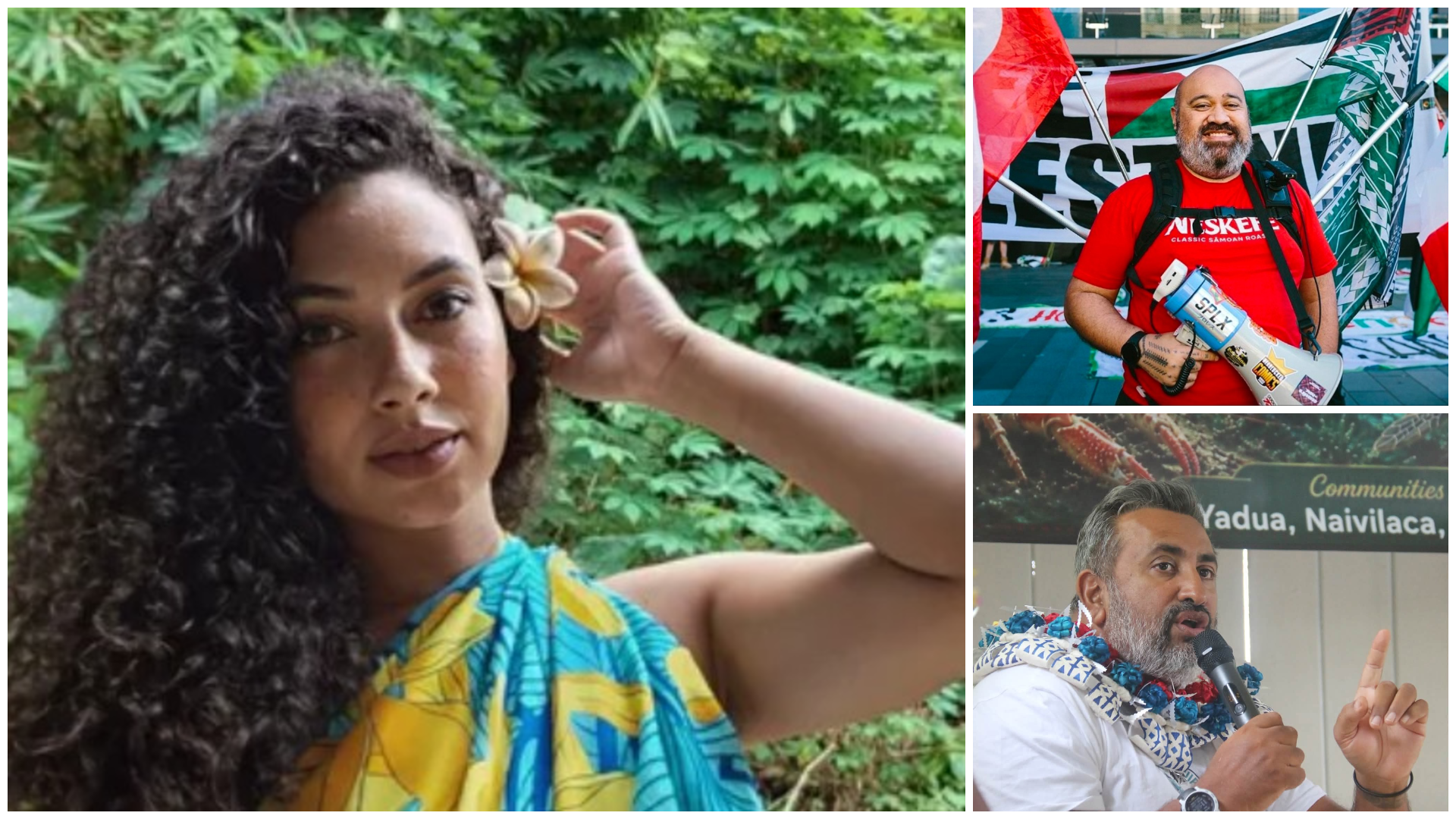
Michel Mulipola, a New Zealand-based Samoan comic book artist, former professional wrestler, ex-Green Party electoral candidate and lifelong Indigenous sovereignty activist, carries a legacy of anti-colonial resistance woven directly into his family lineage. His great-grandfather Mataʻutia Karauna Solomona served as a core secretary of Samoa’s iconic Mau movement, the 1920s and 1930s grassroots campaign to end New Zealand’s brutal colonial occupation of Western Samoa. Solomona’s 1929 arrest triggered the infamous Black Saturday massacre, where New Zealand military and police forces gunned down dozens of unarmed Mau protesters, cementing a multigenerational commitment to freedom that Mulipola describes as “in my blood.”
Mulipola rose to regional prominence for a viral custom artwork reimagining the Palestinian national flag using traditional Samoan petroglyphs, crafted to illustrate the shared fight for self-determination between Pacific Indigenous communities and Palestinian people. The piece spread rapidly across Samoan diaspora networks, with community members printing the design to carry at pro-Palestine rallies across the globe. But the widespread attention also drew fierce backlash: Mulipola, an avowed atheist, was publicly accused of abandoning his Samoan cultural identity simply for refusing to endorse the state of Israel. These hostile reactions laid bare a long-simmering, underdocumented tension across the Pacific Islands, decades in the making, that has intensified since the outbreak of the 2023 Gaza genocide.
A small but fast-growing cohort of young Pasifika theologians, intellectuals and community organisers is now pushing back against 70 years of evangelical missionary conditioning, heavily exported from the United States, that has tied uncritical political support for Israel directly to local cultural and religious identity. For generations, questioning pro-Israel stances has been framed as a personal insult to one’s own community, rather than a legitimate political position, entangling debates over Palestine with far deeper conversations about colonial legacies, Indigenous identity, unaccountable religious authority, and the fundamental right of all peoples to self-governance.
While Christianity was first introduced to Pacific island communities by European missionaries starting in the late 18th century, and gradually integrated into local social and cultural life, the specific strain of Christian Zionism that now dominates many evangelical spaces is a far more recent phenomenon, according to Reverend James Bhagwan, General Secretary of the Pacific Conference of Churches (PCC). The PCC, an ecumenical body representing 35 national denominations and 11 national church councils across 20 Pacific states and territories, has spent decades advocating for Indigenous self-determination in occupied territories including West Papua, Kanaky (New Caledonia) and French Polynesia. Bhagwan notes that Christian Zionism has “slowly crept into every corner of Pacific community life over the last 40 years”, riding the expansion of US-backed Pentecostal and evangelical movements across the region. He emphasizes that his organisation cannot arbitrarily pick and choose which Indigenous liberation movements to support, and argues that many Pacific Christians have been deliberately misled to conflate the biblical historical Israel, the modern 20th century state of Israel, the Jewish faith, and Zionist political ideology, leading them to adopt pro-Israel positions rooted in religious dogma rather than factual understanding of Palestinian lived reality.
This widespread lack of public awareness extends even to the existence of Palestinian Christian communities, a fact Mulipola witnessed firsthand during a 2023 counter-protest against Destiny Church, the radical New Zealand Pentecostal movement led by prominent pro-Israel activist Brian Tamaki. As Tamaki railed against pro-Palestine demonstrators, Mulipola’s friend Rand Hazel — a Palestinian Christian born in Jerusalem whose family spoke Aramaic, the native language of Jesus — took the megaphone to introduce himself, leaving Tamaki visibly stunned. Mulipola explains that most Pacific communities have been inundated with Eurocentric propaganda that falsely frames all Palestinians as Muslim, and frames unconditional support for Jewish migration to the Holy Land as a non-negotiable religious duty.
In Fiji, award-winning journalist and activist Mara Mahoney has spent years unpacking how these false narratives became embedded in local culture. Raised in the remote Savusavu village, Mahoney was immersed from early childhood in evangelical Bible study, mandatory church attendance and Christian schooling that taught her the modern state of Israel was the exclusive home of God’s chosen people, and propagated the unsubstantiated myth that Indigenous Fijians are direct descendants of the biblical Lost Tribes of Israel. This fabricated origin story, first circulated by 19th century British missionaries in the decades between 1835 and Fiji’s 1874 cession to the British Crown, was carefully woven into existing Fijian oral storytelling traditions and pseudo-genealogical records to make questioning support for Israel feel like an act of betrayal against one’s own ancestry and faith. As Mahoney explains, when activists attempt to share documented facts about the 1948 Nakba and Palestinian dispossession, many community members push back saying “who are we to question God?”, as challenging pro-Israel positions means confronting an entire interconnected system of colonial education, family expectation and deeply held personal identity.
Mulipola notes that much of the Christianity imposed on Pacific communities under colonial rule was intentionally structured around fear, framing “God-fearing” obedience as a core moral value rather than a manipulative, abusive tool of control that punishes anyone who dares to speak out against authority. In Samoa, this dynamic is reinforced by fa’aaloalo, the longstanding cultural norm of deference and respect for elders and community leaders, which discourages open pushback against religious figures who promote Christian Zionist talking points. Mahoney confirms an identical dynamic operates across Fijian communities, where cultural respect for senior leaders often overrides willingness to challenge false political narratives.
For Mulipola, the parallel between his great-grandfather’s anti-colonial Mau movement and the modern Palestinian struggle is not merely symbolic: both are fights for sovereignty, collective dignity, and the inherent right of a displaced people to determine their own future. His Samoan petroglyph Palestinian flag artwork is designed to make that shared history of resistance visible, highlighting the identical core value of “steadfastness” that defines both the Samoan concept of mau and the Palestinian cultural value of sumud.
Activists are now developing community-led, culturally rooted strategies to shift public opinion, rather than adopting confrontational approaches that alienate their own communities. Mahoney uses TikTok to share accessible, fact-based educational content, centred around the traditional Pacific practice of talanoa: open, non-adversarial meaningful dialogue that prioritises curiosity over winning arguments, rather than aggressive interrogation designed to prove opponents wrong. Even with family members who hold fiercely pro-Israel views, she notes that many people privately acknowledge the injustice of civilian casualties in Gaza once they are given safe space to speak without judgement, even if they are not yet ready to reject the broader ideological framework of Christian Zionism. Bhagwan argues that building direct, sustained relationships between Palestinian Christian communities and Pacific church networks could further dismantle widespread misinformation, particularly if programming centres young people across both regions.
Beyond cultural and social barriers, activists note that Pacific government positions on Palestine are heavily shaped by pragmatic geopolitical and economic pressures. Recent United Nations votes on Palestinian self-determination, refugee aid and illegal Israeli settlements show deep regional divisions: traditional Israeli allies including the Marshall Islands, Samoa and Tuvalu have softened their longstanding opposition to pro-Palestine resolutions to abstentions or absences, while Micronesia, Palau and Nauru continue to vote in lockstep with Israel, and Fiji, Tonga and Papua New Guinea split their votes across different measures. Pro-Palestine organising is explicitly criminalised in Fiji, where police routinely reject applications for protest permits and issue formal warnings to community organisers. Bhagwan explains that small Pacific island states, already crippled by existential climate change threats and underfunded development priorities, are targeted with targeted aid, investment and diplomatic partnerships by both the United States and Israel, which have far more resources to offer than Palestinian diplomatic representatives. Mulipola notes that Israel is actively expanding its regional outreach, including securing an invitation to attend the 2025 Pacific Leaders Forum, leveraging decades of built Christian Zionist ties to advance its geopolitical interests while Palestine lacks the funding and diplomatic footprint to compete for influence.
While both Mahoney and Mulipola acknowledge that generational attitude shifts will take years, and that many community members too trapped by fear will never change their views, they point to a fast-growing cohort of young Pasifika people who are now questioning the uncritically accepted religious and political narratives they were raised on, offering tangible hope for a future where Pacific Indigenous self-determination movements stand in full, unapologetic solidarity with Palestine.