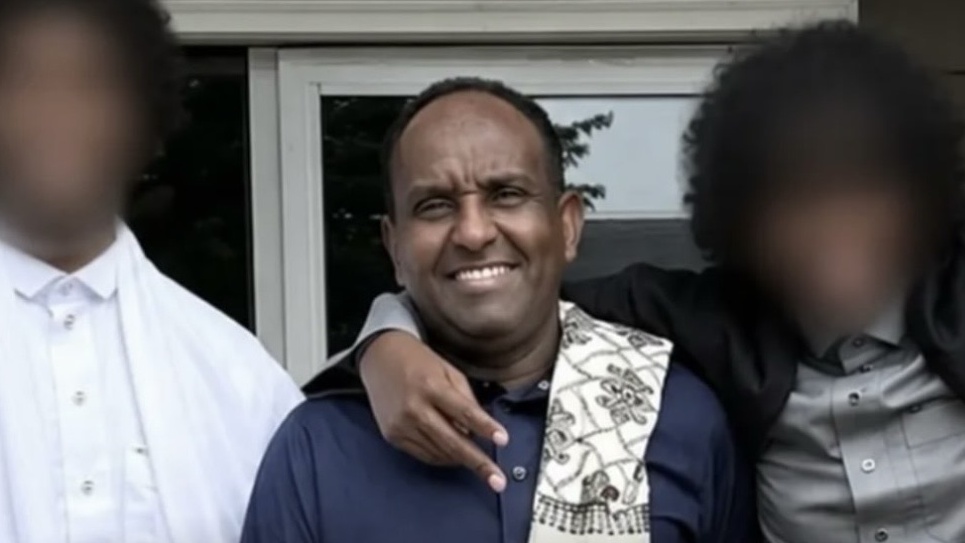
A 2026 late-night violent assault in a Minneapolis suburb has left a beloved Somali-American rideshare driver clinging to life in a medically induced coma, sparking widespread community outcry over rising anti-Muslim and anti-Somali rhetoric across the U.S. state of Minnesota, home to one of the nation’s largest Somali diaspora populations.
Mohamed Yusuf, a dedicated Uber driver and devoted family breadwinner, was on shift in Hopkins, Minnesota, in the early hours of November 14 when a passenger allegedly initiated a targeted confrontation. After asking for Yusuf’s name, the suspect openly stated he held animosity toward the name “Mohamed” before launching a brutal, unprovoked attack: he strangled Yusuf from behind, wrested control of the driver’s vehicle, and struck him multiple times with the car before leaving him for dead in a roadside ditch nearly a mile from the initial site of the assault. First responders who were dispatched to reports of a suspicious abandoned vehicle at approximately 1:20 a.m. discovered Yusuf suffering from catastrophic, life-threatening injuries: multiple broken ribs, fractured legs, two collapsed lungs, severe spinal damage, and extensive internal bleeding. He remains in critical condition at Hennepin County Medical Center, unconscious and fighting for his life, according to his grieving family.
Local law enforcement confirmed that a male suspect identified in arrest records as 29-year-old Samit Apurva Patel was taken into custody on November 14 and charged with first-degree assault, though Hopkins police have not yet formally linked Patel to Yusuf’s assault, publicly named the suspect in the ongoing case, or established an official motive for the attack. Investigators have also not yet classified the incident as a hate crime, a gap that has fueled urgent demands from community members for a thorough, transparent probe into potential bias as a driving factor.
The harrowing incident has ignited widespread outrage across Minnesota’s Somali and Muslim American communities, with advocates, elected officials, and religious leaders uniting to condemn the violence and call for accountability. U.S. Congresswoman Ilhan Omar, a prominent Somali-American representative for Minnesota, issued a forceful statement on X (formerly Twitter) framing the assault as a preventable act of racial violence rooted in sustained dehumanization of marginalized communities. “My heart is with Mohamed and his family. I am praying for his full recovery. This horrific act of racial violence is unacceptable. No one should live in fear because of who they are. The relentless dehumanization of the Somali community has real consequences. We must unequivocally condemn this violence and reject the hatred that divides our communities,” she wrote.
High-profile Muslim-American scholar Dr. Omar Suleiman also addressed the attack, noting that targeted assaults against Minnesota’s Somali population have spiked in frequency in recent months. “Attacks on our Somali community are more and more frequent. Mohamed Yusuf went to work to provide for his family and is now fighting for his life after a horrific attack. May Allah grant him a full recovery and hold accountable those who spread and act upon such hatred,” he shared in a public social media post.
At a press conference held outside Hennepin County Medical Center two days after the attack, Jaylani Hussein, executive director of the Minnesota chapter of the Council on American-Islamic Relations (CAIR-MN), explicitly tied the violence to years of inflammatory political rhetoric targeting Somali immigrants. He cited repeated derogatory public remarks from former President Donald Trump, Minnesota House Majority Whip Tom Emmer – who recently claimed on a conservative podcast that Minnesota had “inherited Somalia’s civil war” – and local far-right agitators as key contributors to a festering climate of bigotry that normalized anti-Somali hostility. “For more than a year and a half, Muslims across this country, and specifically Somali Americans here in Minnesota, have lived in an unwritten climate of fear, hatred, bigotry and dehumanisation,” Hussein told assembled reporters, elected officials including Minneapolis Mayor Jacob Frey, and a crowd of fellow rideshare drivers. “This rhetoric has built an environment that we are living in today, an environment which we believe has created this heinous attack that took place on Saturday night here in Minnesota. This attack did not happen in a vacuum. It was created, festered and driven by sustained campaigns of dehumanization.”
Family members of Yusuf echoed these concerns in public statements, with one relative posting on X that the passenger explicitly stated he “hated people named Mohamed” during the assault. “I’m angry at our government for feeding that hatred with its anti-Muslim and anti-Somali rhetoric,” the post read, adding that Yusuf was widely known as a gentle, generous man who only ever wanted to work to support his household. Minnesota State Senator Omar Fateh also joined calls for a fully transparent, expeditious investigation, noting that Yusuf “should be home safe with his family, not fighting for his life after an attack fueled by hatred towards his Somali identity.”
Rideshare platform Uber issued an official statement condemning the assault, noting that the accused passenger has been permanently banned from the platform and that the company will provide full cooperation with ongoing law enforcement investigations. A community-led GoFundMe campaign launched to cover Yusuf’s mounting medical bills and support his family has already raised more than $140,000 as of press time, as hundreds of local residents, fellow drivers, and advocates rally to stand in solidarity with the injured driver and his loved ones.