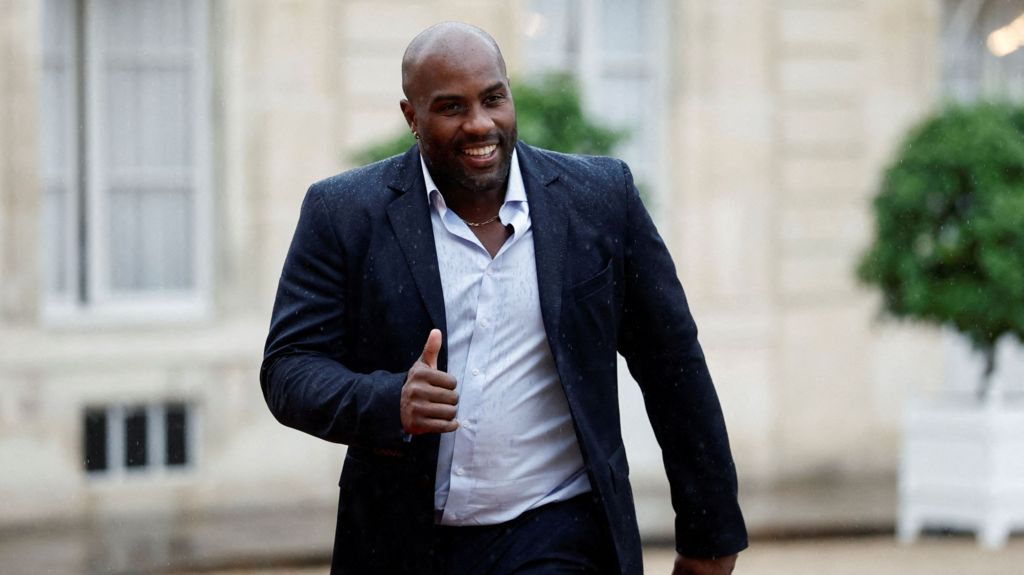
On the surface, the disciplined, rule-bound world of elite competitive judo and the often fractious arena of French electoral politics share almost no overlapping traits, save for the core goal of outmaneuvering an opponent to secure a decisive win. That unspoken disconnect has done nothing to deter Teddy Riner, the Guadeloupe-born 37-year-old five-time Olympic gold medalist and 11-time world heavyweight judo champion, from formally throwing his hat in the ring for France’s upcoming April 2027 presidential election, marking one of the most unexpected outsider candidacies in the nation’s recent political history.
At this early stage, Riner’s campaign infrastructure is remarkably sparse: he holds no prior public office experience, has no formal political party backing, and has not yet published a detailed policy manifesto. The entire public-facing footprint of his bid to date consists of a simple campaign slogan “La France qu’on aime” (The France we love), a viral social media announcement, and a single initial campaign stop at a hospital in Paris’ northern Seine-Saint-Denis suburb. Despite this apparent lack of traditional political preparation, no seasoned electoral analyst can afford to dismiss Riner’s chances out of hand. He is consistently ranked as one of the most beloved public figures in contemporary France, regularly topping national public opinion polls as a figure who embodies widely cherished national values, with a decorated athletic record and a thriving parallel business career that have cemented his broad cross-demographic appeal.
His carefully produced, decorous campaign launch video, filmed against a backdrop of books and the French national flag, has amassed more than 28 million total views across Instagram and X, with 14.5 million views recorded on Instagram alone. An Ifop poll conducted within 24 hours of the video’s release found that 22% of surveyed French voters stated they would be open to casting their ballot for the champion athlete. The precedent for high-profile sports and entertainment figures ascending to head of state office is already well established globally, from Liberia’s former president and ex-professional footballer George Weah to a long line of celebrity-turned-politicians across multiple continents, leading many French voters to openly question why a decorated judoka could not one day occupy the Élysée Palace.
“Anyone who writes Riner off for being an outsider to the closed, established political in-crowd is making a huge mistake,” Guillaume Tabard, a senior political analyst at leading French daily Le Figaro, told local media. “But Riner would be equally mistaken if he believes that his status as a non-political figure is sufficient to carry him all the way to the presidency.”
Virtually the entirety of France’s traditional political class has opted to treat Riner’s candidacy with genuine seriousness, or at minimum performative respect, a choice driven by two key calculations. First, Riner’s unparalleled national popularity means any attempt to mock his presidential ambitions would risk a fierce public backlash that would backfire on his critics. Second, the current state of France’s mainstream centrist political landscape is defined by widespread disarray, as the established middle ground of French politics struggles to field a candidate capable of matching the clear public enthusiasm for hard-right leader Marine Le Pen and hard-left firebrand Jean-Luc Mélenchon, who are currently widely projected to face off in the second, final round of the presidential election next May.
Positioning himself explicitly as “neither left nor right”, Riner has centered his early campaign messaging around promises to unify a deeply divided nation, put more disposable income back into ordinary households, and push back equally against racist extremism and street-level anti-social behavior that erodes public safety. His entry into the race has forced every established political campaign to recalibrate their strategies, as his broad popular appeal cuts across traditional partisan lines. While many political observers predict his campaign could quickly fizzle out once the initial hype of his celebrity announcement fades and he is forced to confront detailed policy scrutiny, there remains a tangible possibility that his outsider momentum could upend all existing pre-election polling projections, a shift that would bring no joy to France’s struggling centrist factions.
To date, Riner has proven himself a skilled practitioner of the core rhetorical playbook for successful outsider anti-establishment candidacies, leaning heavily into the central refrain: “Don’t Worry! I’m NOT a Politician!” In an era where any public figure associated with the traditional French political “system” is automatically viewed with deep suspicion by large swathes of the electorate, Riner has framed his lack of insider experience as a key strength, arguing that his background as a high-achieving elite athlete and successful private sector businessman has given him unfiltered access to the real, everyday struggles of ordinary French people that insulated, out-of-touch political apparatchiks are completely blind to.
In his widely shared launch address, Riner deployed rousing, accessible rhetoric to connect with disaffected voters: “People say I am a fool for wanting to run for the presidency. Am I a fool? Well, if refusing to see France sink under the weight of debt; refusing to see mothers and fathers grit their teeth every time they do their weekly shop, and tremble with fear when their kids go out on the street… if all that means being a fool, then yes call me a fool.”
That strong opening performance has won him widespread public attention, but the hard work of building a credible presidential campaign is only just beginning. Riner has yet to outline detailed positions on a suite of pressing national policy priorities, including controversial pension reform, public education investment, the ongoing cost of living crisis, France’s ballooning public debt, the rise of domestic populist extremism, and the nation’s long-term stance on Russia’s ongoing full-scale invasion of Ukraine. The broad outlines of his early policy positioning suggest he leans toward center-right stances on economic governance and law and order issues, while his Guadeloupean heritage has positioned him as a vocal, high-profile advocate for anti-racism efforts, with his public condemnation of extremism largely targeted at Marine Le Pen’s hard-right National Rally movement. His self-styled centrist, anti-extremist platform, however, is entering an already overcrowded political space: more than a dozen separate candidates are currently vying for support from France’s broad centrist electorate, ranging from the Socialist Party-backed Raphaël Glucksman to the Republicans’ Bruno Retailleau, with former prime ministers Edouard Philippe and Gabriel Attal also failing to gain meaningful popular traction. There is even widespread speculation that Christine Lagarde, the current head of the European Central Bank who will step down from her post next February, could enter the race as another centrist contender.
The addition of Riner’s high-profile candidacy will almost certainly further dilute the already fragmented centrist vote share, a dynamic that makes it far more likely that Jean-Luc Mélenchon will secure a spot in the election’s final second round run-off. That explains the uncharacteristically positive reaction from Mélenchon, leader of the hard-left France Unbowed (LFI) party, who told reporters last week: “We know how it goes: neither right nor left means not left.” The only other major political figure who appears genuinely enthusiastic rather than performing a polite, forced smile at Riner’s announcement is sitting French president Emmanuel Macron, who publicly praised Riner as a “great champion” and argued that politics “did not belong to the professionals”. Many political analysts note that Macron’s warm reception is likely driven by his long-running, frosty public rift with his former prime ministers Philippe and Attal, both of whom have worked aggressively to distance themselves from the deeply unpopular sitting president. Riner has moved quickly to dismiss any suggestions he is aligned with Macron’s administration, describing the president’s public praise as a “poisoned chalice” and telling reporters: “I’m not the president’s envoy, I’m not a Macronist.”
While competitive judo is famously known as “the gentle way” in its original Japanese etymology, and governed by strict rules of mutual respect and formal pre- and post-match bows, Riner will soon discover that French presidential politics is a far more unforgiving arena, where opponents rarely show deference and often deploy brutal, unregulated attacks to take down rivals. If his campaign continues to gain momentum and he evolves from a novelty outsider candidate to a genuine electoral threat, he can expect his personal life, professional record, and every past public statement to be subjected to relentless, often hostile scrutiny from both rival campaigns and the national press.