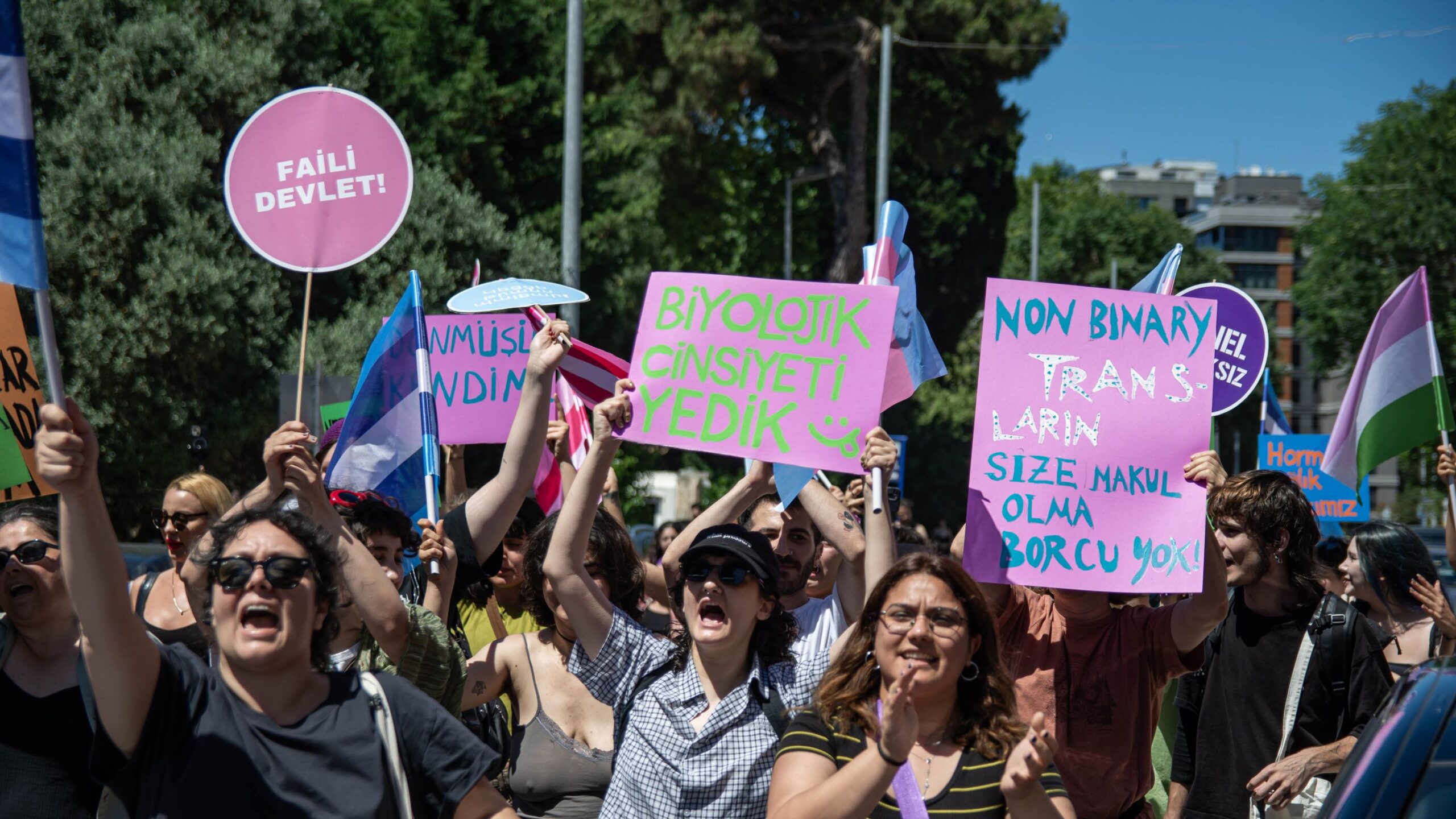
Istanbul’s provincial governor’s office carried out a forced sealing operation on Wednesday, shuttering the physical headquarters of Lambda Istanbul LGBTI+ Solidarity Association, the oldest continuously operating LGBTQ+ advocacy group in the country, under the official justification that the space was functioning as an unregistered, unauthorized social club.
Founded in 1993 by a cohort of activists who had organized Turkey’s very first Pride march in Istanbul, Lambda Istanbul opened its permanent community office in 2002 and secured full formal legal registration as a civil society association four years later, in 2006. In an official public statement released immediately after the raid, the group pushed back sharply against the authorities’ framing of its decades of transparent, publicly documented operations, noting that all of its activities had long been conducted in full alignment with official regulatory requirements. The organization condemned the office closure as a deliberate new step in a broader state campaign designed to marginalize queer communities, strip LGBTI+ people of safe communal gathering spaces, and systematically erode their fundamental right to peaceful collective assembly.
The wave of enforcement actions did not end with Lambda Istanbul’s closure. On the following day, Thursday, fellow Istanbul-based LGBTI+ advocacy group Hevi LGBTI+ announced that the city’s Chief Public Prosecutor’s Office had submitted a formal indictment seeking the full legal termination of the organization, alongside criminal prosecution of its five founding board members on charges of violating national legislation governing civil associations.
While same-sex relations have never been criminalized under Turkish national law, and public attitudes toward queer communities remain deeply fragmented across the country, the ruling Justice and Development Party (AKP) led by President Recep Tayyip Erdogan has escalated targeted pressure on LGBTQ+ civil society in recent years. Earlier in 2024, Erdogan publicly declared that the period from 2026 onward would be designated the “Decade of the Family,” framing the broader LGBTI+ community as an existential threat to traditional Turkish family structures and core cultural values.
These public statements have coincided with the launch of the sweeping nationwide “My Family is Safe” enforcement operation, which has unfolded over recent months to include raids on hundreds of private residences and civil society offices, detentions of activists and civil society members, and the blocking of more than a hundred social media accounts and independent websites. As of the latest public updates, over 80 individuals have been formally arrested and remain in pre-trial detention, facing a range of heavily contested charges including public obscenity, aiding and abetting prostitution, and maintaining unreported financial ties to foreign entities. The Turkish government and its allied supporters have repeatedly framed these operations as a necessary policy measure to protect family integrity and shield minors from harmful content.
The scope of the crackdown has extended far beyond LGBTI+ specific organizations, with Turkish authorities successfully requesting that social media platform X restrict access to the official accounts of numerous independent civil society and media entities. Blocked accounts include Amnesty International’s Turkish national branch, left-leaning daily newspaper Evrensel, the Academics for Peace network, the Media and Law Studies Association, the Sexual Education, Treatment and Research Association (CETAD) that provides critical support services to people living with HIV and AIDS, and the official account of the Psychiatric Association of Turkey. One other high-profile target is Kaos GL, one of the country’s most widely recognized LGBTQ+ advocacy organizations, where Ankara’s chief prosecutor’s office has confirmed 21 arrests as part of an ongoing separate investigation.
This report is produced as part of Middle East Eye’s independent, in-depth coverage of social and political developments across the Middle East, North Africa, and surrounding regions.