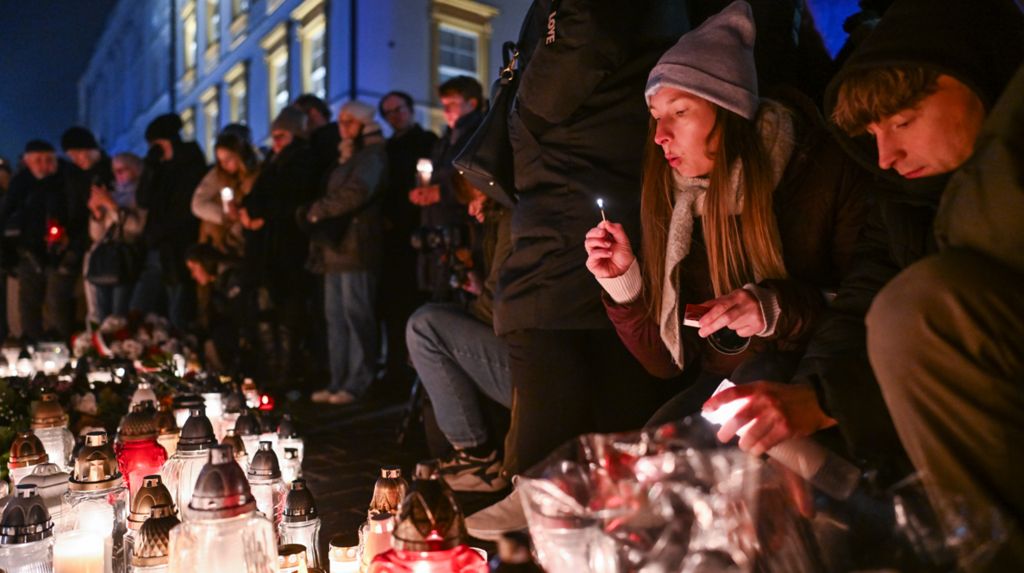
Tens of thousands of Krakow residents, joined by Polish national leaders, gathered for a silent, candle-lit march through the city’s historic core on Monday night, paying tribute to the six people killed and dozens more injured during an unprecedented weekend shooting rampage that has shattered Poland’s long-held reputation as one of Europe’s safest nations.
The somber procession was led by President Karol Nawrocki and Prime Minister Donald Tusk, two figures locked in years of bitter, polarizing political rivalry, who set aside their public feuding for a rare display of national unity to stand with grieving communities in the aftermath of the country’s worst modern mass casualty attack. When the crowd reached Krakow’s 13th-century Market Square, a bugler sounded a mournful note from the tower of St. Mary’s Basilica, as mourners laid bouquets of flowers and lit beeswax candles at small, makeshift shrines marking every cobblestone spot where a victim lost their life.
The alleged perpetrator, 24-year-old Michal Oksinski, was fatally wounded in a shootout with responding police officers shortly after the attack began, and died in hospital in the early hours of Monday without regaining consciousness. Investigators have since uncovered a sequence of premeditated violence: Oksinski is accused of first shooting and killing his parents and sister at his family home, before driving 200 kilometers south to Krakow armed with four legally registered firearms and hundreds of rounds of ammunition, which he and his father had acquired as members of a local civilian shooting sports club.
Initial statements from Poland’s interior minister claiming the attacker was motivated by far-right extremist ideology have since been walked back by the national prosecutor’s office, which confirmed there is no conclusive evidence linking Oksinski to a formal extremist movement, no published manifesto, and no verified ideological motive to date. Dr. Pawel Musialek, a political analyst from Jagiellonian University, criticized the interior minister’s early remarks as a cynical attempt to score domestic political points in Poland’s fiercely divided political landscape, noting that preliminary evidence suggests the attack may have ties to isolated darknet subcultures rather than organized extremist groups. Investigators are currently analyzing Oksinski’s electronic devices, a collection of patches attached to his military-style clothing, and a yellow Gadsden flag found hanging in his bedroom, which prosecutors noted carries multiple overlapping associations with anti-establishment rebellion and libertarian ideas that are not inherently violent or hate-driven.
Two days after the rampage, Krakow’s city center remains open for business but is enveloped in a heavy, subdued mood. Many storefronts still bear visible bullet damage, including a Zara clothing shop whose shattered glass facade remains boarded up. Tourists and local residents alike pause to photograph the pockmarked bullet holes blasted into Market Square’s stone walls, as staff at nearby shops recount the chaos of Saturday’s attack, when crowds mistook the crack of rifle fire for celebratory fireworks before fleeing for their lives.
Victims confirmed so far include a 50-something Polish mother of four who worked as a painter and was visiting Krakow for a local art exhibition, alongside one British citizen and one Austrian national whose identities have not yet been formally released to the public. Several drivers of the iconic horse-drawn carriages that ferry tourists around the square are also recovering from serious gunshot wounds. For many residents who fled conflict to find safety in Krakow, the attack has carried a particularly acute sting: Olha, a Ukrainian refugee who works at a nearby chocolate shop, recalled crowds of terrified people rushing into her store to escape the gunman as he fired through shop windows from his moving vehicle. “We left our war-torn country looking for safety, and this place was supposed to be our sanctuary,” she said, adding that she feels robbed of a chance for full justice now that the attacker is dead.
The attack has sparked immediate nationwide scrutiny of Poland’s firearms regulations, which have been significantly relaxed and expanded for civilian gun owners since the 2022 full-scale Russian invasion of neighboring Ukraine. Oksinski passed all mandatory legal background checks, including required psychological evaluations, to legally own his weapons. The Polish government has since announced an urgent, sweeping official review of all firearms licensing protocols. At the site where police intercepted the gunman’s vehicle, a separate memorial has sprung up to honor the responding officers who were wounded in the shootout, including 30-year-old Jakub Kulik, who remains in critical condition after taking a bullet to the chest. Handwritten cards left by local children and residents thank the officers for their bravery, with one note reading simply: “Thank you Mr Policemen, get better soon.”
Across the city, residents grapple with the sudden, brutal collapse of the national narrative that Poland was an insulated, low-crime oasis untouched by the kind of mass gun violence that has plagued other Western European and North American nations. Many residents interviewed by local media expressed frustration that the attacker died before he could face public trial, leaving the community with no clear explanation for the unprovoked, devastating rampage that shattered dozens of lives.
Polish unity on show in silent march to honour Krakow shooting victims