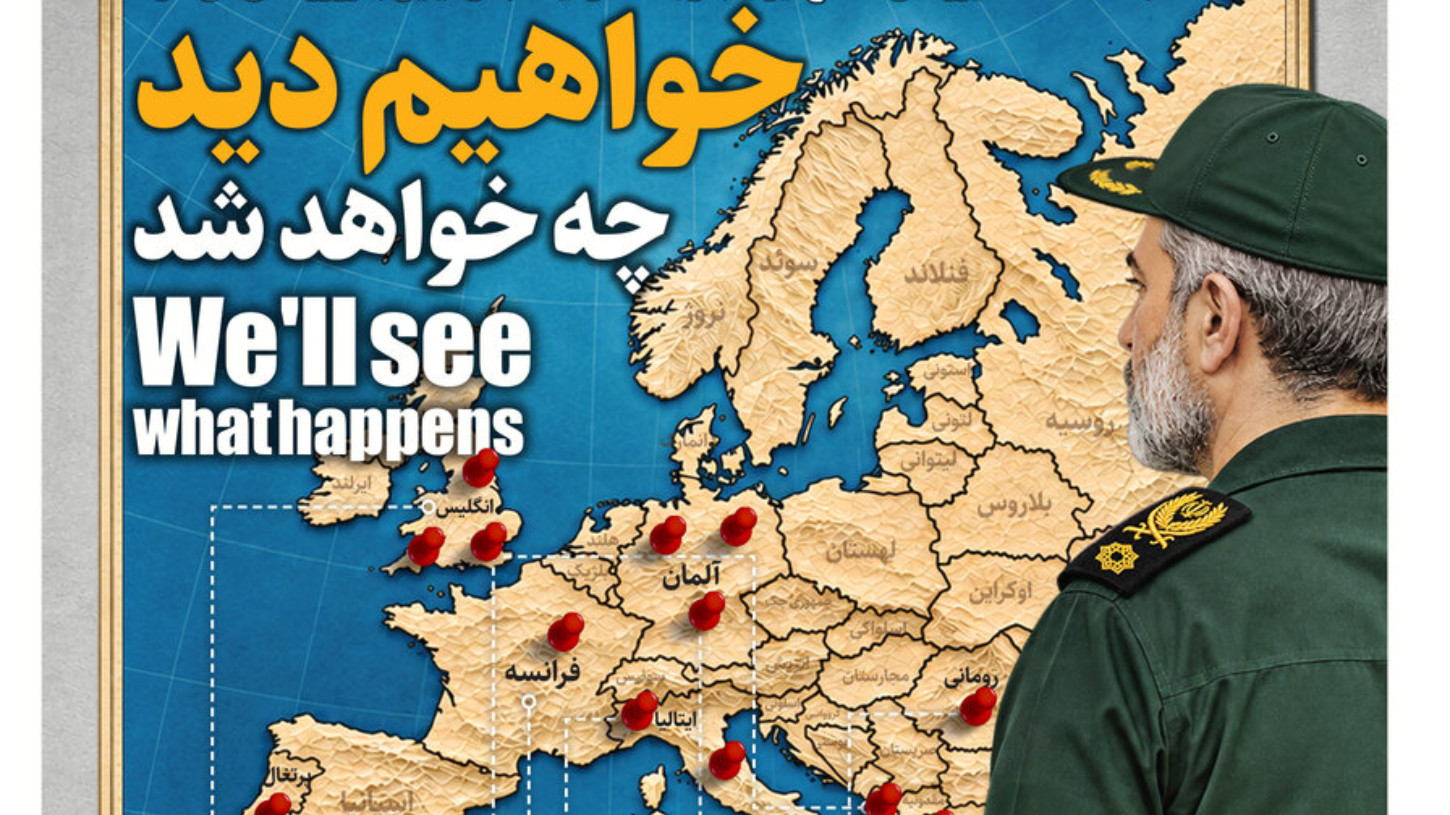
A cascade of reports from Iranian daily newspapers closely affiliated with the Islamic Revolutionary Guard Corps (IRGC) has laid out a public inventory of potential military targets across European nations, in the immediate aftermath of recent US strikes targeting Iran’s Qeshm Island last week. The wave of publications coincides with surging global speculation that the United States may be on the cusp of re-escalating full-scale military confrontation with Iran.
On Tuesday, leading Iranian daily Hamshahri splashed a detailed map of Europe across its front page, explicitly marking US military installations and bases hosted by the United Kingdom, Germany, France, Italy, Romania, Greece, Albania, and Portugal as the formal “target bank of the Iranian armed forces.” The paper framed Iran’s newly updated military posture as a doctrine of “confrontation without geographical limits,” a phrase first coined by Iran’s Supreme Leader Mojtaba Khamenei, noting that under this expanded framework, all US support hubs, air and naval staging grounds, and associated logistical infrastructure across European territory now qualify as legitimate potential targets for Iranian retaliation.
Fellow conservative daily Kayhan, whose top editor is directly appointed by Iran’s supreme leadership, issued an accompanying stark warning: if the United States refuses to meet Iran’s preconditions for a negotiated peace settlement, “the geography of the battle will expand to the heart of Europe and the depth of overseas bases.” The publication further emphasized that Iran’s military doctrine targeting the US, Israel, and their allied nations has shifted to a far more direct, offensive orientation, singling out the United Kingdom as the European state that has played the “most key and prominent role” in ongoing hostilities against Iran.
Against this backdrop, a segment of senior Iranian officials has publicly framed the US Republican Party’s losses in recent midterm elections as a meaningful setback to former President Donald Trump’s long-documented hawkish foreign policy agenda. However, Iranian news platform Khabar Online pushed back against overly optimistic assumptions of imminent US de-escalation, drawing a direct parallel to the 2006 US midterm elections held during the height of the US-led occupation of Iraq. The publication noted that while the 2006 Democratic takeover of Congress was widely expected to force a rapid withdrawal of US troops from Iraq, then-President George W. Bush instead used broad executive war powers to authorize a major “surge” that increased US troop levels on the ground, extending the conflict rather than ending it. Khabar Online concluded that historical precedent demonstrates a congressional majority opposed to war cannot unilaterally halt a presidential administration’s military campaign without unified political coordination and sufficient legislative backing to override a presidential veto.
Additional strategic context emerged from a recent interview with Daniel Levy, a veteran Israeli peace negotiator who participated in the 1993 Oslo B talks, speaking to BBC Persian. Levy revealed that Israel’s February 28 launch of military strikes against Iran was rooted in a deliberate goal of fragmenting the Iranian state, replicating the destabilization campaigns previously implemented in Iraq and Syria. “Israel’s explicit objective was the collapse of the Iranian state, the creation of widespread chaos across the country, and the breakup of Iran into smaller entities – a playbook we already saw executed in Iraq and Syria,” Levy stated, adding that Israeli leadership never truly believed its public propaganda claiming the campaign would trigger spontaneous popular regime change in Iran. He further noted that early reports of Israeli forces funneling weapons to Iranian Kurdish opposition groups based in Iraq aligned with an initial plan to carve out a “liberated” enclave inside Iranian territory, to serve as a staging ground for operations against Iran’s central government. Levy also described Israel’s public embrace of Reza Pahlavi, the exiled son of Iran’s deposed Shah, as a purely temporary tactical move to advance its destabilization goals, rather than a serious commitment to installing him as Iran’s new leader, noting the Pahlavi family was viewed as nothing more than a disposable “tool for creating chaos.”
As military tensions remain at a fever pitch, diplomatic efforts to broker a permanent ceasefire between the US and Iran are quietly gaining traction, with growing speculation that China could emerge as a central broker. Recent high-level diplomatic contacts between Tehran, Beijing, and Muscat point to the emergence of a previously unreported parallel negotiation channel. Pro-reformist Iranian daily Shargh reported that Iranian senior security official Ali Bagheri Kani’s recent closed-door meetings in Beijing could mark the formal launch of this new China and Oman-led diplomatic track, framing the trip as part of Tehran’s ongoing consultations to evaluate new peace initiatives and leverage the influence of major global powers to prevent further catastrophic escalation. Conservative daily Jame Jam meanwhile framed Bagheri Kani’s visit as part of Iran’s broader push to align Moscow and Beijing with its regional policy priorities, alongside ongoing mediation efforts with third-party intermediaries including Qatar and Pakistan. The publication cautioned, however, that mere verbal statements of support from China and Russia will not be sufficient to end the ongoing conflict, noting that meaningful de-escalation will only be possible if these global powers take concrete, practical action to push back against longstanding US unilateral military interventions across the Middle East.
Iranian press review: Newspapers warn of war reaching ‘heart of Europe’