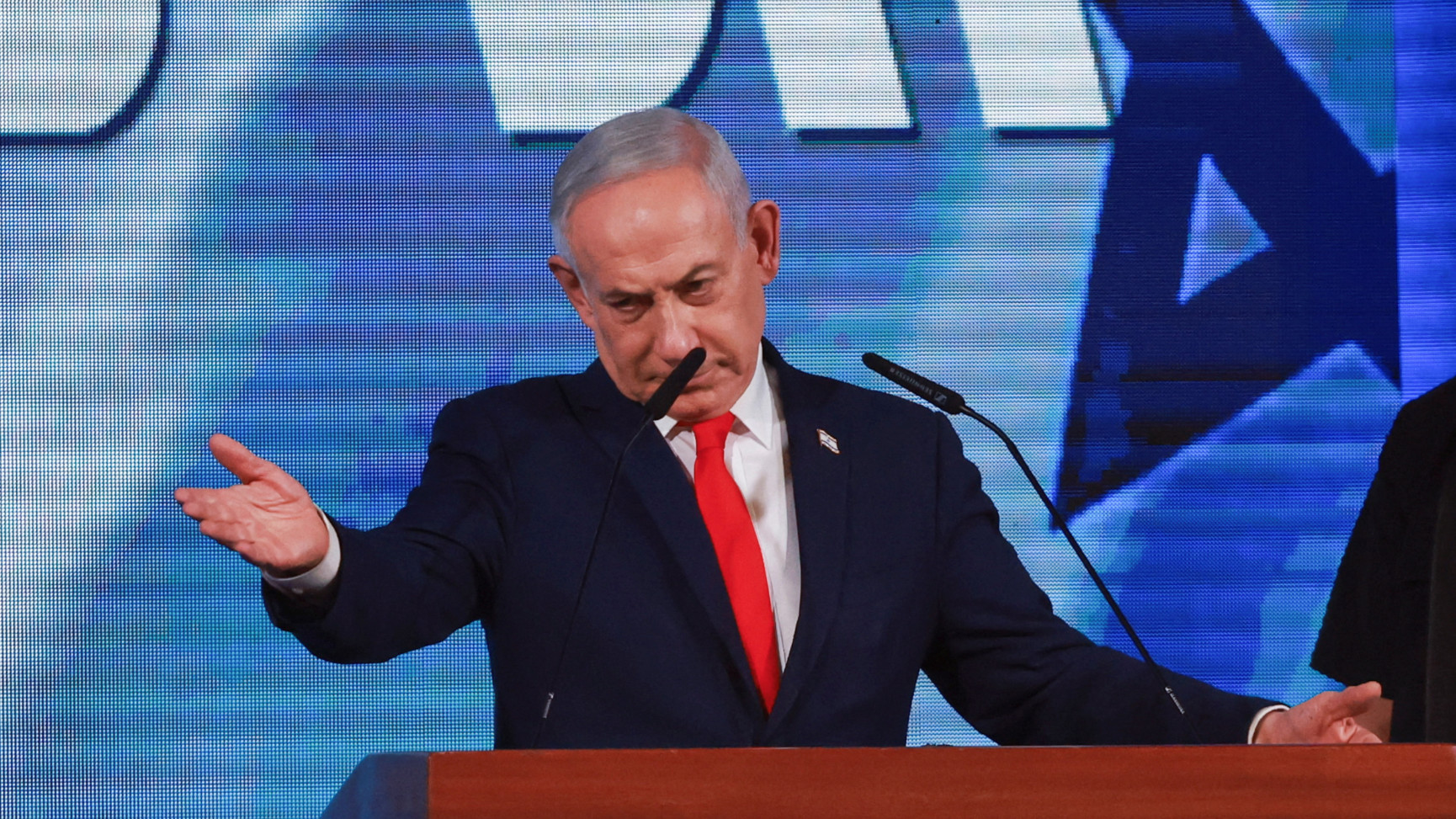
Following the Democratic Party’s resounding landslide victory that secured full control of the U.S. Congress on Wednesday, a cross-section of Israeli political figures, diplomatic experts and mainstream media commentators have issued urgent warnings about cascading national security risks for Israel, tied directly to plummeting U.S. public and bipartisan approval of long-serving Prime Minister Benjamin Netanyahu.
Former Israeli prime minister Yair Lapid, who secured re-election to the Knesset just one week prior as a member of the centre-right Together alliance, stated publicly on the X platform Wednesday morning that the U.S. election outcome had fully eliminated any remaining feasibility of forming a proposed national unity government with Netanyahu’s Likud faction. Lapid emphasized that allowing Netanyahu to remain in office represented an unacceptable threat to Israeli national security, eroding domestic democratic guardrails and isolating the country on the global diplomatic stage.
Local Israeli media reports in the lead-up to the U.S. vote had previously revealed that sitting U.S. President Donald Trump had been exerting targeted pressure on both Netanyahu and Israeli opposition leaders to negotiate a unity government that sidelined extremist hardline factions, in order to clear a path for Trump’s planned Middle East policy priorities. That proposed framework is now formally off the table, multiple opposition leaders confirmed.
Yair Golan, head of the left-wing Democrats alliance and the most progressive leader in Israel’s Zionist opposition bloc, echoed Lapid’s assessment in the aftermath of the U.S. election, which saw a wave of progressive Democratic candidates secure congressional wins, including Michigan’s Abdul El-Sayed, the first Muslim candidate ever elected to the U.S. Senate. Golan argued that Netanyahu has become politically toxic across the U.S. political spectrum, with eroding support among both Democratic and Republican lawmakers, and that his continued tenure as prime minister could set Israel on a trajectory of international sanctions, widespread global isolation, and a direct diplomatic collision with its longstanding closest ally the United States. Golan framed the moment as an existential choice for Israeli voters and policymakers: between a Netanyahu-led trajectory of a boycotted, regressive, isolated state, or a path toward a strong, technologically advanced, democratic and secure Israel, and called for immediate action to install a new change-focused governing coalition. His party’s Knesset member Gilad Kariv reinforced that position, noting that any Israeli public figure still advocating for a unity government with Netanyahu was demonstrating a total lack of understanding of both recent Israeli domestic electoral shifts and the full implications of the U.S. congressional results.
Progressive incoming Democratic legislators such as El-Sayed, who have publicly advocated for ending unconditional U.S. military aid to Israel over allegations of genocide in Gaza, are viewed by Israeli U.S. affairs analysts as posing unprecedented long-term risks to Israel’s core national interests. Former Israeli foreign minister Tzipi Livni, a longstanding vocal critic of Netanyahu, noted that the prime minister is no longer capable of defending the global legitimacy of the Jewish state, or upholding Israel’s internationally recognized right to self-defense, in the face of the emerging policy priorities of the new incoming congressional class.
Gili Cohen, diplomatic correspondent for Israel’s public broadcaster Kan 11, argued that the U.S. electoral results represented not just a major defeat for Trump’s Republican party, but a historic blow to Israel’s longstanding diplomatic standing in Washington, putting decades of uninterrupted, large-scale U.S. military aid to Israel in serious jeopardy. Amir Tibon, a senior correspondent for left-leaning Israeli daily Haaretz, described the U.S. election outcome as a political earthquake carrying catastrophic long-term consequences for Israel, writing on X that “Netanyahu’s continued tenure is an immediate danger to our special relationship with the United States”, and that the prime minister’s toxic reputation now extends well beyond Democratic ranks to include Republican leaders, many of whom now openly blame Netanyahu for contributing to their party’s congressional losses. Tibon added that Israel can only begin to rebuild its badly eroded public standing in the U.S. if it formally parts ways with Netanyahu, and that failure to do so would lead the country down a deeply dangerous, uncharted diplomatic path.
Even traditionally pro-Netanyahu right-wing Israeli political commentators echoed these widespread concerns. Prominent journalist Ariel Kahana, speaking to Israel’s Radio 103FM, stated that Israel had suffered a severe strategic blow in the U.S. elections, noting that Israel’s policy positions had effectively been a hidden ballot issue for American voters, and that Netanyahu had become an unsustainable liability for the country’s U.S. ties. Kobby Barda, a leading political analyst at the nonpartisan Jewish People Policy Institute think tank, went further to argue that Iran was the de facto biggest winner of the U.S. electoral results, while Netanyahu was the single largest individual loser, adding that Netanyahu could no longer credibly serve as the public face of the Israeli government given his collapsing approval ratings across U.S. political circles.
Former Israeli ambassador to the U.S. Michael Oren issued a stark warning that the election of progressive figures such as El-Sayed, whom he described as a virulently anti-Israel and antisemitic official, could trigger cascading catastrophic harms for Israel. Oren noted that a full halt to U.S. military aid would only be the first step of a broader breakdown in bilateral cooperation, with shared intelligence streams, joint military technology development, visa access for Israeli citizens traveling to the U.S., and steady supplies of critical military components all at imminent risk, and that targeted U.S. sanctions against Israeli government figures were now a plausible policy outcome. Oren concluded that the 50-year era of the longstanding unshakeable U.S.-Israel bilateral relationship as it has been widely understood is now formally over, leaving the future of the alliance shrouded in deep, unprecedented uncertainty.
US election results fuel Israeli opposition’s push to remove Netanyahu