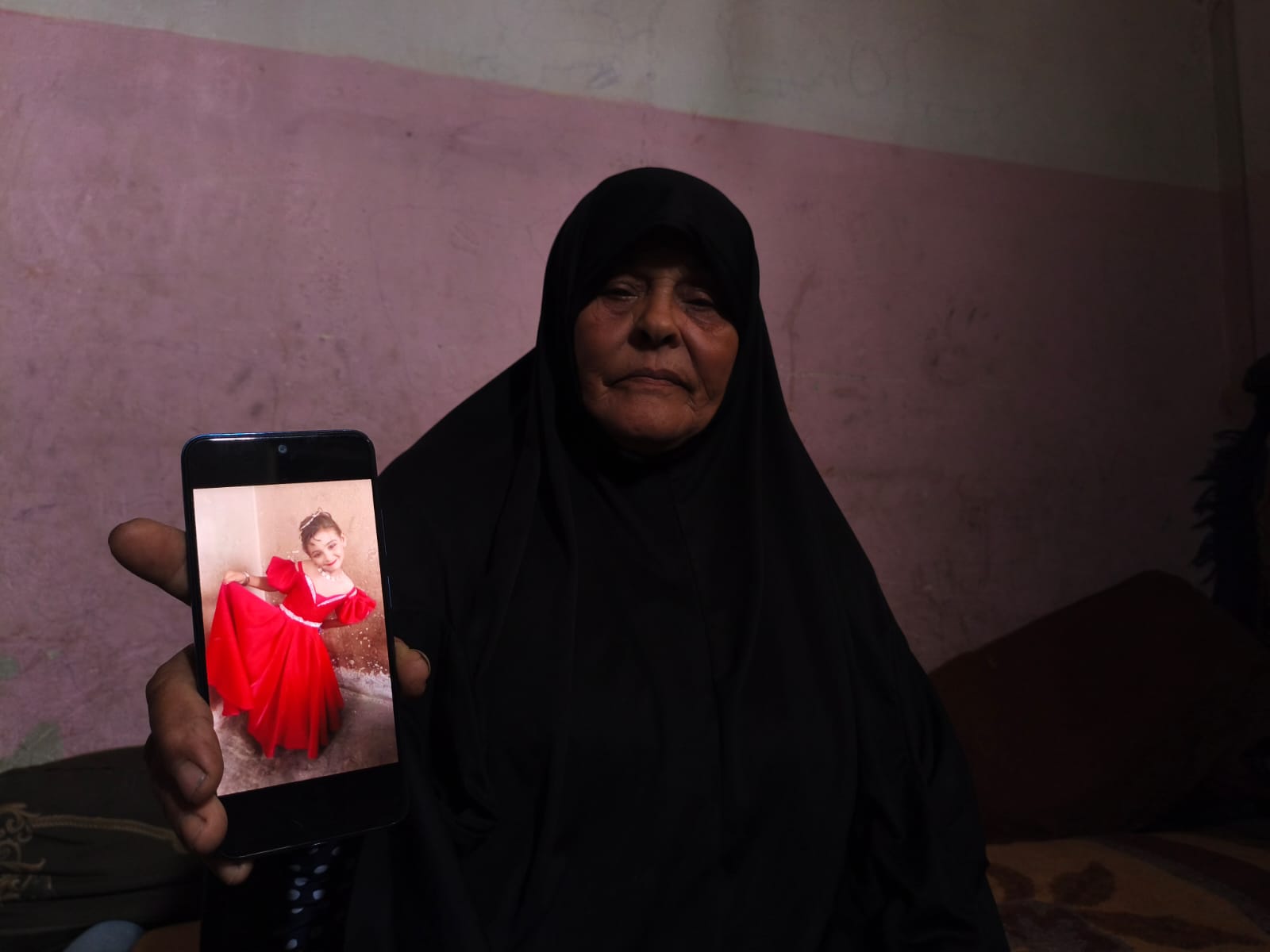
On an ordinary afternoon in central Gaza’s Deir al-Balah, 8-year-old Fatima al-Bayouk had just finished her schoolwork and stepped outside her grandmother’s home to play with her cousins when an Israeli bullet pierced her neck. Stumbling back to the house shaking, her shirt soaked through with blood, the young Palestinian girl screamed that her cousin had been shot, unaware she herself had sustained a life-threatening injury. The bullet had lodged deep in her lung, and after seven days of medical care, she succumbed to her wounds.
This tragedy was doubly devastating for Fatima’s grandmother, Safia Abo Amra. Just months prior, Fatima had been the sole survivor of an Israeli air strike on her immediate family’s home in Khan Younis on December 13, 2023, which killed every other member of her household. What began as a mission to nurture the orphaned girl back to safety quickly evolved into a profound, life-giving bond for Abo Amra, who had already lost her own daughter and several grandchildren in the early phases of Israel’s military campaign in Gaza. “Fatima was my best friend. We did everything together, cooking, going on walks; we even slept on the same mattress. I have seven sons and six daughters, yet Fatima was more precious to me than all of them,” Abo Amra shared with Middle East Eye. “With her beautiful soul, she was the one to help me through my grief for my daughter and grandchildren.”
Warm, bright, and endlessly cheerful, Fatima was known across her extended family for her infectious smile that lifted the mood of everyone around her. She was diligent with her schoolwork, loved dressing up for family gatherings and weddings, and was so beloved that her grandmother walked her to and from a local private school every day, opting to pay monthly tuition rather than send her to a nearby UN facility where stray Israeli bullets were frequently reported. The family had just purchased brand new winter clothes for her shortly before her death, a gift she never got the chance to wear. Only six months before Fatima was killed, her favourite uncle Masoud Abo Amra, who lived with a mental disability, was also shot and killed by Israeli gunfire while visiting relatives in Khan Younis.
Fatima’s senseless death is far from an isolated incident. It is part of a well-documented, pervasive pattern of unprovoked Israeli gunfire originating from military positions, tanks, and quadcopter drones that has killed and maimed hundreds of Palestinian civilians across the Gaza Strip since the October 2025 ceasefire went into effect. The threat is most acute for displaced families living in close proximity to the so-called “Yellow Line,” the boundary of Israel’s expanding buffer zone across the territory. In the 12 months following the ceasefire, Israeli military control over Gaza swelled from 53% to 70% of the total land area, a shift that local residents widely view as a deliberate, systematic campaign to push Palestinian families out of their homes and informal displacement camps through constant, life-endangering harassment.
For thousands of displaced Gaza residents, the unrelenting gunfire has turned even the most routine daily tasks into potentially lethal gambles. Nineteen-year-old Zaid al-Kafarna, who fled northern Gaza with his 10-person family to the Um Duhair displacement camp just south of Deir al-Balah days before the 2025 ceasefire, recounted that distant, occasional shooting near the camp gradually escalated into a daily, omnipresent threat that regularly claims civilian lives. His close friend and neighbour Mohammad Aqel was killed by a stray bullet just weeks before the interview, as he prepared to travel back to his home in northern Gaza. Kafarna’s own mother Shereen was recently wounded by an Israeli bullet that penetrated the family’s tent. “When the shooting starts, life stops in our camp. Neighbours warn each other. We leave everything and hold the children, then lie on the ground to avoid the bullets hitting around us. Everyone is terrified, especially the children,” Shereen explained.
The constant shooting also cripples access to life-saving basic resources. Zaid al-Kafarna described harrowing scenes where families waiting in long queues for food and clean water are suddenly targeted by tank and drone fire, forcing crowds to dive for cover on the roadside while aid trucks flee the area to escape attack, leaving thousands of people with no supplies for the day. Many families have been forced to abandon their camps to flee the gunfire, but for most displaced Palestinians, there are no safe destinations left to go, and exorbitant transport costs make relocation financially impossible for nearly all. Left with no other options, residents have resorted to building makeshift sand barriers around their tents and digging shallow trench shelters to hide in during shooting sprees. Shadi Siam, a displaced father of five, dug a small earthen trench next to his family’s tent, where they hide for two to five hours at a time until gunfire subsides. He shared that his greatest fear is the coming winter, when the trench will fill with rainwater and become completely unusable, leaving his children with no protection at all.
For Safia Abo Amra, the loss of Fatima has ripped open unhealed wounds from earlier in the war. “I was shocked and couldn’t speak or move. Her death was twice as painful for me; it reminded me of my daughter and grandchildren who were killed at the beginning of the war,” she said. “My life was attached to Fatima’s. I wish I could die after her.”