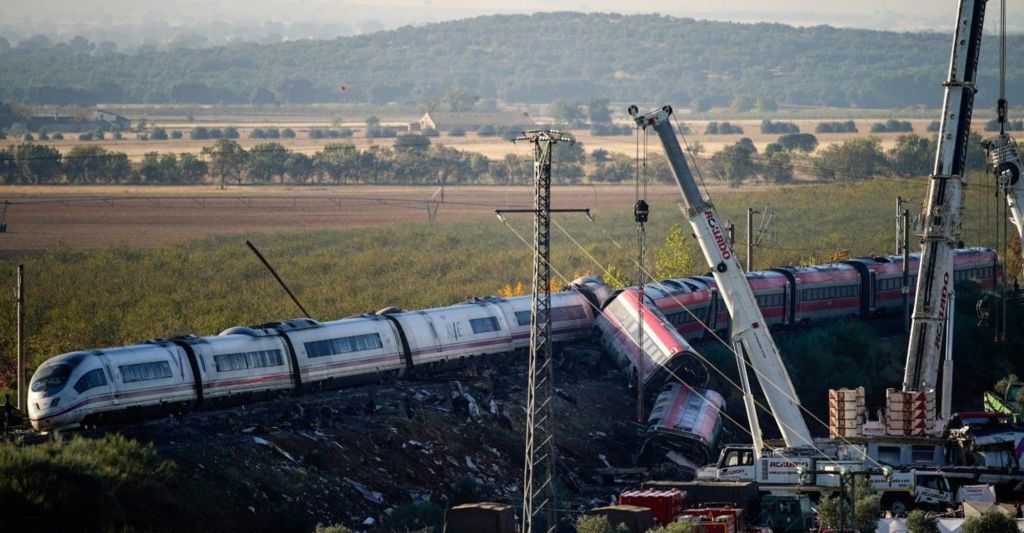
A devastating high-speed rail collision south of Madrid this week has left 69 people confirmed dead, marking the second fatal high-speed rail disaster in Spain in just nine months, following a 46-fatality crash near Córdoba last January. Wreckage from the Toledo-area incident was scattered across active tracks and down adjacent embankments, leaving families of victims reeling from unfathomable personal loss, while the catastrophe has rapidly eroded public confidence in the national rail network and the ruling Socialist administration of Prime Minister Pedro Sánchez, who called a snap general election just weeks prior to the crash.
Even before the rail disaster unfolded, Sánchez’s government was already navigating widespread public fury over long-running unproven corruption allegations targeting the prime minister’s inner circle, soaring housing costs, a chaotic summer migrant surge into the Spanish exclave of Ceuta, and viral footage of a 70-year resident pensioner being forcibly evicted from her home that sparked nationwide housing rights protests, the unrest that prompted Sánchez to schedule the early general election in the first place.
Though formal investigative proceedings for the latest Toledo crash have only just commenced, the government moved quickly to shape public narrative in the immediate aftermath. Transport Minister Oscar Puente appeared at multiple press briefings, starting within hours of the collision, to frame the incident as a product of cascading human error rather than systemic infrastructure failures, deflecting accountability away from cabinet leadership. He pushed back fiercely against widespread claims of chronic underinvestment in rail safety, defending Spain’s LZB high-speed signalling system as fully up to standard, noting the same technology is deployed widely in Germany and Austria. Puente even disclosed that the LZB system had registered 170 failures so far in 2023, dismissing the figure as “normal” and aligned with average performance across European Union member states.
The critical failure, according to Puente’s account, occurred when the signalling system malfunctioned and control of the line switched to manual operation: a rail traffic controller instructed a stalled train to resume travel at speeds up to 160 km/h, even though a second train was stationary on the same stretch of track ahead. Audio recordings from the Madrid control centre confirm staff monitoring the situation on live screens could clearly see the impending collision, yet no stop order was ever transmitted to the oncoming train.
Opposition leaders from the centre-right Popular Party (PP) have publicly called for Puente’s immediate resignation on moral and ethical grounds, but the transport minister has rejected all calls to step down, framing his continued tenure as a public duty to oversee safety improvements, clarify the full sequence of events, and restore public confidence in rail travel.
Polling experts warn the dual high-profile rail disasters, with the January Córdoba crash investigation still unresolved, have amplified widespread public distrust not just in the national rail system, but in state institutions at large, with Spanish voters historically holding ruling governments accountable for large-scale public safety failures. Leading pre-crash electoral forecasts projected the PP would secure a first-place finish and form a governing coalition with the far-right Vox party, with 95% of polling simulations pointing to that outcome even before the Toledo tragedy. Prior to the crash, Sánchez had been running an upbeat, optimistic campaign targeted at mobilizing disenchanted left-leaning non-voters, but political analysts confirm his team has now completely lost control of the electoral agenda, as public sentiment shifts toward widespread frustration that national systems are failing to function properly.
Grassroots anger has already spurred small far-right-led protests in Madrid over the crash, with law enforcement deploying large standby police units to pre-empt potential larger demonstrations organized via social media over the coming weekend. Ordinary commuters across the country report growing fear of using the once-revered high-speed AVE rail network, with many telling reporters the recent string of crises will push them to shift their voting allegiance from left-wing parties to conservative options in the upcoming election.